
TL;DR:
- Handling fees are set by the parcel service for customs clearance of packages from non-EU countries. They are separate from import duties and VAT and can vary significantly depending on the carrier and shipment. Starting in 2026, a national handling fee of €2 per declaration line will apply to shipments under €150, adding extra costs for online stores and consumers.
You order something online from China or the United States, the package arrives, and then you receive a letter or email with a payment request from the parcel service. Not for the product, but for “clearance fees” or “handling fees.” Many people don’t know where this comes from, confuse it with taxes, or assume there’s nothing they can do about it. In this article, we explain exactly what handling fees are, who determines them, what other costs are involved in international shipments, and what you can do as a consumer or online store.
Key Insights
Point | Details |
|---|---|
Handling fees are transport service charges | These fees are charged by the parcel service for customs declaration, not by Customs itself. |
In addition to VAT and import duties | Handling fees are separate from import duties and VAT; you pay them for shipments from outside the EU. |
New national handling fee in 2026 | A temporary extra national surcharge will apply to e-commerce packages under €150 from non-EU countries. |
Correctable in case of errors | Incorrect handling fees can sometimes be refunded or corrected with the carrier. |
Transparency prevents surprises | Clearly communicating costs to customers and anticipating fees helps avoid surprises. |
What Are Handling Fees and Why Do You Pay Them?
When a package arrives from outside the European Union to the Netherlands or Belgium, it must go through customs. This sounds simple, but in practice, the parcel service—such as PostNL, DHL, FedEx, or another courier—handles this customs process on your behalf. This takes time, manpower, and administrative effort. For this, they charge the recipient a fee: the handling fee, also known as clearance fee .
Additional costs when ordering for international packages are not something Customs invents. This is a common misconception. Customs imposes import duties and VAT, but the clearance fees themselves are determined by the parcel service. Each carrier sets its own rate.
It’s important to understand that handling fees are separate from taxes. They are purely a service charge from the carrier for performing the customs procedure. You can think of them as an administrative fee that the courier charges for processing the necessary paperwork and border checks.
When Do You Pay Handling Fees?
Handling fees do not apply to packages from other EU countries. As long as goods have already been cleared within the EU, no customs procedure is required. Fees only come into play for shipments from non-EU countries, such as:
- China, Japan, or other Asian countries
- The United States or Canada
- The United Kingdom (post-Brexit)
- Australia and other non-EU countries
Note: Even if you order through a European online store, if the goods are physically shipped from a non-EU country, the same rules and fees apply.
It’s good to know that international shipping rules can vary by carrier and country. What PostNL charges is not the same as what DHL or another provider charges. By understanding these differences, you can sometimes save costs before ordering or shipping. And if you want to learn more about how import-costs affect your profit as an online store, it’s certainly worth reading.
What Costs Can You Expect with International Shipments?
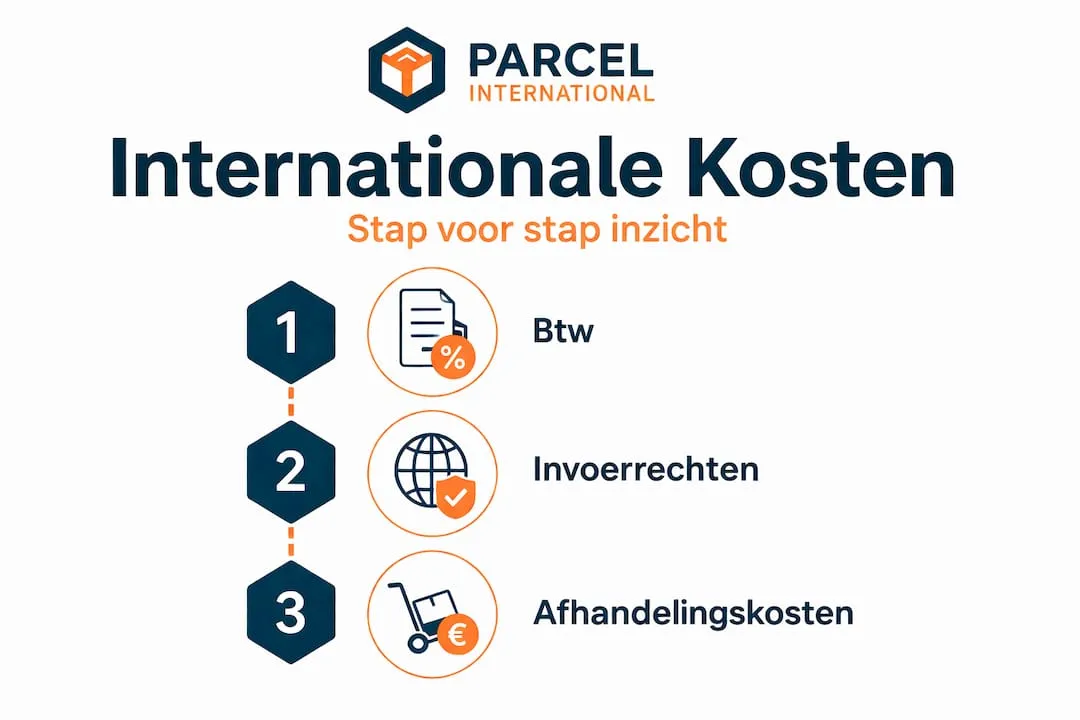
Now that the difference is clear, here’s an overview of the international costs you might encounter. For international packages from outside the EU, there are three main categories of extra costs. These can add up significantly, especially if you weren’t aware they were coming.
Overview of the Three Cost Categories
Cost Category | Imposed By | When Applicable | Dependent On |
|---|---|---|---|
VAT (Sales Tax) | Tax Authority | Always for imports outside the EU | Value of the goods |
Import Duties | Customs (EU) | Depending on product type | Product category and origin |
Handling Fees | Postal or courier service | For customs-required shipments | Carrier’s rate |
This distinction is not just academic. It has direct implications for how much you ultimately pay and what you can claim back or dispute if something goes wrong.
VAT is collected by the Tax Authority and calculated based on the value of the package plus any shipping costs. Since July 1, 2021, there is no longer a VAT exemption for packages under €22, so even small shipments are fully taxed. This is an EU measure that applies to all member states.
Import duties are a different matter. They are determined by Customs based on the product category and country of origin. Some products, such as clothing or electronics, fall under higher rates. Since July 1, 2026, the exemption for import duties on shipments under €150 no longer applies. For shipments from outside the EU to consumers, a fixed amount of €3 per product type temporarily applies (until July 1, 2028).
Handling fees are the most variable. They can differ significantly by carrier, ranging from a few euros to more than €15 per shipment. It’s wise to consider these costs when comparing shipping options. A good place to start is understanding the cost structure of international freight.
Pro tip: As an online store, you can calculate and communicate the total costs to your customer upfront. This is called the “landed cost” (the total purchase price including all taxes and surcharges at the destination). By making this transparent, you avoid negative surprises for the recipient and build trust.
The key to smarter shipping is knowing how to optimize your shipping costs. Small adjustments in your choice of carrier, packaging, or shipping route can already make a noticeable difference.
New national handling fee: what changes for e-commerce and consumers?
In addition to the classic customs clearance fees, a national handling fee has been introduced as of 2026. This is a relatively new development that many online stores and consumers are not yet aware of.
The background: the EU is working on new customs policies for e-commerce parcels from outside the EU valued under €150. Until this European system is fully operational, member states have the option to temporarily introduce a national handling fee. In the Netherlands, this specifically involves a national handling fee of €2 per declaration line for e-commerce shipments from non-EU countries under €150.
What does the national handling fee entail?
Here are the key features of the new fee at a glance:
- The fee amounts to €2 per declaration line for e-commerce shipments
- Only applicable to parcels from outside the EU with a value under €150
- Applies to shipments where the recipient resides in the Netherlands or the goods are shipped to the Netherlands
- The fee is expected to be introduced around November 1, 2026; this is not yet final
- Carriers or platforms may be designated as responsible for collection
The term 'declaration line' deserves clarification. If you order a parcel with multiple different products, each product line may count as a separate declaration line. For an order with three products, this could mean three lines, bringing the fee to €6 for a single order.
Impact on small and medium-sized online stores
For small online stores that deliver or import from abroad, costs can add up quickly. Consider a Dutch importer receiving dozens of parcels from China daily: that €2 per line adds up fast. For businesses already operating on tight margins, this is a cost that must be seriously factored into pricing.

It is also relevant for European online stores shipping products from a non-EU country to Dutch customers. They must inform their customers about these additional costs, or risk complaints and returns.
A practical consequence is that online stores need to adjust their pricing or checkout flow. Costs that were previously invisible must now be made transparent. This requires smart shipping tips for international e-commerce and good preparation for the changes.
While reading this, it’s important to recognize how quickly policies can change. What is today a temporary national fee could become a permanent European standard tomorrow. This makes it even more crucial to stay well-informed and adjust your processes in a timely manner.
What can you do as a consumer or online store?
Now that you know where and why you pay, it’s time to see what you can do as a consumer or business. Handling fees are not a fixed given that you must always accept without question.
For consumers: steps to take with unexpected or excessive costs
- Check the invoice carefully. Review what the carrier is charging exactly. Is the amount broken down into VAT, import duties, and handling fees? If this breakdown is missing, request it.
- Compare with the expected costs. If the online store provided an estimate of import costs at purchase and it does not match what the carrier is now charging, there may be an error.
- Contact the carrier. Costs can sometimes be reclaimed when a carrier charges the wrong amount. You should contact the postal or courier company immediately and explain what went wrong.
- Request documentation. Ask the carrier for the declaration and calculation. This helps you assess whether it is correct.
- Use official complaint procedures. Major carriers like PostNL, DHL, and FedEx have formal procedures for disputing costs. Use these procedures and document everything in writing.
- Involve Customs as a last step. If you believe errors were made in VAT or import duty calculations, you can contact Customs. Handling fees fall outside their jurisdiction, but taxes do not.
Pro tip: Always keep the original order confirmation from the online store, including any information about expected import costs. This is your strongest piece of evidence if you want to file a claim with the carrier.
For online stores: how to handle handling fees smartly
As an e-commerce entrepreneur, you have influence over how these costs affect your customers. A transparent approach saves you a lot of customer service and reputational damage:
- Communicate the landed cost. Always show the total price in your online store, including estimated import duties, VAT, and handling fees. This is especially important for customers in countries outside the EU.
- Work with a reliable carrier. Not every carrier charges the same handling fees. By comparing, you can offer customers a better deal.
- Adjust your pricing. If you know customers pay an average of €10 in handling fees, consider whether you can incorporate this amount into your product price or offset it with free shipping above a certain order value.
- Proactively inform your customers. For international orders, send an email explaining potential additional costs upon arrival. This prevents confusion and negative reviews.
With the right approach, you can ship internationally at a low cost without surprising your customers with unexpected fees. For more strategic insights on how to structurally save on shipping costs as a business, check out our practical guide.
Why paying attention to handling fees pays off: our vision
Many businesses and individuals treat handling fees as a peripheral issue, a minor additional cost they have little control over. After more than 15 years in international logistics, we at Parcel International know this is a real oversight.
The concept of 'landed cost' has been known in international trade for decades, but in the e-commerce world, it is still too often ignored. Online stores pass on shipping costs, may mention customs duties, but then forget the carrier’s handling fees. The result: a customer in Japan or the US receives a package and must pay an amount at the door that was never mentioned during checkout. That customer won’t return.
What we notice in practice is that this isn’t just about small amounts. Online stores shipping to consumers in the United Kingdom, for example, saw an increase in returns after Brexit because customers were surprised by handling fees that no one had disclosed upfront. This could have been entirely avoided with transparency in the ordering process.
The new national handling fee in 2026 will only make this problem more urgent. It’s not just an additional cost. It’s a signal that regulations around international e-commerce are becoming more complex, and companies that don’t keep up will face the consequences in the form of dissatisfied customers and shrinking margins.
Our advice: treat handling fees as a strategic variable, not as an inevitable nuisance. By understanding why shipping costs fluctuate and when they are highest, you can make smarter decisions about when to ship, which carrier to choose, and how to inform your customers.
The companies that perform best in international e-commerce aren’t necessarily the largest. They are the companies that understand and communicate their total cost structure. It starts with insight into costs like handling fees, which may seem small at first glance but in practice make the difference between a satisfied customer and a lost order.
Take control of international shipping costs
Looking for actionable solutions? Here’s what you can easily do right now.

At Parcel International, we’ve been helping consumers and small to medium-sized online stores navigate the complexities of international shipping since 2007. You can instantly compare parcel services without creating an account, so you immediately gain insight into the actual costs per carrier, including any handling fees. This way, you avoid surprises for yourself or your customers. Want to better understand how customs regulations work and how to use them to your advantage? We explain it step by step, so you can ship internationally with confidence to over 220 countries and regions.
Can't find your question? Our support team is here for you 24/7 via the help centre.
How do I know if I have to pay handling fees for my parcel?
If you receive a parcel from a country outside the EU, the parcel service almost always charges handling fees in addition to VAT and import duties. This applies to countries like China, the US, and the United Kingdom, where extra costs are standard when ordering.
Who determines the amount of the handling fees?
The postal or courier company sets the amount of the handling fees, not Customs. Each carrier establishes its own rate, so costs can vary significantly between parcel services, as confirmed by Customs.
What if I have paid too much in handling fees?
You can submit a request for correction or refund to the transport company, provided you act in time. Keep your order confirmation and check via customer service how to proceed with reclaiming extra costs.
Is the new handling fee of 2026 the same as handling costs?
No, the national handling fee is an additional surcharge for certain e-commerce shipments, separate from existing handling costs. It is a separate fee introduced by Customs for e-commerce parcels, as described in the Customs announcement for e-commerce, and is independent of the carrier’s service charge.
Get a grip on your parcel shipping
Compare carriers, choose the best price and keep track of your international shipments. You can calculate and book without an account.
