
TL;DR:
- Cargo insurance is essential protection for valuable international shipments.
- Different insurance policies suit various products and risks, including all-risk and third-party policies.
- Proper preparation, documentation, and swift action in case of damage prevent issues and save costs.
Many e-commerce businesses assume that the carrier automatically covers all damage if an international shipment goes wrong. This is a costly misunderstanding. Carriers typically offer only limited liability, which often does not cover the actual value of your products. If you are serious about shipping internationally, cargo insurance is not an optional extra but a business necessity. In this article, you will learn what cargo insurance entails, the types available, how to file a claim, and which best practices you can apply today.
Key Insights
Point | Details |
|---|---|
Not everything is covered | Many risks fall outside standard carrier coverage; a separate policy is often a must. |
Choose insurance wisely | Align the policy and coverage with your shipment, its value, and specific global destinations. |
Avoid claim issues | Ensure proper documentation and preventive measures to avoid delays and disputes. |
Proactive is cheaper | Investing in preventive insurance ultimately saves on damage, time, and reputation. |
What Does International Cargo Insurance Mean?
Cargo insurance protects the value of your products during transport. This applies to all stages: from pickup at your location to delivery to the customer, regardless of the mode of transport. Cargo insurance safeguards against damage, loss, and theft for international shipments. While this sounds straightforward, the reality is more nuanced.
What Is Typically Covered Under Cargo Insurance?
- Physical damage during transport (packaging, breakage, deformation)
- Loss or disappearance of the entire shipment
- Theft of goods in transit
- Damage from water or fire under some policies
What Is Usually Not Covered?
- Damage due to poor packaging by the sender
- Normal wear and tear or inherent product defects
- Losses due to insufficient documentation
- Damage from force majeure, unless explicitly covered
For international shipments, the risks are greater than for domestic ones. Your package passes through multiple countries, customs offices, and transshipment points. Each node is an opportunity for something to go wrong. Consider a container damaged during transshipment at a port or a package lost in a large distribution center in Asia.
In case of loss, a carrier typically compensates only a few euros per kilogram. For a €1,000 electronics shipment, this might mean a reimbursement of just €20. Without cargo insurance, you bear the rest of the cost.
This is especially relevant for e-commerce businesses. You often ship high-value products to customers who trust you for a seamless experience. If a shipment is damaged or lost, you have a problem with that customer, regardless of formal liability. Want to learn more about how to properly take out shipping insurance? It’s wise to also understand the different types of shipping insurance before making a choice.
Different Types and Coverages: What to Choose as an E-Commerce Business?
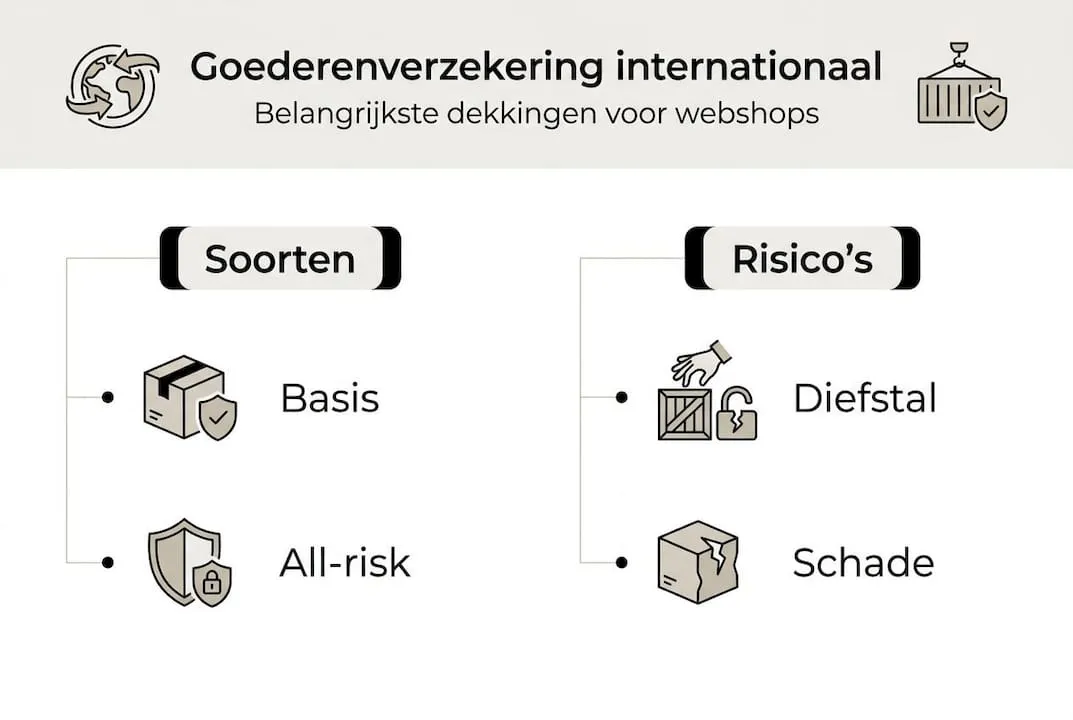
Not every insurance policy is suitable for every situation. The choice of insurance varies greatly based on the type of shipment, value, and destination. These are the three most common types:
Type | Coverage | Suitable for |
|---|---|---|
Basic Insurance | Limited: only major damage or total loss | Low-cost shipments with minimal risk |
All-Risk Insurance | Nearly all damage, including partial damage | High-value or fragile products |
Third-Party Insurance | Through an external insurer, independent of the carrier | Businesses with large volumes or specific requirements |
Basic insurance is the cheapest option but offers the least coverage. An all-risk policy is more comprehensive but costs a higher premium. Third-party insurance through specialized providers often offers the most flexibility, especially if you deal with diverse types of international shipments.
How to Choose the Right Insurance? Follow These Steps:
- Determine the value of your average and maximum shipment per route.
- Analyze the destination: some countries or regions have higher risks of theft or damage.
- Review the exclusions of the policy carefully, particularly regarding packaging requirements.
- Compare premiums versus potential claim costs: calculate the break-even point.
- Consider the international shipping options you use and align the insurance accordingly.
A common mistake is underestimating the need for additional insurance for products over €500. Many standard policies have a maximum compensation limit well below this amount. Always check the key shipping insurance policies for your specific product category.

Pro Tip: Do you regularly ship products over €1,000? Consider taking out an open policy or subscription-based insurance. This saves time, lowers the average premium per shipment, and prevents accidentally sending an expensive shipment uninsured.
How to File a Claim and Avoid Hassle?
Having insurance is step one. Knowing how to file a claim when something goes wrong is step two—and many businesses underestimate this step. A correct claim requires clear documentation and evidence. Without this, you risk a rejected claim.
Follow this step-by-step plan in case of damage:
- Document the damage immediately upon receipt or upon discovering a loss. Photos are crucial.
- Report the damage to the carrier within the specified timeframe, often 24 to 72 hours after receipt.
- Notify your insurer as soon as possible, even if you don’t have all the information yet.
- Gather your evidence documents: invoices, packing slips, photos, correspondence with the carrier.
- Submit the official claim via your insurer's form or portal, complete and signed.
- Track the status and respond quickly to any additional questions from the insurer.
What mistakes do companies make most often? They wait too long to report, fail to take photos upon receipt, or do not have the original invoice. These three mistakes alone are enough for an insurer to reject a claim.
Properly preparing goods for transport also reduces the risk of damage, meaning you’ll need to file fewer claims. Fewer claims keep your premium low in the long run.
Another key point: understand the difference between carrier liability and your own insurance. These two are sometimes confused, leading to uncertainty about who covers what. Discuss this in advance with your insurer and carrier so you know exactly where to turn if something goes wrong. More insight into types of shipping insurance can help with this.
Pro tip: For every outgoing shipment, automatically take photos of the packaging before shipping. Save them by order number. This takes thirty seconds per shipment and can save you thousands of euros in the event of a claim.
Smart Best Practices for International Cargo Insurance
Good preparation and preventive measures demonstrably lead to fewer damage claims. This isn’t just theory—it’s a practical advantage you can benefit from immediately. Below are the most important best practices.
Prevention starts with packaging. Use double-walled cardboard boxes for fragile products, fill empty space with shock-absorbing material, and label shipments clearly. The safest packaging methods can guide you here.
Administration is your lifeline. Always keep:
- Original purchase invoices for the goods
- Commercial invoice and packing slip per shipment
- Tracking confirmations and delivery receipts
- Correspondence with the carrier and customer
- Photos of packaging before and after shipping
Timing and selection are critical. Take out insurance before the shipment departs, not after. Select your insurance based on the actual value of the contents, not the shipping costs.
Common Mistake | Best Practice |
|---|---|
Forgetting to take out insurance | Automate insurance activation in your order process |
Underinsuring valuable goods | Always insure for the full replacement value |
Not taking photos at shipping | Build a standard photo step into the packaging process |
Reporting damage too late | Set an internal deadline: report within 24 hours |
Wrong policy for product type | Align the policy with the product category and destination |
Practical Tips make it possible to optimize shipments and insurance as an integrated system. Don’t treat cargo insurance as a separate cost but as part of your overall logistics strategy. The cargo-insurance-guide offers additional depth for entrepreneurs who want to take this seriously.
Our Vision: Why Proactive Insurance Pays Off
Companies that only seriously consider cargo insurance after a major loss pay twice. First for the uncovered damage, then for the higher premium because their risk profile has worsened. We see this pattern time and again.
The companies that perform best in logistics treat insurance as a strategic choice, not just a mandatory checkbox. They review their policies every quarter, adjust coverages for new product lines and destinations, and build claim prevention into their operational processes.
There’s also a competitive advantage. If you can promise a customer that their shipment is fully insured and you act quickly in case of damage, you build trust that competitors without a solid insurance infrastructure can’t offer. This directly translates into repeat purchases and positive reviews.
At Parcel International, we believe that practical international tips combined with a solid insurance strategy form the foundation of sustainable international e-commerce success. Proactive action isn’t more expensive in the long run—it’s cheaper, safer, and commercially smarter.
Manage Your International Shipments Smarter and Safer
Do you want to proactively protect your business and ship internationally more efficiently? Then it’s smart to use all available resources.

At Parcel International we’ve been helping e-commerce businesses with international shipments to over 220 countries and territories since 2007. You can compare carriers, take out insurance, and choose the right solution for every shipment. Want to understand which types of international shipments best suit your situation, or gain insight into the causes-of-delays in international shipments so you can prevent them? We’re ready with practical advice and custom solutions for your logistics challenges.
Can't find your question? Our support team is here for you 24/7 via the help centre.
Is cargo insurance mandatory for international shipments?
Cargo insurance is mandatory under Incoterms CIF and CIP.
What types of damage are often excluded from cargo insurance?
Certain risks, such as inadequate packaging, may be excluded. Intentional damage and missing documentation are other common exclusions that can invalidate claims.
What is the difference between all-risk and basic insurance?
An all-risk insurance covers nearly all forms of damage, including partial damage, while basic insurance policies are more limited and often only compensate for total loss or severe damage.
How quickly will I receive compensation from a cargo insurance claim?
Processing time varies by insurer and the complexity of the claim. Proper documentation significantly speeds up the claims process and prevents unnecessary delays.
What documents are required for a damage claim on an international shipment?
Proof of damage, photos, packing slip, and insurance documents are essential. For damage claims, evidence and proper documentation are necessary to qualify for compensation.
Get a grip on your parcel shipping
Compare carriers, choose the best price and keep track of your international shipments. You can calculate and book without an account.
