
In a nutshell:
- Incoterms are international agreements that determine who is responsible for transport, risk, and costs in shipping. They help prevent unexpected costs and delays by clarifying responsibilities. Choosing the right Incoterm and documenting it correctly saves time, money, and uncertainty in the trade process.
Incoterms are standardized international delivery terms that define who is responsible for transport, risk, and costs when shipping goods. The official edition is Incoterms® 2020, with 11 rules established by the International Chamber of Commerce (ICC). There is no separate Incoterms 2025 edition. When shippers and independent businesses refer to “Incoterms 2025 explained,” they mean the application of Incoterms® 2020 in current trade practices. This guide provides clear explanations, comparisons, and practical tips to apply Incoterms correctly in international shipping.
What Do Incoterms Cover Exactly?
Incoterms address three key aspects: who arranges and pays for transport, when risk transfers from seller to buyer, and who handles customs formalities. Without clear agreements, shippers risk unexpected costs, delays, or damage with no liable party.
The three core questions Incoterms answer:
- Transport and costs: Who books the freight space and who pays the shipping costs?
- Risk transfer: At what point does responsibility for loss or damage shift from seller to buyer?
- Customs and clearance: Who handles the export declaration in the country of origin and the import declaration in the destination country?
Incoterms do not govern the transfer of ownership of goods. That is a separate legal matter to be specified in the sales contract. Incoterms are also not a legal requirement but a voluntarily adopted standard recognized globally by businesses and customs authorities.
Pro tip: Always specify not just the Incoterm in every contract, but also the exact location. “FCA Rotterdam” is far stronger than just “FCA.” The location precisely defines where risk transfers.
What Are the Incoterms and What Do They Mean?

The 11 official rules in Incoterms® 2020 are divided into four groups: the E-term, F-terms, C-terms, and D-terms. Each group represents a different distribution of costs and risks between buyer and seller.
The four groups at a glance
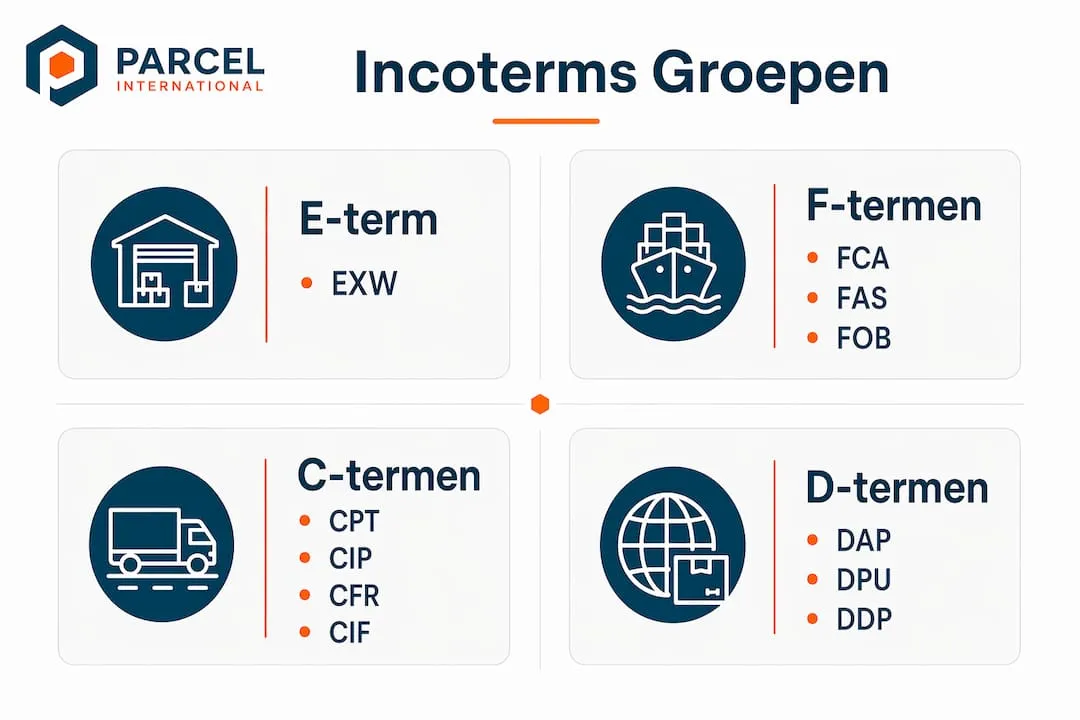
E-term (departure): EXW (Ex Works) is the only E-term. The seller makes the goods available at their own location. The buyer handles everything: pickup, transport, export, and import. EXW places minimal obligations on the seller and maximum responsibility on the buyer.
F-terms (free to carrier): FCA, FAS, and FOB. The seller handles export and delivers the goods to an agreed point. From that point, the buyer takes over. FCA (Free Carrier) is the most flexible F-term and works for all transport modes.
C-terms (costs paid by seller): CPT, CIP, CFR, and CIF. The seller pays freight costs to the destination, but risk transfers earlier, upon delivery to the carrier. With C-terms, costs and risks do not align. This is a common misconception.
D-terms (delivery at destination): DAP, DPU, and DDP. The seller bears both costs and risks until the destination. DDP (Delivered Duty Paid) is the most comprehensive term: the seller pays everything, including import duties and local taxes.
Comparison Table: Most Commonly Used Incoterms
Incoterm | Who arranges transport | Who pays import duties | Risk transfer |
|---|---|---|---|
EXW | Buyer | Buyer | Upon pickup at seller’s location |
FCA | Buyer | Buyer | Upon delivery to carrier |
FOB | Buyer | Buyer | Upon loading on board ship |
CIF | Seller | Buyer | Upon loading on board ship |
CIP | Seller | Buyer | Upon delivery to carrier |
DAP | Seller | Buyer | Upon arrival at destination |
DDP | Seller | Seller | Upon arrival at destination |
FOB and CIF are exclusively for sea freight and inland waterways. FCA and CIP work for all transport modes, including air and road. If you ship a container via Rotterdam or Antwerp, use FCA instead of FOB. FOB is technically outdated for container shipping but is still widely used in practice.
How Do Incoterms Affect Customs and Import Duties?
Incoterms directly impact the customs value of your goods. The customs value determines the basis for import duties and VAT upon entry. Which costs are included in the customs value depends on the chosen Incoterm.
With EXW, only the factory price appears on the invoice. Freight, insurance, and other costs are calculated separately. However, customs includes these costs in the customs value up to the EU border. With DDP, all costs are already included in the invoice price, making the customs value higher than with EXW, resulting in higher import duties.
Customs experts advise always considering the relationship between the chosen Incoterm, the price basis on the invoice, and customs compliance when drafting contracts. An incorrectly stated Incoterm on the invoice leads to an inaccurate customs declaration, costing time, money, and potentially resulting in fines.
Pro tip: Always verify that the Incoterm on your commercial invoice matches the actual agreements in your contract. Customs authorities in countries like Germany and the UK actively check this.
Who Handles the Import Declaration?
Under EXW, FCA, FOB, CFR, and CIF, the buyer handles the import declaration and pays import duties. Under DDP, the seller does. DAP and DPU fall in between: the seller delivers the goods to the destination, but the buyer handles import clearance.
Incorrect application of Incoterms and an inaccurate specification of the place of delivery lead to incorrect customs declarations and delays. Dutch Customs emphasizes that you should always combine the Incoterm with an exact location in the contract and on the commercial invoice.
How to Apply Incoterms Correctly in Practice
Correct application of Incoterms starts with choosing the right term for your situation. This is followed by proper documentation in contracts and shipping papers. Mistakes at this stage cost you money and customer trust.
- Choose the Incoterm based on your need for control Do you want to maintain control over transport and quality as a seller? Then opt for a D-term such as DAP or DDP. Do you want minimal logistical responsibility? Choose EXW or FCA. The choice depends on your need for control over the logistics process.
- Always specify the exact place of delivery Do not write 'CIF' but 'CIF Rotterdam, Waalhaven'. An exact location designation prevents disputes about the moment of risk transfer and responsibility for documents.
- Align your insurance with the chosen Incoterm The insurable interest must match the moment when the risk transfers. Under CIP, the seller is required to take out insurance. Under CIF, there is a minimum coverage obligation. For all other Incoterms, insurance is not mandatory but advisable for the party bearing the risk.
- Exercise extra caution with dropshipping With dropshipping, it is difficult to strictly apply Incoterms because the supplier delivers directly to the end customer. Align the Incoterms with your supplier and specify who handles the import in the end customer’s country.
- Use FCA instead of FOB for container transport FOB is technically unsuitable for container transport because the risk transfers when loading on board. For containers, the cargo is already transferred to the terminal earlier. FCA better aligns with actual logistics practice.
- Verify the Incoterm with every new business relationship What you agree upon with a regular supplier does not automatically apply to a new partner. Always document the Incoterm in writing in the contract and on the invoice.
Also read the international-incoterms-explained for a practical approach per shipping scenario.
Key Insights
Incoterms® 2020 determine who handles transport, risk, and customs in international shipping, and a wrong choice or unclear location designation directly leads to higher costs and delays.
Point | Details |
|---|---|
Official Edition | Incoterms® 2020 is the valid version; there is no separate 2025 edition. |
Risk and costs do not always align | Under C-terms, the seller pays for transport, but the risk transfers earlier to the buyer. |
Exact location is mandatory | Always write the Incoterm plus an exact place name in the contract and on the invoice. |
Customs value depends on the Incoterm | The chosen Incoterm determines which costs are included in the customs value and thus how much import duty you pay. |
Insurance follows risk | Take out insurance for the party bearing the risk, aligned with the moment of risk transfer. |
Why Choosing the Right Incoterm Is More Than a Formality
I see a recurring pattern among shippers and independent entrepreneurs: the Incoterm is chosen because the supplier is used to it, not because it is the best choice for the situation. This is an expensive habit.
A concrete example: a Dutch webshop sourcing products from China under EXW terms. The buyer then arranges everything, from pickup at the factory to import into the Netherlands. This sounds simple, but in practice, it means the buyer is also responsible for the Chinese export declaration—something many buyers are unaware of, leading to issues at the Chinese border.
DDP sounds attractive to buyers because the seller handles everything. However, if the seller does not have a VAT registration in the country of import, they cannot legally complete the import process. As a buyer, you still end up with the problems, even though you thought you had nothing to worry about.
My advice: choose the Incoterm that matches your own logistics knowledge and capacity. If you have no experience with customs procedures in the destination country, opt for a term where the seller or a specialized party handles it. Use the international logistics checklist to prepare your shipments step by step. Clear agreements upfront save you a lot of time and money afterward.
— Pascal
Parcel International supports you in international shipping
International shipping becomes simpler when you know which Incoterm fits your shipment and business relationship. Parcel International has been active since 2007 and serves shippers in over 220 countries and territories.
Parcel International helps you compare shipping options, choose the right carrier, and correctly handle documents for customs and clearance. Whether you are shipping a one-time consignment or regularly exporting goods, you will find reliable shipping solutions for express, air, sea, and road transport at Parcel International.
Can't find your question? Our support team is here for you 24/7 via the help centre.
Which Incoterm is best for container transport?
For container transport, use “any-mode” Incoterms such as FCA, DAP, or CIP. Sea-specific terms like FOB and CIF are unsuitable for container shipments because the risk transfer moment does not align with the actual logistics reality.
What are Incoterms 2025?
There is no official Incoterms 2025 edition. The valid version is Incoterms® 2020, established by the ICC with 11 rules. When people refer to 'Incoterms 2025,' they mean the application of Incoterms® 2020 in current trade practices.
What is the difference between EXW and DDP?
Under EXW, the seller makes the goods available at their location, and the buyer handles everything else. Under DDP, the seller arranges and pays for everything up to the destination, including import duties. These represent the two extremes in responsibility distribution.
How does an Incoterm affect the customs value?
The chosen Incoterm determines which costs are included in the customs value. Under EXW, the customs value is lower because freight costs are calculated separately. Under DDP, all costs are included in the invoice price, resulting in a higher customs value and higher import duties.
Do I need to use special Incoterms for dropshipping?
In dropshipping, it is difficult to strictly apply Incoterms because the supplier delivers directly to the end customer. Always agree with your supplier on which Incoterm applies and specify who handles import and customs formalities in the end customer's country.
Get a grip on your parcel shipping
Compare carriers, choose the best price and keep track of your international shipments. You can calculate and book without an account.
