
TL;DR:
- Proper preparation and correct documentation prevent costs and delays when importing.
- Collaborating with freight forwarders and leveraging customs regulations saves money and time.
- Common mistakes, such as incorrect product codes and insufficient compliance, can be easily avoided.
Many e-commerce businesses start importing and quickly encounter unexpected costs, customs issues, or delays. An incorrect product code, a missing document, or unclear agreements with suppliers can cost you weeks. This article provides a clear, step-by-step overview of everything you need to import goods correctly and cost-effectively, whether from within the EU or outside it. Whether you operate in the Netherlands or Belgium: mastering the import process saves money and accelerates growth.
Key Insights
Point | Details |
|---|---|
Streamlined Import Process | With the right step-by-step plan, importing goods proceeds smoothly and compliantly. |
Smart Optimization | Use customs regulations and freight forwarders to reduce costs and increase speed. |
Avoid Pitfalls | Ensure compliance, correct product codes, and realistic delivery expectations to prevent fines and delays. |
EU vs. Non-EU Differences | Importing from the EU is simpler; non-EU imports require additional declarations, import duties, and documentation. |
What You Need to Import Goods
Before ordering even a single package from a foreign supplier, you must have several things in order. Importing is not just about placing an order and waiting. It is a structured process with fixed requirements, and ignoring these requirements will cost you later.
The official Chamber of Commerce step-by-step guide outlines a 14-step import process, from checking product regulations to applying for an EORI number and determining the correct Taric code. This is not overkill. Each component serves a purpose.
Key Documents and Tools at a Glance:
- EORI Number: This is your registration number with customs. Without this number, you cannot import goods from countries outside the EU. You can apply for it through Dutch Customs or the Belgian FOD Finances.
- Commercial Invoice: Contains the value, quantity, and description of the goods. This document is the basis for the customs declaration.
- Taric Code: This is the European product code that determines which import duty rate applies. An incorrect code leads to immediate problems.
- Incoterms: These are international trade rules that define who is responsible for transport, insurance, and customs. Common terms include DDP (Delivered Duty Paid) and EXW (Ex Works). Choose carefully, as this determines who bears the costs.
- Product Regulations: Some goods are prohibited or subject to restrictions. Think of electronics with CE marking, food supplements, or cosmetics. Always check this before ordering.
Pro-tip: Use the customs-clearance-tips from Parcel International to streamline your document flow before placing an order. This helps avoid last-minute surprises upon shipment arrival.
For imports from outside the EU, there are two additional options that can reduce costs. The customs-warehouse allows you to store goods without paying import duties immediately. You only pay when the goods enter the market. The Article 23 permit (for the Netherlands) enables you to defer import VAT to your tax return, significantly improving your cash flow.
Finally, choose your suppliers carefully. Always request a detailed product specification and verify their experience with exporting to Europe. Additionally, check out the international-packaging-tips for useful guidelines on safe and compliant packaging.
Document | Purpose | Required For |
|---|---|---|
EORI Number | Customs Identification | Non-EU Import |
Commercial Invoice | Determining Goods Value | Always |
Taric Code | Determining Import Duty Rates | Non-EU Import |
Incoterms | Division of Responsibilities | Always |
Certificate of Origin | Proof of Product Origin | Product-Dependent |
Step-by-Step Guide to Importing Goods: From the EU and Outside the EU
Now that you know what you need, it’s time for execution. The import process varies significantly depending on where your goods originate.
Importing from the EU
For eu-import-no-customs or import duties apply. You are essentially buying within a single market. However, there are key considerations:
- Find a reliable supplier within the EU and request a trial shipment.
- Verify that the goods comply with European product standards.
- Document payment and delivery agreements in writing.
- Process VAT correctly in your accounting (intra-community acquisition).
- Account for potential excise duties on products like alcohol or tobacco.
Importing from Outside the EU
This is more complex. Non-EU imports require an EORI number, correct Taric code, import declaration, payment of import duties, and sometimes excise duties. Step-by-step:
- Determine the Taric code for your product using the European Taric database.
- Calculate import duties based on the customs value (product price plus transport and insurance).
- Submit an import declaration to Customs (or have a freight forwarder do this for you).
- Pay the import VAT or use your Article 23 permit.
- Check if your product meets import restrictions or certification requirements.
- Receive the goods and update your inventory records.
For shipments from China, refer to the detailed approach in optimizing-shipments-from-china, specifically for Asian suppliers, including tips on lead times and quality control.
An important consideration for non-EU import via dropshipping: if you use the IOSS system (Import One-Stop Shop), you can centrally remit VAT for shipments under €150. Note: as of July 1, 2026, the exemption for import duties under €150 no longer applies; for shipments from outside the EU to consumers, a fixed amount of €3 per product type temporarily applies (until July 1, 2028). Also, be mindful of the so-called handling fees that some carriers charge if you do not provide an IOSS number. These costs can add up quickly.
Feature | EU import | Non-EU import |
|---|---|---|
Import duties | None | Yes, depending on Taric code |
Customs declaration | Not required | Required |
EORI number | Not required | Required |
VAT reverse charge | Not applicable | Possible via Article 23 |
Processing time | Short | Longer due to customs inspection |
More background on customs-rules-explained helps you better understand and expedite this process. If you want to start-international-shipping, proper preparation for the customs procedure is essential.
Smart optimization and cost savings: customs regimes, freight forwarders, and dropshipping
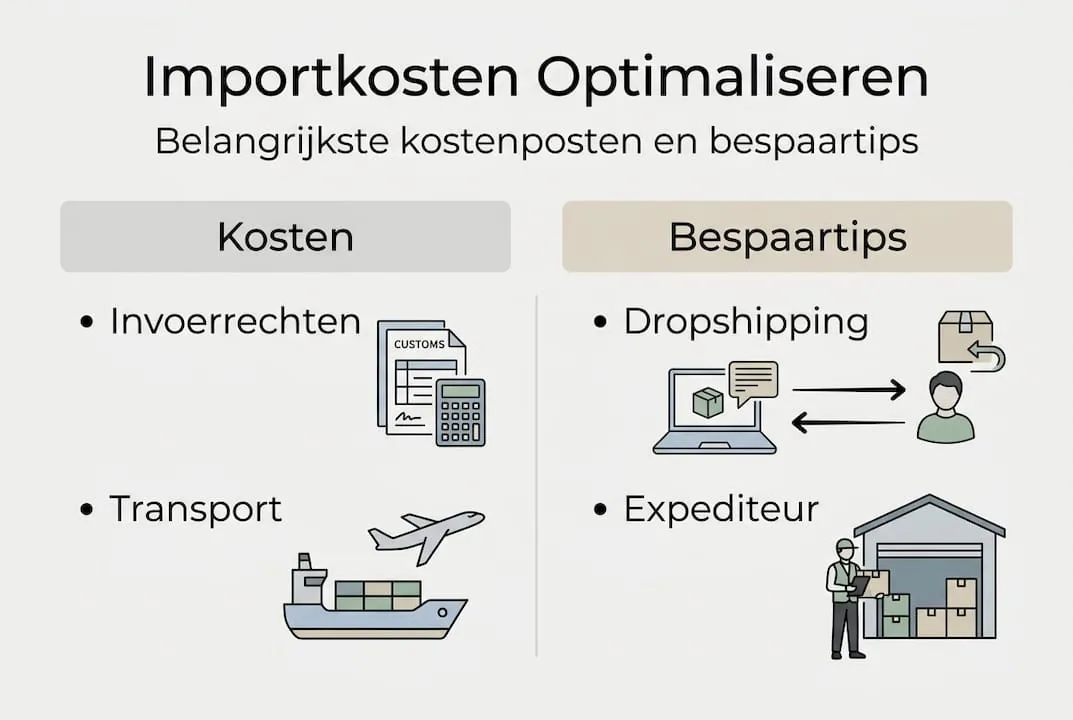
Importing doesn’t have to be expensive if you apply the right strategies. There are multiple ways to reduce costs without compromising speed or reliability.
Customs regimes that save you money
The optimization-via-customs-regimes such as customs warehousing, inward processing, and Article 23 are powerful tools that many small businesses underutilize. Inward processing is particularly interesting: you import raw materials or semi-finished goods, process them in Europe, and export the final product without paying import duties on the portion that is re-exported.
Companies that correctly apply inward processing can save thousands of euros per year on import duties, depending on their product volume and margins.
Working with a freight forwarder
A freight forwarder is a logistics specialist who handles customs declarations, arranges transportation, and ensures compliance on your behalf. The role-of-a-freight-forwarder in e-commerce logistics is often underestimated. Especially for larger volumes or complex product categories, a freight forwarder is not a cost but an investment.
Benefits of a freight forwarder:
- Accurate customs declarations, reduced risk of fines
- Access to better freight rates through networks
- Time savings for you as an entrepreneur
- Knowledge of local regulations in the country of origin
Pro tip: Compare multiple freight forwarders on price and service. Always ask for references from clients in your product category. A good freight forwarder knows the specific rules for your type of goods.
Dropshipping as a cost-saving strategy
Dropshipping allows you to sell products without holding inventory. The supplier ships directly to your customer, significantly reducing your inventory costs. However, there are risks: you have less control over delivery times and quality. Choose suppliers with proven experience in European e-commerce and transparency about their shipping times.
More insight into the impact-of-import-costs on your profit margin helps you make better decisions when choosing your import strategy. And if you’re considering shipping larger volumes, be sure to read the shipping-sea-containers-guide for e-commerce.
Common mistakes and how to avoid them
Even experienced importers make mistakes. Most are avoidable if you know what to watch for.
- Using the wrong Taric code. This is by far the most common mistake. An incorrect code leads to wrong import duties, potential fines, and delays at customs. Always verify your code via the official Taric database and have it validated by a freight forwarder if necessary.
- Insufficient compliance. Dutch and Belgian customs are pragmatic but strict on safety and counterfeiting. Importing products without the correct certificates or with a false invoice value risks seizure and heavy fines. Ensure your documentation is always accurate.
- Insufficient attention to delivery options. Not every carrier is equally suited for every type of product or destination. Compare options based on price, speed, and reliability. Review the international-shipping-rules to know what is allowed per country.
- Dropshipping without quality control. With dropshipping from non-EU countries, risks related to delivery time and quality control are real. Customers who wait too long or receive a product that doesn’t meet expectations won’t return. Set clear SLAs with your supplier.
- Ignoring IOSS and handling fees. If you use dropshipping for shipments under €150 to EU customers and do not provide an IOSS number, carriers will charge handling fees to the recipient. This directly damages customer satisfaction.
Pro tip: Create an import checklist for every new product you add to your assortment. Verify the Taric code, product regulations, certificates, and supplier agreements before going live.
Most import problems arise not from bad intentions but from a lack of preparation. An extra hour of research upfront can save you weeks of delays later.
Gain more control over the process with customs rules explained, a practical guide for anyone shipping internationally.
Our vision: importing as a growth accelerator for e-commerce
Many entrepreneurs see importing as an administrative burden. That’s understandable, but it’s the wrong mindset. Those who structure the import process well have a structural advantage over competitors who handle it ad hoc.
The impact of import costs on your margin is greater than most entrepreneurs realize. Those who consistently save on import duties through customs regimes gain an advantage with every product, every month. It adds up.
The KVK step-by-step plan advises e-commerce SMEs to prioritize carriers, consider EU suppliers, and thoroughly inform themselves about IOSS and handling fees. We add one more thing: do not treat logistics as an afterthought. The companies that grow the fastest in e-commerce are often those that professionalized their supply chain the earliest. Compliance is not a brake on growth. It is the foundation of it.
Next step: Optimize your international logistics
You now have a clear picture of how importing works, what it costs, and how to operate more efficiently. The next step is to put this into practice with the right tools and partners.

Parcel International has been helping e-commerce businesses since 2007 compare and optimize international shipments in over 220 countries. Whether you need a logistics checklist to evaluate your process, want to learn more about the role of a logistics service provider, or are ready to get started with optimizing e-commerce logistics, you’ll find the tools and network to take your import strategy to the next level with us.
Can't find your question? Our support team is here for you 24/7 via the help centre.
What is the difference between import from the EU and outside the EU?
For EU imports, there are no import duties or customs fees; for imports from outside the EU, obligations such as EORI, Taric, and import duties apply. The administrative burden for non-EU imports is significantly higher.
Which documents are required for import outside the EU?
You need at least an EORI number, a commercial invoice, and the correct Taric code. The Chamber of Commerce import process outlines all standard requirements, including product regulations and any necessary certificates.
How can I save costs when importing goods?
Use customs regulations such as active processing or an Article 23 permit, and consider dropshipping to reduce inventory costs. Optimization through customs regulations and engaging a freight forwarder are the most effective methods.
What are common mistakes when importing?
Incorrect product codes, missing compliance, and unrealistic delivery expectations with dropshipping are the most common pitfalls. Customs strictly enforces safety and counterfeit regulations, and dropshipping carries additional risks regarding delivery time and quality control.
Get a grip on your parcel shipping
Compare carriers, choose the best price and keep track of your international shipments. You can calculate and book without an account.

Recommendation
- Customs clearance tips for e-commerce: Save time – Send with Parcel International
- What are import costs – Impact on your profit – Send with Parcel International
- Customs regulations explained: Smooth international shipping – Send with Parcel International
- How to plan international shipments: The complete 2026 guide