
In a nutshell:
- Import involves bringing goods into the country from abroad, while export involves sending goods from the Netherlands to other countries. The difference determines direct costs, customs procedures, and regulations that must be complied with. Proper administration, documentation, and role selection are essential to avoid delays and penalties.
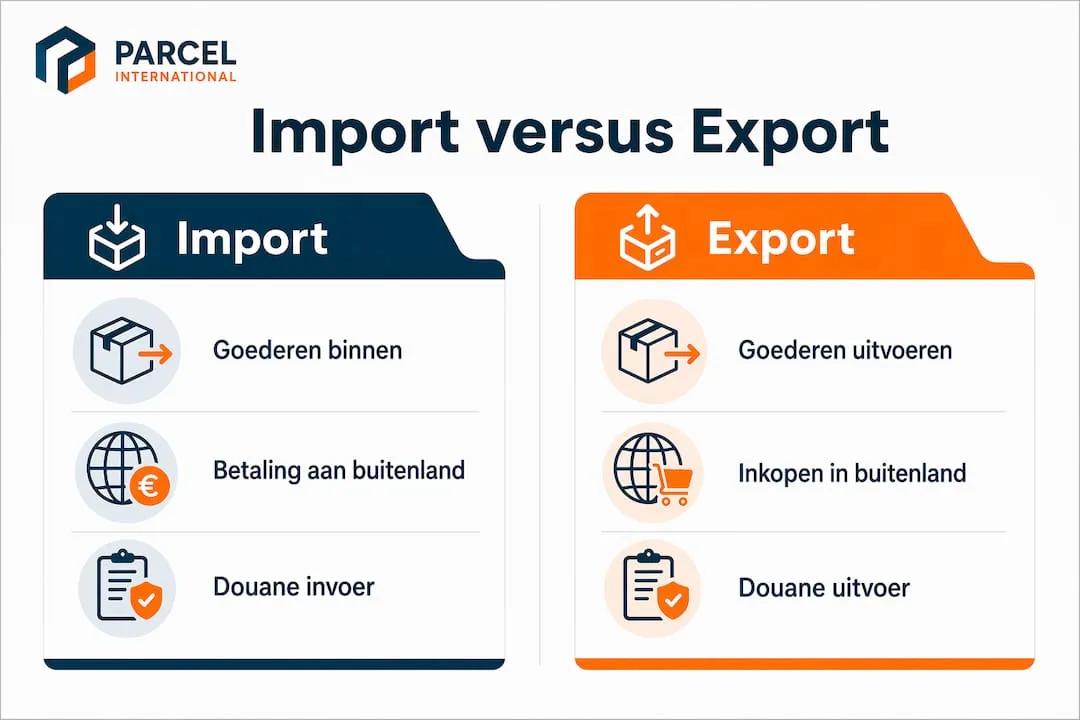
Import refers to bringing goods or services into the country from abroad. Export refers to selling and shipping them to foreign markets. This fundamental difference in import vs. export determines the direction of goods and financial flows and has direct implications for customs obligations, taxes, and contracts. Importers pay import duties and bear VAT obligations as the recipient. Exporters must comply with Dutch export regulations and the requirements of the destination country. While both processes may seem straightforward, the legal and fiscal details make the difference between a smooth shipment and a costly delay.
What exactly is the difference between import and export?
Import and export are opposites in international trade. Import involves bringing goods or services into the Netherlands from abroad. Export involves sending goods or services from the Netherlands to another country. The direction of the goods flow determines which rules, documents, and costs apply.

The trade balance is the difference between exports and imports over a specific period. If the Netherlands exports more than it imports, there is a trade surplus. This surplus strengthens the country's economic position and attracts foreign currency. A trade deficit has the opposite effect: more money flows out of the country than comes in.
Re-export is a special category that puts the Netherlands on the global map. Re-export involves goods that are imported and then exported again with little or no processing. Rotterdam and Schiphol serve as transit hubs, which means the Netherlands statistically exports a lot without those goods being produced locally. Specific customs declarations apply to re-export, even though the Netherlands is not the final market.
The distinction between an importer and a commercial agent is less well-known but equally important. An importer purchases goods in their own name and bears ownership and risk. A commercial agent acts on behalf of a foreign principal without acquiring ownership. This role choice has significant implications for contract types, VAT obligations, and liability.
What legal and customs procedures apply to import and export in the Netherlands?
The rules differ significantly depending on whether you trade within or outside the European Union. This distinction is the starting point for every importer or exporter in the Netherlands.
Trade within the EU
Free movement of goods applies to all EU member states. If you purchase goods in Germany or Belgium, no import duties or customs declarations are required. However, VAT rules apply: you process the purchase as an intra-Community acquisition in your VAT return. Product requirements, such as CE marking, automatically apply across the EU, simplifying administration.
Trade outside the EU
For imports from third countries, such as China, the United States, or the United Kingdom, the situation changes completely. You must file a customs declaration with Dutch Customs, pay import duties based on the customs value, and settle VAT upon import. Additional documents may be required, depending on the product and country of origin.
For exports outside the EU, Dutch export regulations and the import requirements of the destination country both apply. Accurate invoices, packing lists, and transport documents are mandatory. Product requirements and certifications valid in Europe do not automatically apply in other markets. A CE marking does not open doors in the United States or Japan.
The required permits vary by product. Strategic goods, chemicals, and certain agricultural products require export licenses. For some import products, such as foodstuffs or medical devices, specific import permits or inspection certificates are necessary.
Pro tip: Always check with the Chamber of Commerce (KVK) which permits apply to your specific product and destination before signing a contract. Retroactively arranging permits costs more time and money than gathering information upfront.
What practical documents do you need for import and export?
Documentation for international trade is more extensive than many entrepreneurs expect. Invoice, packing list, and Bill of Lading are essential for both import and export, but the combination and additional documents vary significantly by country and product.
The core set of documents for most international shipments includes:
- Commercial invoice: contains value, quantity, description, and parties involved. Customs uses this to calculate import duties.
- Packing list: details the weight, dimensions, and contents of each package. Required for multiple packages or pallets.
- Bill of Lading or air waybill: the transport contract and proof of ownership for sea freight and air freight, respectively.
- Certificate of origin: proves where goods were produced. Relevant for preferential tariffs in trade agreements.
- Import or export license: required for regulated product categories.
For intra-EU trade, customs documents are largely unnecessary. An invoice with the VAT numbers of both parties is sufficient for most shipments. For non-EU trade, the documentation set is more extensive and country-specific.
Document | Import outside EU | Export outside EU | Intra-EU |
|---|---|---|---|
Commercial invoice | Required | Required | Required |
Packing list | Required | Required | Recommended |
Bill of Lading | For sea freight | For sea freight | Not required |
Certificate of origin | Sometimes required | Sometimes required | Not required |
Customs declaration | Required | Required | Not required |
Incoterms determine who bears the costs, risks, and insurance during transport. Unclear Incoterms often lead to conflicts between trading partners. EXW (Ex Works) places all responsibility on the buyer. DDP (Delivered Duty Paid) places everything on the seller, including import duties and customs clearance. The choice of Incoterm determines who handles the customs declaration and who bears the risk if a shipment is damaged or lost.
The European Commission’s Access2Markets database is a practical tool for looking up required documents and tariffs by country and product. Use this database as the first step when preparing to enter a new export market.
How do imports and exports affect your business and tax obligations?
The tax implications of imports and exports are concrete and direct. Underestimating them risks fines, additional assessments, and border delays.
HS codes and import duties
Every goods category has an HS code (Harmonized System code). This code determines the import duty rate and any additional measures, such as anti-dumping duties or quotas. An incorrect HS code leads to inaccurate duty calculations and potential fines during inspections. Customs may hold a shipment until the correct code is confirmed.
VAT obligations
For imports outside the EU, you pay VAT at import to Customs. Businesses with an Article 23 permit may defer VAT to their VAT return, improving cash flow. For exports outside the EU, the zero VAT rate applies, provided you can prove the export with customs documents. For intra-EU deliveries to VAT-registered customers, the intra-community supply rule with a zero rate applies, but you need the customer’s VAT number.
The following situations most commonly lead to VAT errors:
- Applying the zero rate without proof of export or delivery to a VAT-registered customer.
- Forgetting that services to non-EU customers follow different VAT rules than goods deliveries.
- Failing to reclaim import VAT when entitled as a business.
- Not reporting intra-community acquisitions in the periodic VAT return.
Pro tip: Ask a VAT advisor to review your first import or export transaction. One correct setup saves you years of corrections.
The difference between an importer and a commercial agent also affects liability. An importer is the legal owner of the goods and responsible for the customs declaration. A commercial agent is not. Choosing the wrong role in a contract can unexpectedly expose you to liability for import duties or product liability.
What are the most common mistakes in import and export?
Mistakes in international trade are costly. They lead to delays, fines, and sometimes seizure of goods. The most common errors can be avoided with proper preparation.
- Underestimating legal obligations. Businesses underestimate the complexity of customs and VAT obligations. They assume a product legal in the Netherlands can be sold anywhere. This is incorrect. Each country has its own product requirements, certifications, and import restrictions.
- Incorrect or incomplete documentation. An invoice with an incorrect value or a missing packing list holds up a shipment at the border. Customs conducts random checks, but discrepancies always trigger a full inspection. Correct shipping documents prevent most delays.
- Errors in HS codes. An incorrect code leads to the wrong tariff. Sometimes you pay too much, sometimes too little. Underpayment results in additional assessments plus interest. Customs does not accept ignorance as an excuse.
- No market research for export. Market research is essential for success in international trade. Domestic sales models rarely work directly in other markets. Pricing, distribution channels, and consumer behavior vary by country. Exporters who skip this step encounter unexpected competition or regulations.
- Choosing the wrong Incoterm. An exporter agreeing to EXW when the buyer has no experience with customs clearance creates a problem. The goods are ready, but no one handles the customs declaration. Choose Incoterms that match the capabilities of both parties.
For businesses importing from non-EU countries for the first time, professional support from customs brokers is the most effective way to avoid mistakes. Brokers know local regulations, have contacts at Customs, and significantly speed up the clearance process.
For exporters to Germany, there are also export subsidies for Dutch companies available that reduce startup costs. Use these opportunities before entering a new market independently.
Key insights
Imports and exports differ fundamentally in direction, documentation, and tax obligations. Mastering this distinction prevents most errors in international trade.
Point | Details |
|---|---|
Core difference | Import involves bringing goods in, export involves sending goods out. The direction determines all rules. |
EU versus non-EU | Within the EU, no import duties or customs declarations apply. Outside the EU, both are mandatory. |
Documentation | Invoice, packing list, and Bill of Lading are always required. Additional documents vary by country and product. |
Incoterms | The chosen Incoterm determines who bears the risk, costs, and customs clearance. Choose wisely. |
Tax pitfalls | Incorrect HS codes and VAT errors lead to fines. Have your first transaction reviewed by an advisor. |
My perspective on import and export after years in logistics
Why most mistakes happen before the shipment even starts
I see it time and again: businesses only think about customs and VAT when the shipment is already en route. By then, it’s too late to adjust documentation or renegotiate the Incoterm. The damage is already done, literally and figuratively.
What stands out to me is that the difference between a smooth shipment and a stranded one rarely lies in the size of the company. Small e-commerce businesses with their documentation in order import more smoothly than large companies that rely on routine. Routine is dangerous in international trade because regulations change. The United Kingdom left the EU, after which dozens of Dutch exporters suddenly faced new customs obligations they hadn’t anticipated.
My honest advice: treat every new trade route as a new project. Verify the HS code, confirm the Incoterm, and check the documentation requirements of the destination country. The customs regulations by country change more often than you think. Those who stay on top of this have a structural advantage over competitors who don’t.
Partnering with a reliable freight forwarder or logistics service provider isn’t a sign of weakness. It’s a business decision that saves time, money, and stress. The complexity of non-EU trade almost always justifies that investment.
— Pascal
Parcelinternational makes international shipping simpler
International trade comes with logistical challenges you don’t have to face alone. Since 2007, Parcelinternational has provided solutions for parcel shipping and on-demand freight transport to over 220 countries and territories.
Whether you’re importing or exporting goods, Parcelinternational helps you compare shipping options, choose the right carrier, and manage logistics without hidden costs. For those who want to know which shipping options best suit their shipment, Parcelinternational offers a clear overview of international-shipping-options for every situation.
Can't find your question? Our support team is here for you 24/7 via the help centre.
Are there customs regulations within the EU?
No customs duties apply within the EU due to the free movement of goods, but you must still comply with national product requirements, VAT rules, and excise goods regulations.
Which documents are required for import outside the EU?
You need at least an EORI number, a commercial invoice, and the correct Taric code. The Chamber of Commerce import process outlines all standard requirements, including product regulations and any necessary certificates.
What are Incoterms® and why are they important?
Incoterms® determine who arranges transport and bears risk in cross-border shipments, but they do not regulate transfer of ownership or payment, for which additional agreements in your delivery terms are required.
What is the difference between import and export?
Import is the process of bringing goods or services into a country from abroad. Export is the process of selling and shipping goods or services to a foreign country.
What is an HS code exactly?
An HS code is an international product classification code that determines the import duty rate. An incorrect code leads to inaccurate duty calculations and may result in fines or additional customs charges.
Get a grip on your parcel shipping
Compare carriers, choose the best price and keep track of your international shipments. You can calculate and book without an account.
