
A correct UK address always follows this order: recipient's name, house number with street name, the post town in uppercase, and the postcode in uppercase on a separate line. If sending from abroad, add “UNITED KINGDOM” as the final line. The postcode itself consists of 5 to 7 alphanumeric characters and should never be embedded within other details.
In short:
- Without a postcode or correct post town, a UK address may experience delays as sorting systems cannot guarantee proper processing.
- A postcode consists of 5 to 7 alphanumeric characters in a standard format with a space, such as “M1 1AE” or “EC1A 1BB”.
- For international shipments, the country name “UNITED KINGDOM” must appear below the postcode as the final line, separate from other address details.
- Flat numbers and building names should always appear before the house number or on a separate line, as misplaced details can disrupt automated delivery.
- The postcode and post town determine sorting direction, while information like the county is optional and does not affect delivery.
Step-by-Step: How to Structure a UK Address Correctly
Each line of a UK address serves a function in Royal Mail’s sorting process. Skipping a step or placing information in the wrong order risks delays or returns.
Here’s how to structure the lines:
- Recipient’s name (optionally with job title or department).
- Company name, if it’s a business shipment.
- House number and street name, optionally with flat number or building name on a separate line above.
- The post town, in full uppercase.
- The postcode, in uppercase and on its own line.
- For international shipments: “UNITED KINGDOM” as the final line.
Avoid periods or commas at the end of lines and left-align all text. This is exactly what the Post Office recommends for both domestic and international mail. A county is not required: as long as the post town and postcode are correct, sorting software can process the address flawlessly. Unsure about the correct spelling of a post town? Always verify it alongside the postcode, as they function as a pair—one without the other often causes delays.
How Is a UK Postcode Structured?
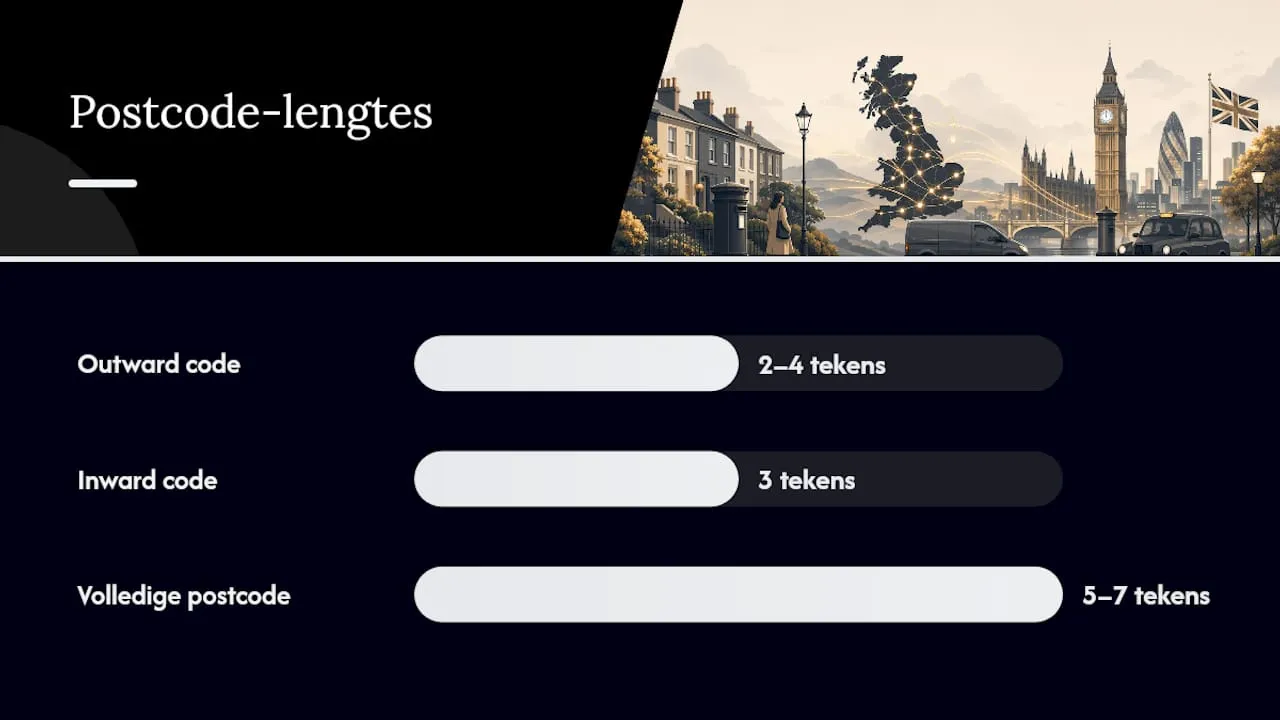
A UK postcode consists of two parts: the outward code and the inward code, separated by a space. The outward code (2 to 4 characters) refers to the sorting office and region; the inward code (always 3 characters) points to a specific area or even a small cluster of buildings. Together, they form a code of 5 to 7 alphanumeric characters.
The main valid formats are:
Format | Example |
|---|---|
AN NAA | M1 1AE |
AAN NAA | CR2 6XH |
AANN NAA | DN55 1PT |
AANA NAA | EC1A 1BB |
ANN NAA | M60 1NW |
ANA NAA | W1A 1HQ |
There is one historical exception: GIR 0AA, once assigned to the National Girobank headquarters. This code occasionally appears in older systems but is irrelevant for new addresses. The UPU outlines these formats in detail, including the rule that a postcode must always appear on its own line in uppercase, even for international shipments.
Unsure if a postcode is correct? Postcode lookup services like postcodes.io instantly return the associated region, county, and coordinates. This is faster and more reliable than guessing from an old address book.
PO Boxes, c/o, and Flats: How to Write Special Addresses
Not every address is a simple house number with a street. A few common variations require a slightly different approach.
- A PO Box is written as “PO Box 123”, without periods. This appears separately above the post town and postcode.
- Use “c/o” (care of) when delivering to a temporary address or via a third party, e.g., “c/o Jansen, 22 High Street”.
- A flat number or unit number should appear before the house number, e.g., “Flat 4, 22 High Street”, or on its own line if the building name is long.
- A building name (such as “Tower House”) sometimes replaces the house number entirely, especially for older or rural addresses.
- For business addresses , include the contact person’s name above the company name if targeting a specific individual; otherwise, the company name alone suffices.
These details may seem minor, but automated sorting systems read addresses line by line. A misplaced flat number could route a shipment to the wrong address within the same building.
What Changes for International Shipments to the UK?
When sending a package from the Netherlands, Belgium, or another country, a few additional rules apply on top of the standard address structure. The final line of the address must always be the country name in English and uppercase: UNITED KINGDOM. This signals customs and international sorting centers where the shipment is headed, even if the rest of the address is in a different script or format.
- Place “UNITED KINGDOM” as the very last line, separate from the postcode.
- Always include a full return address in the country of origin. Without a return address, an undeliverable shipment cannot be returned free of charge.
- Customs documentation is mandatory for parcels; regular letters and documents are often exempt.
- Add a phone number or email address so a courier can contact you if there are delivery concerns.
Pro tip: Always print the return address on a separate small label at the bottom of the package, away from the main address. This prevents customs personnel from confusing the shipping address with the return address.
Ready-to-Use Examples to Copy
The examples below follow the structure used by Royal Mail and the Post Office. Simply replace the name, street, and postcode as needed.
- Residential address:
Jan de Vries
22 High Street
MANCHESTER
M1 1AE - Flat or apartment:
Sarah Thompson
Flat 4, 15 Baker Street
LONDON
NW1 6XE - Business address with contact person:
Attn: Emily Clarke
Global Traders Ltd
Unit 7, Riverside Business Park
GLASGOW
G1 1AB - International shipping from abroad:
Michael Brown
45 Church Road
EDINBURGH
EH1 1AB
UNITED KINGDOM
Save this structure as a template. By only changing the name and postcode, the address will remain readable for both human sorters and scanning systems.
Why these guidelines work
Experienced international shipping services have been sending parcels and freight to many countries for years, using address validation daily as part of the booking process. This experience shows that most delays in UK shipments are caused by a misplaced postcode or a missing return address, not by exotic address formats.
For bulk shipments or e-commerce, we recommend always using a postcode validation tool before shipping, such as the postcode lookup service mentioned above. This prevents dozens of packages with a typo in the postcode from all experiencing the same delay. If you want to learn more about addressing outside the UK, the global addressing guide provides additional examples by country.
What most guides on UK addresses miss
Most online advice repeats the same basic rules without explaining why they exist. That’s the problem: people learn the format but not the logic behind it, and as a result, they make the same mistakes again as soon as an address deviates slightly from the standard example.
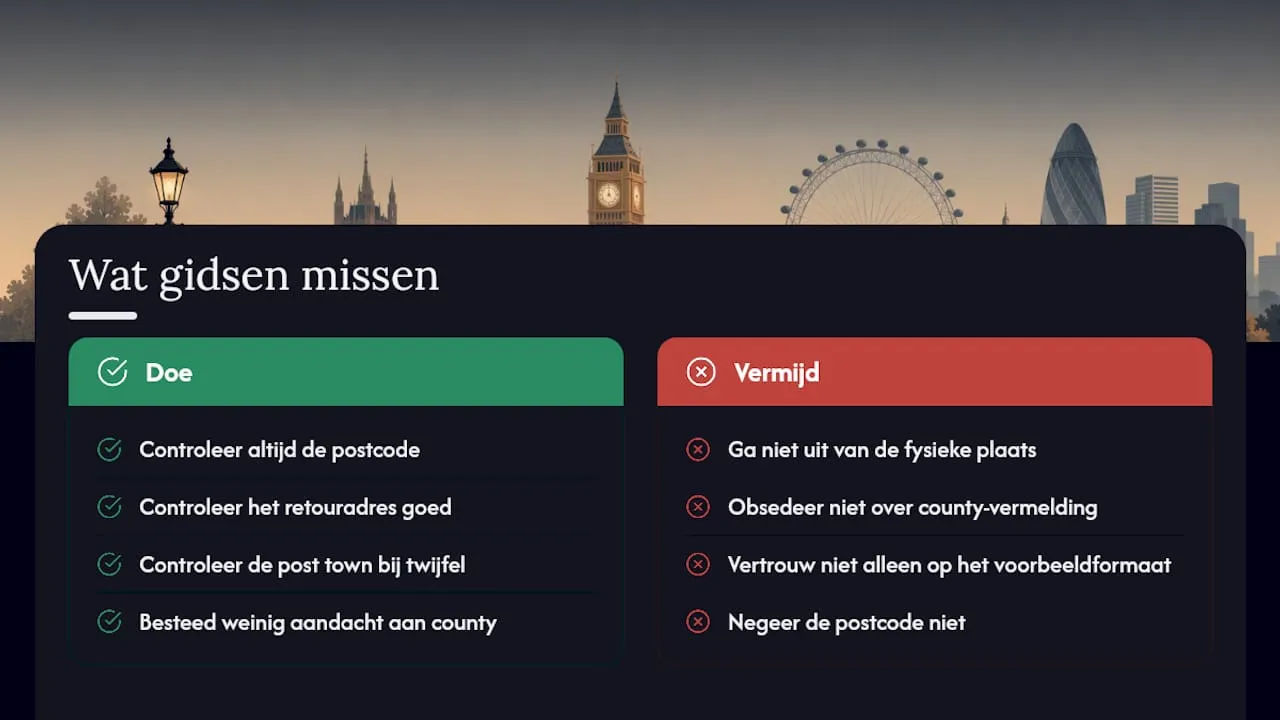
The post town is the most underestimated part of a UK address. Many senders think it indicates the physical location, but it often refers to a sorting centre. As a result, a village may have a post town that has nothing to do with the actual municipal boundary. Understanding this stops the hesitation over 'correct' place names and focuses on what really matters: the postcode.
What I would recommend: spend less time perfecting the county mention, which is already optional, and more time double-checking the postcode and return address. These are the two elements that actually determine whether a shipment arrives or bounces back. All other details are formatting.
— Pascal
Need help shipping to the United Kingdom?
A correct address is the foundation, but international shipping often requires more: the right carrier, customs documentation, and a realistic delivery time. Some platforms compare multiple carriers side by side without extra costs or mandatory accounts, allowing users to choose the best combination of price and speed for shipments to the UK.

Whether you’re sending a single package or regularly booking freight via air, sea, or road, some platforms can automatically generate customs documentation and offer tracking capabilities for shipments. Check out the available shipping options for air, sea, and road transport and request a direct comparison of rates before booking your next shipment to the United Kingdom.
Sources
For the most up-to-date rules, consult the Post Office guidelines for addressing and the PAF code of practice for official postal standards. Technical details on postcode structure can be found at ONS and in UPU documentation.
Can't find your question? Our support team is here for you 24/7 via the help centre.
What does an address in England look like?
An English address consists of the recipient’s name, house number and street name, the post town in uppercase, and the postal code on a separate line, also in uppercase. For shipments from abroad, add “UNITED KINGDOM” as the last line.
How do I write my address in English?
Use the same format as a British address: house number and street, city name, postal code, and country. Include your own address as the return address on a package to the UK so that an undeliverable shipment can be returned without additional costs.
What does a postal code in England look like?
A UK postcode consists of 5 to 7 alphanumeric characters, divided into an outward code and an inward code, separated by a space, such as “M1 1AE” or “EC1A 1BB”. The UPU outlines the six valid notation formats used in the country.
Is a county required in a British address?
No, a county is not required as long as the post town and postcode are correctly provided. The PAF Code of Practice confirms that these two elements are decisive for postal sorting, not the county.
Get a grip on your parcel shipping
Compare carriers, choose the best price and keep track of your international shipments. You can calculate and book without an account.
