
TL;DR:
- Choosing a reliable carrier is essential to avoid extra costs and loss of customer trust. Using KPIs, scorecards, and structured evaluation processes helps e-commerce businesses objectively assess transport partnerships and build sustainable collaborations. Continuous monitoring and clear KPI agreements enable companies to minimize operational risks and secure their international growth.
An unreliable carrier costs you more than you think. If a package arrives late, gets lost in customs, or appears damaged at the customer’s doorstep, you pay twice: for the return shipment and for the loss of customer trust. For small and medium-sized e-commerce businesses aiming for international growth, selecting a carrier is not a side issue—it’s a strategic decision that directly impacts your revenue, reputation, and operational stability. In this article, you’ll learn how to use KPIs, scorecards, and a structured step-by-step plan to objectively evaluate carriers and make the right choice.
Key Insights
Point | Details |
|---|---|
Use carrier scorecards | Scorecards make carrier performance measurable and transparent for international shipments. |
Look beyond price | A multi-indicator evaluation model prevents disappointment by avoiding a focus solely on price. |
Avoid common mistakes | Including regional expertise and claims ratio helps you steer clear of frequent pitfalls. |
Monitor and optimize continuously | Regular performance monitoring ensures sustainable logistical reliability. |
Preparation: What Do You Need to Select a Carrier?
Now that you understand why reliability is so crucial, start by preparing for a solid selection process. Many companies skip this phase and immediately request quotes—that’s a mistake. Without a clear picture of your own logistical needs, you can’t make a fair comparison.
Map your logistical reality
Before approaching a carrier, you need to understand your own situation. While this may seem obvious, many e-commerce businesses lack clarity on their shipping volume, destinations, and service requirements. Start by answering the following questions:
- How many packages do you ship per month, per quarter, per season?
- Which countries and regions do you ship to most frequently?
- What are your average package weights and dimensions?
- What delivery times do your customers expect?
- Do you have specific requirements for returns logistics or customs handling?
This overview forms the foundation for every conversation with a potential carrier. It also gives you negotiating power, as a carrier familiar with your volume and route patterns can tailor their offer more effectively.
Align your logistical goals with your business strategy
Logistics is not an isolated part of your business—it impacts your brand promise, customer satisfaction, and financial margins. If your business strategy prioritizes fast delivery as a competitive advantage, a carrier with the lowest price but slow delivery times is not a good match. If sustainability is your focus, you may want to know whether a carrier offers CO₂ compensation or uses sea freight instead of air freight.
Review practical logistics examples to see how other e-commerce businesses align their logistical choices with their growth strategies. This provides a realistic frame of reference.
Working with KPIs and Carrier Scorecards
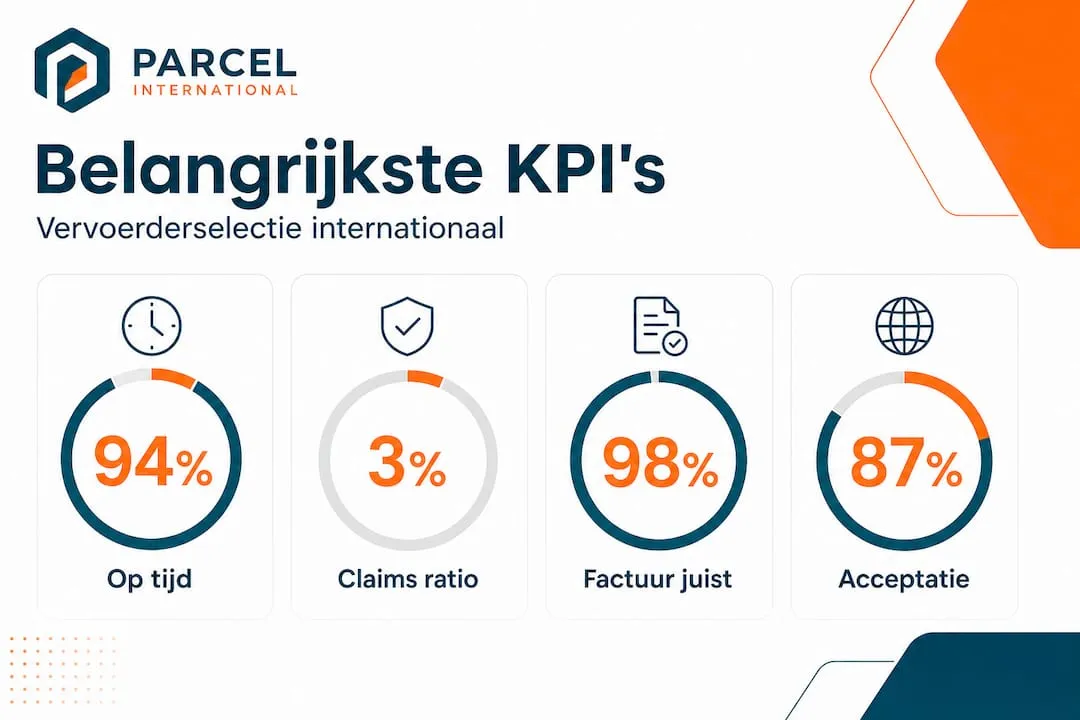
A carrier scorecard is a structured evaluation tool that makes carrier performance measurable. The carrier scorecard dashboard shows how to measure reliability using KPIs, including dimensions such as on-time delivery, tender acceptance rate, claims ratio, and invoice accuracy.
Without KPIs, you’re comparing apples to oranges. A scorecard makes the conversation objective and measurable.
Here’s a simple starting version of a criteria overview:
Criterion | Description | Importance |
|---|---|---|
On-time delivery | Percentage of on-time deliveries | High |
Claims ratio | Percentage of damaged or lost shipments | High |
Billing accuracy | Accuracy of invoices | Medium |
Tender acceptance | Acceptance rate of offered shipments | Medium |
Network coverage | Countries and regions where the carrier operates | High |
Customer service | Response time and problem-solving ability | Medium |
Pro tip: Start filling out your scorecard for your current carrier during the preparation phase. This gives you a baseline and clarifies pain points before you approach new partners.
Streamlining your shipping process also helps with a practical checklist to ensure nothing is overlooked during preparation. Also consider which type of transport best suits your product category: the choice between air vs. sea freight directly impacts which carriers are suitable for you.
Step-by-Step: How to Select a Reliable Carrier
Now that you know what you need, you can start the selection process. A structured approach prevents you from being swayed by sales pitches or one-sided price comparisons.
The step-by-step plan
- Define your selection criteria. Use the KPI categories from your scorecard as a framework. Consciously avoid placing price agreements at the top of the list.
- Create a longlist of carriers. Think beyond the big names. Regional players often have excellent networks in specific markets, such as Eastern Europe, Southeast Asia, or Latin America.
- Send a standardized RFI (Request for Information). Ask each carrier for the same information: network coverage, KPI results from the past year, claims procedure, technological systems, and references.
- Analyze the responses based on your scorecard. Score each criterion to create an objective comparison point instead of relying on gut feeling.
- Conduct a trial period. Select two or three candidates and test them with a limited volume for 60 to 90 days. Measure KPIs daily.
- Evaluate and make a choice. Compare the trial period performance with the promises from the RFI. Choose the carrier that performs most consistently, not necessarily the cheapest.
- Draft a contract with KPI agreements. Establish minimum requirements, along with consequences if they are not met. Consider penalties, escalation procedures, or exit clauses.
- Monitor continuously. Evaluation doesn’t stop after signing the contract. Use your scorecard to track performance monthly.
Beyond price: the evaluation model
The integrated evaluation dimensions of a multi-indicator model include service quality, operational costs, technology level, and network coverage. This model provides a much more complete picture than a simple price comparison.
Carrier scorecards evaluate carriers on on-time delivery, claims ratio, and billing accuracy, enabling you to form a fair, data-driven judgment.
Below is a comparison table for three hypothetical carriers:
KPI | Carrier A | Carrier B | Carrier C |
|---|---|---|---|
On-time delivery | 94% | 87% | 91% |
Claims ratio | 0.8% | 2.1% | 1.2% |
Billing accuracy | 99% | 93% | 97% |
Tender acceptance | 96% | 88% | 92% |
Network coverage | 180 countries | 120 countries | 210 countries |
Technology level | Advanced | Basic | Average |
In this example, Carrier A scores highest on quality, but Carrier C has the broadest network. Depending on your destinations, this could be decisive. The goal is not to find the highest overall scorer, but the one that best fits your specific needs.

Pro tip: Always ask carriers to provide evidence of their KPI results in the form of reports or dashboard screenshots. A claim without data is a marketing story, not a guarantee.
Also check out compare-shipping-methods if you are considering multiple shipping modes, and use the logistics optimization checklist to streamline the selection process.
Common mistakes and how to avoid them in carrier selection
The steps are clear, but mistakes often creep into the process. Here you’ll find them, along with tips to avoid them.
Mistake 1: Price as the only criterion
The most common mistake is selecting based on the lowest price. A cheap carrier that damages 5% of your shipments or delivers 10% late will ultimately cost you much more. Return costs, customer service contacts, negative reviews, and lost customers outweigh a few euros per shipment.
Use your scorecard as a counterbalance. If you are seriously considering a carrier based solely on price, first check the claims ratio and on-time delivery.
Mistake 2: Underestimating regional expertise
Many e-commerce companies choose a carrier strong in Western Europe, only to find that deliveries to Poland, Romania, or Turkey are problematic. Regional network coverage is a specific competency. A carrier with 220 countries on paper is not automatically equally strong in each of those countries.
In the RFI, specifically ask for average delivery times and claims ratio per region. This provides a more realistic picture than a general average.
Mistake 3: Ignoring claims ratio and billing accuracy
Claims ratio (the percentage of shipments with damage or loss) and billing accuracy (the percentage of correct invoices) are often overlooked in the selection phase. Yet, these are two KPIs that significantly impact your operational burden.
A high claims ratio means extensive administration, customer communication, and costs. Low billing accuracy means you must verify and dispute invoices monthly. Both consume time and money that you’d rather invest elsewhere.
“KPIs and scorecards ensure greater transparency and fewer errors in carrier selection.” Without structured scorecard monitoring, you select blindly and address problems reactively rather than proactively.
Mistake 4: No contractual KPI agreements
Choosing a carrier without KPI agreements in the contract is like paying a supplier without specifying requirements. Ensure you establish minimum standards, along with consequences if they are not met.
Mistake 5: No periodic re-evaluation
The market changes. A carrier that performed excellently last year may decline due to mergers, staffing issues, or capacity problems. Therefore, schedule reviews at least semi-annually.
If you notice delivery times consistently increasing, use the tips in reduce-delivery-times to support your discussion with the carrier using concrete data. The logistics optimization checklist helps you establish a cycle of continuous improvement.
Avoidable pitfalls summarized:
- Never select based on price alone; always supplement with quality KPIs
- Always request region-specific performance, not just the average
- Always include claims ratio and billing accuracy in the comparison
- Always establish KPI agreements contractually
- Re-evaluate performance at least semi-annually
How can you measure and monitor carrier performance?
After avoiding mistakes, the next step is measuring and monitoring your carrier. This is the phase many companies neglect after signing a contract. However, a carrier that knows you are not measuring has little incentive to meet the agreed KPIs.
Daily versus periodic monitoring
Not all KPIs need daily tracking. Some are suitable for daily monitoring, while others are better for monthly or quarterly reports.
Daily monitoring:
- Number of shipments sent versus expected volume
- Tracking status of ongoing shipments
- Outstanding claims or complaints
Monthly monitoring:
- On-time delivery percentage
- Claims ratio
- Billing accuracy
- Tender acceptance rate
Quarterly review:
- Overall scorecard rating per carrier
- Comparison with agreed contract standards
- Trend analysis over the past three months
- Strategic discussions with the carrier on improvement points
The use of an integrated evaluation model
A multi-indicator evaluation model for logistics service providers enhances the monitoring of service quality, operational costs, and technology levels. This model goes beyond simple KPI tracking and also helps you weigh soft indicators such as communication quality and problem-solving capabilities.
The core KPIs in a carrier scorecard include on-time delivery, tender acceptance, claims ratio, and billing accuracy, providing a comprehensive view of carrier performance.
What to track in a monitoring overview
Metric | Frequency | Minimum Standard | Action for Deviation |
|---|---|---|---|
On-time delivery | Monthly | 90% | Escalation after 2 months |
Claims ratio | Monthly | Below 1% | Immediate discussion upon exceedance |
Billing accuracy | Monthly | Above 97% | Invoice review and feedback |
Tender acceptance | Quarterly | Above 90% | Adjust capacity planning |
Customer satisfaction score | Quarterly | Above 4/5 | Analyze customer feedback |
Technology as an enabler
Modern carriers offer API integrations and dashboards that provide real-time data insights. If a carrier cannot provide digital reporting, that in itself is a red flag. Technology level is one of the dimensions in the multi-indicator model and speaks volumes about how professionally a carrier operates.
Connect your monitoring to your order management. If you know how to manage shipping orders for international e-commerce stores, you can directly link KPI data to customer experiences and adjust more quickly. Also, use insights on reducing shipping costs to periodically assess the cost efficiency of your carriers.
Practical tip for small teams: You don’t need expensive software to start monitoring. A simple spreadsheet with the above metrics, updated monthly, already gives you a significant advantage over companies that measure nothing at all.
Our perspective: Why traditional selection criteria no longer suffice
For years, selecting a carrier was a relatively simple exercise: request three quotes, choose the lowest price, and hope for the best. That approach may have worked in a time when e-commerce volumes were modest and customers found a two-week wait acceptable. Those days are over.
What we see in practice is that companies clinging to price-driven selection are increasingly caught off guard—not by one-off incidents, but by systemic issues they never saw coming because they never measured anything. A carrier may be “good enough” for years until it’s no longer good enough, and you only discover this through angry customer emails.
The shift we advocate goes beyond implementing KPIs. It’s about a cultural change in how you view logistics partnerships. A carrier is not a supplier you procure like office supplies. It’s a partner co-responsible for your brand experience on the customer side.
A multi-indicator evaluation model builds sustainable partnerships and prevents surprises by creating transparency from the start about mutual expectations. This is fundamentally different from solving problems after the fact.
What we also notice: Companies that invest in thorough carrier evaluation and monitoring save significantly in the long run on customer service, reverse logistics, and ad-hoc issues. The initial time investment pays for itself in operational stability.
Look at logistics examples from companies already applying this successfully. It gives you a realistic view of what’s possible when you take selection and monitoring seriously.
Our message is simple: The companies that will be most competitive in international e-commerce are not those with the lowest shipping costs. They are the companies that combine the most reliable delivery with sharp costs—and have the data to prove it.
Take action now: Compare carriers and find the best for your shipment
You now know how to select a reliable carrier, which KPIs matter, and which mistakes to avoid. The next step is to turn that knowledge into action. At Parcel International, you can directly compare multiple carriers on price, delivery time, and destination—without hidden costs or time-consuming negotiations.

Parcel International has been active since 2007 in over 220 countries and combines years of experience with a modern platform where you can easily choose between express, sea freight, air freight, and road transport. Whether you’re shipping a one-time consignment or sending large volumes weekly, the platform is built to simplify your logistics process. Explore the comparison options directly on the website and find the carrier that fits your criteria, destinations, and expectations.
Can't find your question? Our support team is here for you 24/7 via the help centre.
Which KPIs are most important for comparing carriers?
The most important KPIs are on-time delivery, tender acceptance, claims ratio, and billing accuracy, as defined in the carrier scorecard dashboard. These four metrics together provide a complete view of reliability and operational quality.
How can I avoid selecting carriers based solely on price?
Use a multi-indicator evaluation model that considers service quality, technology level, and network coverage in addition to price. Scoring all dimensions prevents a low price from masking poor quality.
What if my carrier does not meet the agreed KPIs?
Monitor performance regularly with a scorecard and address deviations directly with your carrier. The carrier scorecard dashboard provides concrete insights into where deviations occur, allowing you to base discussions on data rather than intuition.
How often should I measure my carrier's performance?
Analyze performance at least monthly with a scorecard and conduct quarterly reviews for strategic adjustments. Scorecard monitoring provides recurring insights, enabling you to identify trends before they become problems.
Get a grip on your parcel shipping
Compare carriers, choose the best price and keep track of your international shipments. You can calculate and book without an account.
