
TL;DR:
- Importing and exporting require thorough preparation due to customs formalities, proper documentation, and tariff codes. Without good planning, you risk delays, fines, and customer loss. Using systems, checklists, and reliable partners prevents costly mistakes and ensures efficient international shipments.
Importing and exporting may seem simpler than they are. You place an order with a supplier in China or sell to customers in the U.S., and suddenly, you encounter customs forms, tariff codes, mandatory certificates, and transport responsibilities that are nowhere clearly explained. Without proper preparation, you may face additional charges, shipments stuck at customs, or customer relationships breaking down due to delayed deliveries. In this article, you’ll learn exactly how to handle import/export: from initial documents and your EORI number to transport, customs clearance, and export restrictions.
Key Insights
Point | Details |
|---|---|
EORI Number Requirement | An EORI number is essential for customs declarations when importing or exporting outside the EU. |
Complete Documentation | Ensure all required documents and certificates are complete for customs and compliance. |
Clarity on Incoterms® | Incoterms® define who manages transport and risks, which is essential for smooth trade. |
Preparation Prevents Delays | Proper coordination and documentation minimize customs delays and unexpected costs. |
Check Export Restrictions | Always verify product restrictions or bans through reliable sources like Access2Markets. |
Requirements for Importing and Exporting
Before sending even a single product across the border, your paperwork must be in order. It may sound bureaucratic, but it’s the only way to avoid delays and fines. Most small e-commerce businesses underestimate how much needs to be arranged in advance.
The EORI Number: Your Basic Customs Identification
The first thing you need is an EORI number (Economic Operators Registration and Identification). You need this unique identification number for every customs declaration when importing or exporting outside the EU. Without this number, customs will simply refuse to process your shipment. You can apply for it free of charge via Customs or the Chamber of Commerce. It will be available within a few working days.
Documents per Product and Destination
The documents you need depend on the product and the country of origin or destination. Access2Markets outlines standard import requirements: a commercial invoice, transport document, import declaration, and, depending on the product, additional certificates such as a phytosanitary certificate, CE marking, or proof of origin.
The most common import documents are:
- Commercial Invoice: Lists price, quantity, description, and parties involved.
- Bill of Lading or Waybill: Proof of transport agreement and ownership of the shipment.
- Packing List: Detailed overview of the shipment contents.
- Import Declaration: Mandatory declaration to customs for release of goods.
- Certificate of Origin: Required for preferential tariffs or if the importing country demands it.
- Specific Certificates: Such as health or quality certificates for food, electronics, or chemicals.
It pays to go through an international shipment checklist beforehand to ensure nothing is forgotten and your shipment departs without issues.
Taric Codes: The Basis of Import Duties
Every type of goods has a Taric code, a ten-digit code within the EU (the first eight digits are the HS code). This code determines how much import duty you pay and which regulations apply. An incorrect code is one of the most common mistakes made by beginning importers. You can look up the code via the Taric database of the European Commission.
Document | When Required | Where to Apply |
|---|---|---|
EORI Number | Always for import/export outside the EU | Customs or Chamber of Commerce |
Commercial Invoice | Always | Supplier or exporter |
Certificate of Origin | Depending on trade agreement | Chamber of Commerce |
Phytosanitary Certificate | Plants, vegetables, fruit | NVWA (Netherlands Food and Consumer Product Safety Authority) |
CE Marking Documentation | Electronics, toys, machinery | Manufacturer or conformity assessment body |
Step-by-Step Guide to the Import Process
After understanding the preparations, here are the practical steps for a smooth import process. The Chamber of Commerce import step-by-step guide outlines 14 concrete steps, from market research to clearance and final payment.
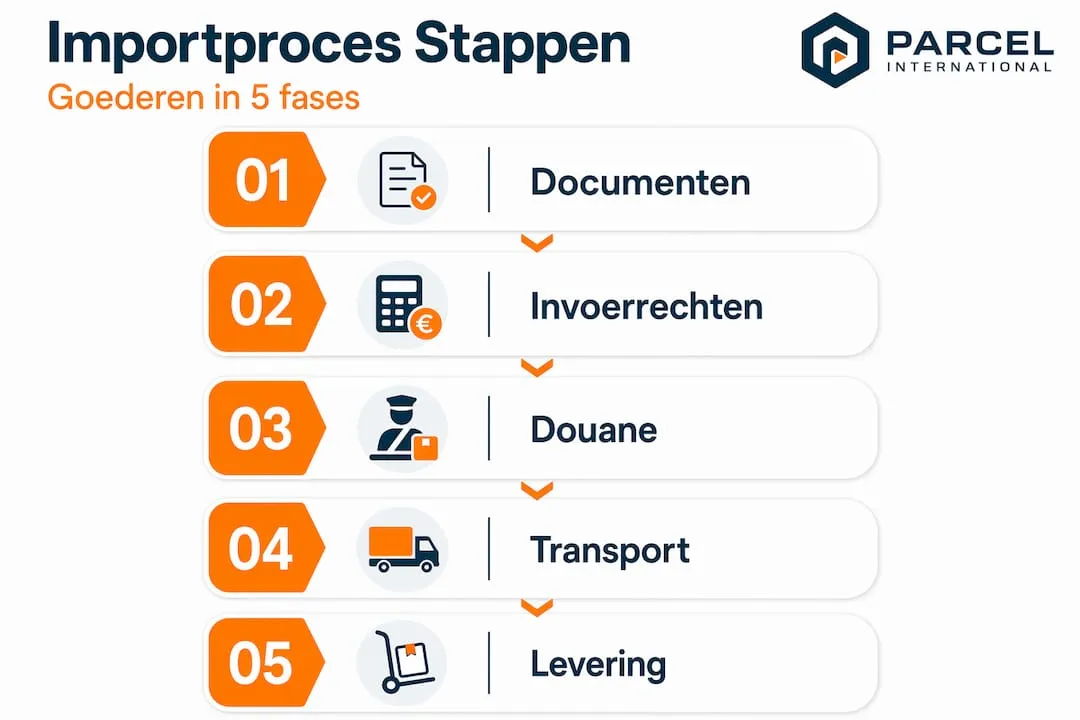
In summary, as an importer, you go through the following phases:
- Market Research and Supplier Selection: Identify suitable suppliers and check their reputation. Request samples before ordering large volumes.
- Product Suitability and Import Restrictions Check: Not everything is allowed into the EU. Think of products containing chemicals, batteries, or protected species. Check this via Access2Markets or Customs.
- Agree on Incoterms®: Discuss with your supplier who arranges transport, who bears the costs, and where the risk transfers. This must be documented in the contract.
- Determine Tariff Code (Taric): Look up the correct ten-digit code and calculate the expected import duties and VAT to avoid surprises upon arrival.
- Collect Documents: Request the commercial invoice, packing list, bill of lading, and any certificates from the supplier. Verify all details for accuracy.
- Arrange Transport: Choose a carrier that fits the weight, volume, and urgency of your shipment. Air freight costs are higher but deliver faster. Sea freight costs are lower for large volumes.
- Submit Import Declaration: File a declaration with customs before the goods arrive. This can be done yourself or via a customs broker.
- Pay Import Duties and VAT: After approval by customs, pay the due import duties and VAT. Your goods will then be released.
- Receive and Inspect Goods: Check the shipment for damage and completeness. Report any discrepancies immediately to the carrier and file a claim for damage in a timely manner.
Pro Tip: Always request a proforma invoice from your supplier before placing a final order. It contains all the details you need to calculate import duties and properly prepare your financing.
A well-prepared international logistics checklist prevents discovering mid-process that a document is missing. Such mistakes not only cost money but also time and customer satisfaction.
Transport and customs clearance for import and export
Goods don’t move from A to B on their own. Choosing the right mode of transport, agreeing on responsibilities, and correctly handling customs clearance are three distinct tasks that are closely interconnected.
Modes of transport and their applications
Not every product is suited for every mode of transport. The Chamber of Commerce (KVK) emphasizes that correct transport documents and proper alignment of transport choices are essential for smooth transit. Below is an overview:
Mode of transport | Suitable for | Advantage | Disadvantage |
|---|---|---|---|
Air freight | Small, lightweight, high-value | Fast (1 to 5 days) | Expensive per kilogram |
Sea freight | Large volume, heavy | Cost-effective per unit | Slow (3 to 6 weeks) |
Road transport | European destinations | Flexible, door-to-door | Limited to continent |
Rail transport | China-Europe routes | Faster than sea, cheaper than air | Limited coverage |
Incoterms®: Who does what?
Incoterms® are international trade rules that define who bears the transport risk and who is responsible if goods are damaged or lost. The eleven Incoterms® 2020 range from EXW (everything at the buyer’s expense) to DDP (everything at the seller’s expense, including import duties). For e-commerce businesses, understanding this is crucial. A supplier offering “FOB Shanghai” means you are responsible once the goods are loaded onto the ship. If you don’t understand this, you may pay for damage that could have been avoided.
You can find a complete explanation of international Incoterms to quickly compare the most commonly used variants.
Customs brokers: When should you hire one?
A customs broker handles clearance for you. For businesses that frequently import or export, this is often the smartest choice. They know the procedures, have direct contacts with customs, and prevent common mistakes. Learn more about what customs brokerage entails if you are considering outsourcing this.
In most cases, the cost of a broker far outweighs potential additional charges, fines, or delay costs if you make mistakes yourself.
Pro tip: Always ask your broker for a cost breakdown. Most charge a fixed fee plus variable costs for storage and processing. This way, you know exactly what you’re paying and can fairly compare providers.
Preparing for export: Restrictions, liability, and documentation
After preparing for transport and customs, it’s time to thoroughly prepare for export. Exporting may seem simpler than importing since you’re sending goods out rather than bringing them in. However, there are pitfalls here as well.
Export restrictions and prohibited products
Not all goods can be exported freely. Some products are subject to export restrictions due to strategic, political, or security-related reasons. Think of military technology, certain chemicals, or products subject to sanctions. ABN AMRO emphasizes that you must actively check export bans before shipping any goods.
Access2Markets is a practical tool from the European Commission. You can look up export conditions and documents by country and product category, so you won’t face surprises.
Export documentation you need
The most commonly required export documents are:
- Certificate of origin: Proves where the product was manufactured. Required for preferential tariffs under trade agreements.
- Export declaration (EX document): Mandatory for goods leaving the EU above a certain threshold value.
- Commercial invoice: Includes detailed description, value, and parties involved.
- Sanitary and phytosanitary certificates: Mandatory for certain food products, plants, or animal products.
- Permit for controlled goods: Required for strategic goods, dual-use items, or military equipment.
Product liability and insurance
Are you exporting products that could cause damage to the end user? As an exporter, you are liable. A Business Liability Insurance (AVB) covers damage to third parties resulting from your products. Consider this seriously, especially if you export to markets with strict product liability laws, such as the U.S.
A good international export checklist helps you systematically verify all export obligations before shipping.
Why good preparation makes the difference in import and export
There’s a pattern you see repeatedly with e-commerce businesses going international: they excel at buying or selling but treat logistics as an afterthought. That’s precisely when things go wrong.
The most costly mistakes are rarely the big ones. They’re the small ones: an incorrect Taric code, a missing signature on a certificate, or a misunderstood Incoterm that suddenly makes you responsible for import duties your supplier should have paid. The Chamber of Commerce (KVK) makes it clear that preparation prevents delays and eliminates surprises at customs. This advice may seem obvious, but in practice, many entrepreneurs skip this step.
From our experience with international shipments, we consistently see that businesses that perform well in import and export aren’t necessarily those with the best suppliers or the lowest transport rates. They are the businesses that have a system. They use fixed checklists, work with the same customs broker for recurring shipments, and make a conscious choice about Incoterms® and transport insurance for every new shipment.
Another often overlooked point: the link between Incoterms® and your insurance. If you agree to FOB but forget to take out transport insurance, you risk being uninsured from the port of origin to your warehouse. That’s a risk you can avoid with just fifteen minutes of preparation.
Growing e-commerce businesses expanding into new markets also find that complexity increases as volume grows. What works manually for ten shipments a month can break down at a hundred shipments. Invest early in processes and use practical customs clearance tips to automate errors out of the system.
Optimize your import and export with Parcel International
You now know what’s involved in arranging imports and exports: the documents, Incoterms®, customs, and transport choices. The next step is ensuring you don’t have to reinvent the process every time.

Parcel International helps e-commerce businesses and international traders simplify international shipments. Active since 2007 and operating in over 220 countries, we provide access to reliable express and parcel services; air and sea freight are available on request via a quote. Compare rates directly, choose your carrier, and ship without hidden costs. Ready to get started? Compare parcel shipping no account needed.
Can't find your question? Our support team is here for you 24/7 via the help centre.
What are the key steps to avoid customs issues?
Clearly communicate with your recipient about import duties and transit dates to avoid surprises. Regularly monitor your shipment using tracking tools and ensure proper documentation to resolve customs issues quickly.
Why is an EORI number important for international shipping?
An EORI number is a unique identification number used by customs authorities. It is mandatory to register as a market participant and ensures that your shipments are processed faster and more efficiently.
How can Incoterms help e-commerce businesses?
Incoterms define the responsibilities of sellers and buyers in international transactions and help with financial and operational decisions about shipping costs and transfer of risk.
Which documents are required for import outside the EU?
You need at least an EORI number, a commercial invoice, and the correct Taric code. The Chamber of Commerce import process outlines all standard requirements, including product regulations and any necessary certificates.
Which goods are prohibited for international shipping?
Yes, some products may not be exported or only with a permit. Check export restrictions and product bans via Access2Markets before sending a shipment across the border.
Get a grip on your parcel shipping
Compare carriers, choose the best price and keep track of your international shipments. You can calculate and book without an account.
