
In a nutshell:
- Customs clearance is the process of declaring goods at the border and determining import duties. Without proper clearance, goods cannot cross the border, leading to delays or fines. Preparing documents correctly and understanding tariffs helps avoid import issues.
Customs clearance is the formal process of declaring goods to customs and determining import duties and taxes. Without proper clearance, your goods will not pass the border. Every international shipment outside the EU requires this process, whether you are an individual receiving a parcel or a business importing containers. The Dutch Customs, the EORI system, and the European Customs Union collectively set the rules. Knowing these rules helps prevent delays, fines, and unexpected costs.
How to Handle Customs Clearance: Documents and Preparation
Smooth customs clearance starts with the right documents. Incomplete documents cause most delays and can lead to fines. Ensure you have the following documents ready before your shipment departs.

Required Documents for Customs Clearance
The three basic documents are the commercial invoice, the packing list, and the transport document. The commercial invoice includes the value, description, and quantity of the goods. The packing list provides a detailed overview of the contents per package. The transport document, such as a bill of lading or waybill, proves that the goods have been shipped.
In addition to these three, you often need supplementary documents. Examples include a certificate of origin, a phytosanitary certificate for food or plants, or an import license for regulated goods. Check which additional documents apply to your product category.
Document | Provided by |
|---|---|
Commercial Invoice | Seller/Supplier |
Packing List | Seller/Supplier |
Transport Document | Carrier |
Certificate of Origin | Seller or Chamber of Commerce |
Import License | Importer |
EORI Number | Importer |
EORI Number and HS Codes
An EORI number is mandatory for all customs clearances within the EU. Without this number, no declaration can be made. The Dutch Customs typically issues the EORI number within one business day. Apply for it via the Tax and Customs Administration website.
The HS code (extended to the TARIC code in the EU) determines which import duty rate applies to your goods. Accurate classification is crucial to avoid unnecessary fines and higher costs. If you are unsure about the correct code, request a Binding Tariff Information (BTI) from Customs. This provides legal certainty about the classification.
Incoterms and Responsibilities
The chosen Incoterm determines who is responsible for customs clearance and associated costs. Under EXW (Ex Works), the buyer handles everything. Under DDP (Delivered Duty Paid), the seller takes full responsibility, including clearance and duties. Responsibility for customs clearance depends entirely on the agreed Incoterm. Always document this agreement in writing in your contract or purchase order.
Pro tip: Always ask your supplier for the HS code they use and cross-check it with the official TARIC database. Suppliers sometimes use a different code that may not be correct in your country, leading to additional payments or penalties.
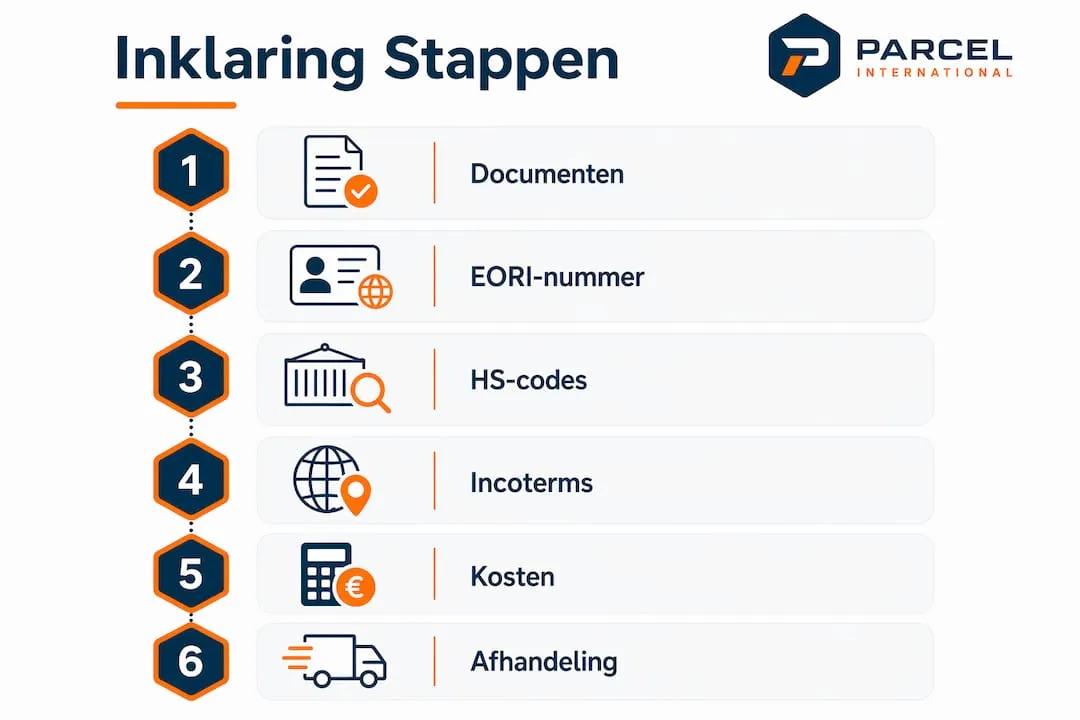
Step-by-Step: How to Handle Customs Clearance
The customs clearance process follows a set sequence. Knowing these steps helps prevent most errors.
- Gather all documents and verify their completeness. Ensure the commercial invoice includes the correct value, description, and quantity. Make sure the packing list matches the invoice. Missing or conflicting information will halt your shipment at customs.
- Apply for your EORI number if you don’t already have one. Without an EORI number, customs cannot process your declaration. The application typically takes one business day. If you already have a VAT number, the process may be faster.
- Determine the correct HS code for your goods. Use the official TARIC database from the European Commission to verify the first six digits. Then, check the full ten-digit TARIC code for the EU. If in doubt, request a Binding Tariff Information.
- Choose the right Incoterm and document your agreements. Agree with your supplier on who will handle customs clearance and who will bear the costs. Document this in writing. Small businesses choosing DDP often underestimate that they are then fully responsible for clearance, duties, and regulatory compliance.
- Submit the customs declaration. Do this yourself via the Dutch Customs system (DMS) or hire a customs broker. A broker knows the local regulations and can help avoid mistakes. For occasional shipments, a broker is almost always the best choice.
- Pay the applicable import duties, VAT, and clearance fees. After approval of the declaration, customs will issue a release notice. Only then can the goods be picked up or transported further.
Pro tip: Always ask your broker for a detailed invoice. This way, you can see exactly what you are paying for import duties, VAT, and the service itself, preventing unexpected surprises.
For a detailed overview of all required customs documents for 2026, you can find a practical checklist at Parcel International.
What Costs Are Involved in Customs Clearance?
The total import costs include import duties, VAT, clearance fees, and additional logistical costs such as storage or unloading fees. Knowing these costs upfront helps avoid underestimating the actual import price.
Overview of Cost Items
- Import duties: a percentage of the customs value, determined by the HS code and country of origin.
- Import VAT: in the Netherlands, 21% (or 9% for certain goods) on the customs value plus import duties plus transport costs.
- Clearance fees: customs broker compensation or administrative fees for self-declaration.
- Storage and demurrage: costs incurred when goods remain too long at the port or airport.
- Additional charges: anti-dumping duties or countervailing duties for specific product categories.
Cost Item | Calculation Basis |
|---|---|
Import Duties | Percentage of the customs value (CIF value) |
VAT on Import | 21% or 9% on customs value + duties + transport |
Customs Clearance Fees (Broker) | Fixed rate or percentage of shipment value |
Storage and Unloading Costs | Per day or per unit, depending on the terminal |
Anti-Dumping Duties | Determined per product category and country of origin |
New rules for e-commerce shipments
From July 1, 2026, the exemption for import duties on e-commerce shipments under €150 within the EU will be abolished. All shipments will then incur a fixed fee of €3 per declaration line plus VAT, unless prepaid at the webshop. This affects anyone who regularly orders or ships small parcels from countries outside the EU. within the EU. All shipments are then subject to a fixed fee of €3 per declaration line plus VAT, unless settled by the webshop. This affects everyone who frequently orders or ships small parcels from countries outside the EU.
Deferring VAT via Article 23
Businesses with a VAT number can defer import VAT to their periodic VAT return using the Article 23 scheme. This significantly improves cash flow, as you do not need to prepay VAT upon import. Prior approval from the Tax Authority is required.
Pro tip: Apply for the Article 23 permit before your first large shipment arrives. The application takes time, and without the permit, you will pay VAT directly to customs, temporarily straining your working capital.
Common customs clearance mistakes and how to avoid them
Most customs clearance issues can be prevented with proper preparation. Below are the most frequent mistakes.
- Incorrect or missing documents. An invoice without a complete description or a packing list that does not match the invoice will immediately halt your shipment. Verify every document before shipping.
- Incorrect HS coding. A wrong code leads to an incorrect tariff, resulting in either overpayment or a subsequent surcharge plus a fine. Always verify the first six digits in the official TARIC database.
- Misunderstandings about Incoterms. Assuming the supplier handles everything under EXW Incoterms can lead to unpleasant surprises upon goods arrival.
- Lack of clarity on the importer of record. Clarity on who the importer of record is prevents disputes and delays at customs. Always document this in writing.
- Not accounting for additional charges. Anti-dumping duties on certain products from China or other countries can significantly increase the import price. Check this in advance via the TARIC database.
“Good communication and clear agreements are often more critical than the choice of transport method for smooth customs clearance. Those who make clear arrangements with suppliers and brokers in advance avoid most issues.”
Pro tip: Save all communication with your broker and supplier in one folder per shipment. If a dispute arises at customs, you will have immediate proof of what was agreed.
For more practical tips on avoiding pitfalls, view the customs handling overview for international shipments from Parcel International.
Key Insights
Customs clearance runs smoothly if you have the correct documents, a valid EORI number, the right HS code, and clear Incoterm agreements in place before the shipment departs.
Point | Details |
|---|---|
Documents in order | Commercial invoice, packing list, and transport document must be complete and accurate before shipping. |
Apply for an EORI number | Without an EORI number, customs will not process your declaration; application typically takes one business day. |
Use the correct HS code | Always verify the TARIC code yourself via the official database to avoid fines and surcharges. |
Document Incoterms in writing | The chosen Incoterm determines who handles and pays for customs clearance; always specify this in the contract. |
Calculate costs in advance | Import duties, VAT, clearance fees, and storage together determine the actual import price. |
Customs clearance in practice: what I always tell importers
In my experience with international logistics, one mistake keeps recurring: people only arrange customs clearance once the goods are already en route. That is too late. By the time a shipment approaches the border, there is no time left to apply for an EORI number or request a missing certificate from the supplier. The clock is ticking, and storage costs accumulate.
What I always advise: start the document check as soon as you place the purchase order. Ask the supplier for the HS code they use and cross-check it with the TARIC database. This takes ten minutes and can save you hundreds of euros in surcharges.
A second point I cannot emphasize enough: choose your Incoterm wisely. Many small business owners opt for DDP because it sounds convenient—the supplier handles everything. However, if something goes wrong with customs clearance in the Netherlands, you, as the importer of record, are still responsible. And then you have no control over the process.
Finally, integrate your customs processes with your accounting. Financial experts highlight the importance of linking accounting software with customs processes for accurate VAT and duty recording. Those who set this up properly always have a real-time view of their actual import costs, enabling better purchasing decisions.
— Pascal
Parcel International helps you with customs clearance
Clearing international shipments requires knowledge of documents, tariffs, and regulations that are constantly changing. Parcel International has been working with shippers in over 220 countries and territories since 2007 and knows the pitfalls of the customs clearance process inside and out.

Whether you want to send a one-time shipment or import regularly, Parcel International assists you with correct documentation, tariff overviews, and choosing the right carrier. Want to know which logistic-documents Everything you absolutely need? Parcel International lists them for you.
Can't find your question? Our support team is here for you 24/7 via the help centre.
What is customs clearance?
Customs clearance is the process by which goods are formally inspected and authorized for entry into or departure from a country. It involves not only the payment of duties but also compliance with regulations and the safeguarding of economic security.
What changes on July 1, 2026, for small shipments?
The exemption for shipments up to €150 has been abolished. Until July 1, 2028, a temporary fixed import duty of €3 per product type applies to shipments from outside the EU to consumers. A handling fee of €2 is expected around November 2026 but is not yet finalized.
Do I need an EORI number for customs clearance?
Yes, an EORI number is mandatory for all customs clearances within the EU. The Dutch Customs Authority typically issues the number within one business day.
What is the average cost of customs clearance?
The costs include import duties, VAT on import, and the fee for the customs agent. The amount of import duties depends on the HS code and the country of origin of the goods.
Can I handle customs clearance myself, or do I need a customs agent?
You can handle customs clearance yourself via the Dutch Customs system, but for occasional or complex shipments, a customs agent is advisable. An agent knows the local regulations and helps avoid costly mistakes.
Get a grip on your parcel shipping
Compare carriers, choose the best price and keep track of your international shipments. You can calculate and book without an account.
