
In short:
- A correctly filled-out address label ensures timely and accurate package delivery.
- It includes essential details such as the full name, address, postal code, and country, following standardized rules.
A properly completed address label guarantees smooth and timely delivery of your package, both domestically and internationally. Shipping labels are more than just a piece of paper with a name on them. Automated sorting systems read each address detail and route packages based on this information to the correct depot. Address errors are one of the main causes of manual interventions in sorting centers, leading to delays and additional costs. The Dutch BAG (Basisregistratie Adressen en Gebouwen) Act requires municipalities to register all residential locations, streets, and house numbers, forming the official basis for correct addressing in the Netherlands. To fill out an address label correctly, follow this standard.
What details should you include on the address label?
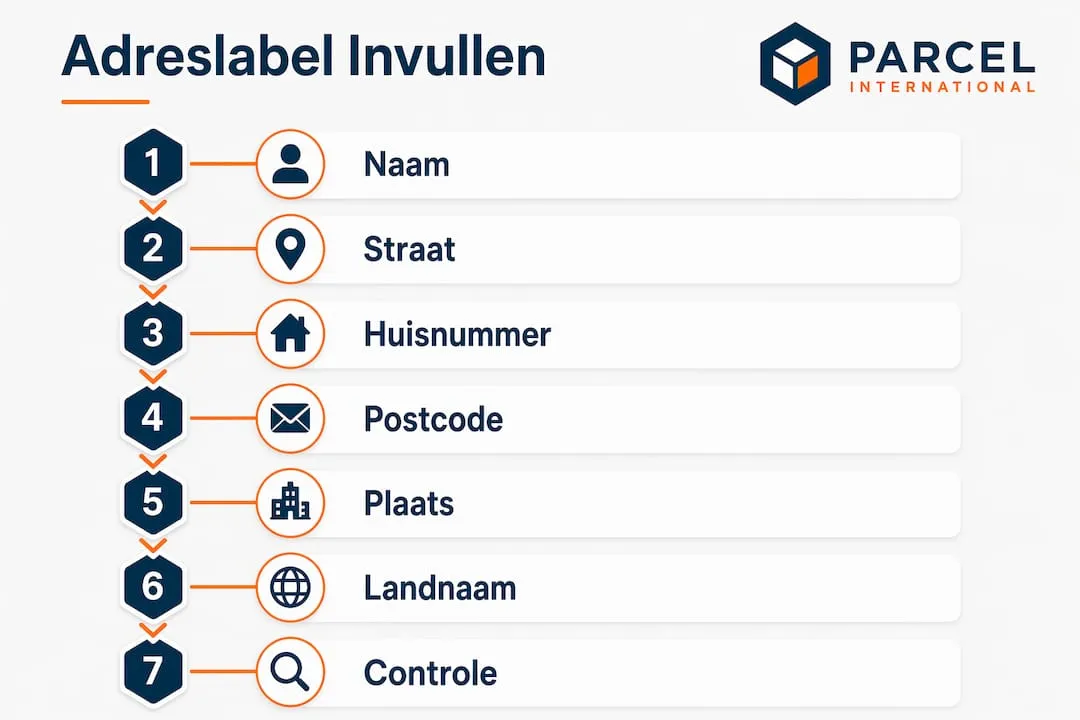
A complete address label always contains the same basic information in a fixed order. This sequence is not arbitrary. Logistics sorting systems process address lines from top to bottom, with each line serving a specific function.
The required details for domestic use are:
- Recipient's full name: write the first and last name in full, without abbreviations. For a business, list the company name on the first line and the contact person's name on the second.
- Street name and house number: write the street name in full. Do not use abbreviations such as “St.” or “Ave.” Place the house number directly after the street name, followed by any additional details like “3A” or “bis.”
- Postal code and city: the Dutch postal code consists of four digits and two letters, followed by exactly two spaces and then the city name in uppercase. Write it as: “1234 AB AMSTERDAM” with two spaces between the letters and the city name.
- Additional information: include an apartment number, floor, or PO box on a separate line, directly below the street name. Never omit this line if the recipient lives in an apartment complex.
Additional rules apply for international shipments. The order of address lines varies by country. In most European countries, the postal code appears before the city name, but in the United Kingdom, the postal code is placed on a separate last line before the country. Always verify the local address format of the destination country.
The recommended order for an international address label is:
- Recipient's name
- Company name (if applicable)
- Street name and house number
- Additional address details (apartment, floor)
- Postal code and city
- Province or state (required in countries like the United States, Canada, and Australia)
- Country name in uppercase
Write the country name at the bottom of the address in uppercase and preferably in English or the language of the country of origin. This is crucial for the initial routing in international sorting systems.
How to fill out the address label practically and legibly?

The legibility of an address label determines whether a sorting machine can process the address automatically or if an employee must enter it manually. Manual processing takes time and increases the risk of errors.
Practical guidelines for a legible label:
- Use a black or blue pen or print the address in a clear, readable font. Avoid italic or decorative fonts.
- Choose a font size of at least 10 points for a printed label. Larger text improves scanning accuracy.
- Avoid special characters in the postal code. Write “1234 AB” instead of “1234-AB.” Hyphens in postal codes cause incorrect sorting because sorting machines recognize spaces, not hyphens.
- Attach the label to the largest and most visible side of the package to ensure it remains scannable and does not come loose during transport.
- Ensure the label does not cover a fold, seam, or tape. A partially obscured label cannot be scanned.
Pro tip: Use a digital address validation tool before printing the label. Such tools verify whether the address is current and complies with national standards, significantly reducing return shipments.
Always double-check the label after attaching it. Ensure all lines are visible and the barcode or QR code is not damaged. A damaged barcode makes automatic processing impossible.
What are the most common mistakes with address labels?
Address errors are avoidable. Most mistakes occur due to haste or unfamiliarity with the rules. Knowing the most common errors helps prevent them.
The five most common mistakes are:
- Hyphen in the postal code: write “1234 AB” and never “1234-AB.” Sorting machines do not recognize the hyphen as a separator.
- City name in lowercase: the city name should be in uppercase. “amsterdam” may not be correctly recognized by some systems. Always write “AMSTERDAM.”
- Missing country name for international shipments: without the country name, the sorting system does not know where to send the package. This is the most costly error in international shipments.
- Outdated or invalid address: an address that no longer exists in the Dutch BAG (Basisregistratie Adressen en Gebouwen) results in a return shipment. Digital address validation tools check addresses for accuracy and compliance with national standards.
- Incomplete additional information: omitting an apartment number or floor means the delivery person does not know which door to use, leading to a failed delivery.
A correctly filled-out address label increases customer satisfaction and reduces shipping costs by minimizing returns and complaints. Customer service and company reputation improve significantly when address errors are reduced.
Proactively verify every address before printing the label. Do not blindly copy the address from an email or spreadsheet without validating it. Small typos, such as a reversed digit in the postal code, are easy to overlook but can significantly impact delivery.
How does address entry differ for international shipments?
International shipments require stricter address label standards than domestic shipments. Each country has its own address format, and foreign sorting systems are not configured to the Dutch standard.
Key considerations for international labels include:
- The country name must always appear on the last line of the label, in uppercase and preferably in English. Write “GERMANY” instead of “Duitsland” when shipping from the Netherlands to Germany.
- Postal code and city formatting vary by country. In Germany, the postal code precedes the city name (“10115 BERLIN”). In the United Kingdom, the postal code appears on a separate line (“SW1A 1AA”).
- Provinces and states are mandatory for countries like the United States (“CA” for California), Canada, and Australia. Do not omit this line, even if it seems unnecessary.
The table below shows address formatting for three common destinations:
Country | Postal code and city format | Province/state required | Country name on label |
|---|---|---|---|
Germany | 10115 BERLIN | No | GERMANY |
United States | NEW YORK, NY 10001 | Yes | UNITED STATES |
United Kingdom | LONDON / SW1A 1AA (on separate lines) | No | UNITED KINGDOM |
Pro tip: Refer to the global addressing guide from Parcel International for precise address formatting per country. This helps avoid routing errors during customs processing.
Customs handling is another reason to ensure the label is error-free. An incomplete or illegible address can lead to customs delays, additional costs, or even package returns. Accurate address labels not only support logistics but are also critical for emergency services relying on precise location data.
Key takeaways
A correct address label requires the full name, street name, house number, properly formatted postal code, city name in uppercase, and for international shipments, the country name in uppercase at the bottom.
Point | Details |
|---|---|
Format postal code correctly | Use four digits, two letters, and two spaces before the city name, without hyphens. |
City name in uppercase | Always write the city name in uppercase so sorting systems can recognize it correctly. |
Country name for international shipments | Include the country name in uppercase and in English as the last line on the label. |
Apply the label to the visible side | Attach the label to the largest flat side of the package, free of folds and tape. |
Validate the address before shipping | Use a digital validation tool to identify outdated or invalid addresses before printing. |
Why an incorrect address label costs more than you think
I frequently see this with individuals and small businesses shipping internationally for the first time: the address label receives the least attention, yet it has the greatest impact. A package returned due to a missing country name incurs not only return shipping costs but also the time to repackage, reprint the label, and resubmit the shipment. Meanwhile, the recipient is already disappointed.
In practice, most errors stem not from ignorance but from haste. People copy an address from an email, paste it onto the label, and assume it’s correct. However, an address in an email isn’t necessarily current or complete. A missing apartment number, a hyphen in the postal code, or a city name in lowercase—these are small details with significant consequences.
My recommendation for small businesses is clear: establish a consistent routine. Digitally validate every address before printing. Use a step-by-step shipping guide as a reference for each new destination. Save sample labels for frequent destinations to avoid looking up the format each time.
The BAG Act provides a standardized foundation for address validation in the Netherlands. Use this as a baseline. Businesses that systematically validate addresses experience fewer returned packages, lower reordering costs, and build a more reliable reputation with their customers.
— Pascal
Parcel International makes correct shipping easier
International shipping starts with a proper address label but doesn’t end there. Parcel International supports individuals and small businesses at every step of the shipping process, from selecting the right carrier to correctly processing address data for over 220 countries and territories.

Through the Parcel International platform, you can compare shipping options, select a carrier, and send packages worldwide without hidden costs. Parcel International has been active since 2007 and offers parcel shipping via carriers such as PostNL, DHL, UPS, and FedEx. Also, review the shipping-label-examples for international shipments to verify your own labels.
Can't find your question? Our support team is here for you 24/7 via the help centre.
How do I ensure the accuracy of my shipping addresses?
Ensure all required address details are provided and implement automated validation tools for real-time address verification. This helps prevent shipping errors.
How should I write the postal code on an address label?
Write the Dutch postal code as four digits, followed by two letters, then two spaces before the city name in uppercase, such as “1234 AB AMSTERDAM”. Do not use hyphens, as sorting machines do not recognize them.
Is the country name required on an international address label?
Yes, the country name is mandatory for international shipments. Write the country name in uppercase as the last line on the label, preferably in English, such as “GERMANY” or “UNITED KINGDOM”.
Where should I place the address label on the package?
Place the label on the largest and most visible side of the package. Ensure the label does not cover any folds or tape to remain scannable during sorting.
What should I do if I make a mistake on the address label?
Remove the incorrect label completely and print a new one. Never place a corrected label over an old one, as scanners may read the wrong address.
Get a grip on your parcel shipping
Compare carriers, choose the best price and keep track of your international shipments. You can calculate and book without an account.
