
In short:
- A shipping document combines the contract, receipt, and customs proof for an international shipment. Correct documentation prevents delays, fines, and the loss of VAT exemption on exports. The right document and accurate details ensure smooth processing and compliance with customs regulations.
A shipping document serves as the contract, receipt, and customs proof for an international shipment in one. Without properly prepared transport documents, you risk border delays, fines, and even the loss of your VAT exemption on exports. Whether you run a small e-commerce business or regularly ship pallets, how you prepare shipping documents largely determines whether your shipment arrives smoothly. This guide explains step by step which documents you need, what information to collect, and which mistakes to avoid at all costs.
How to Create Shipping Documents: Types and Functions
Different transport modes require specific documents: the CMR consignment note for road transport, the Bill of Lading for sea freight, the Air Waybill for air freight, and the CIM consignment note for rail transport. Each document has its own legal framework and function. The choice depends on the mode of transport, destination, and agreed delivery terms.
The difference between a title of possession and a transport document is practically important. A Bill of Lading is a title of possession: whoever holds the original document has the right to the goods. A CMR consignment note or Air Waybill is a transport document without this ownership function. This distinction determines how you manage the document and to whom you transfer it.
In addition to the transport documents themselves, additional documents may be required. A Certificate of Origin is sometimes needed for preferential tariffs when importing into the destination country. For imports into the EU, a mandatory Entry Summary Declaration (ENS) must also be submitted by the carrier before arrival.
Transport Mode | Document | Function | Title of Possession? |
|---|---|---|---|
Road | CMR Consignment Note | Transport and receipt proof | No |
Sea | Bill of Lading (B/L) | Transport and ownership proof | Yes |
Air | Air Waybill (AWB) | Transport and receipt proof | No |
Rail | CIM Consignment Note | Transport and receipt proof | No |
What Information Do You Need for Shipping Documents?
Creating accurate shipping documents starts with gathering the right basic information. If any detail is missing, customs may reject the shipment or delay processing. The following information is always required.
- Name and full address of the sender and recipient, including country and postal code.
- Description of goods: use the official goods description, not an internal product name. Include the number of packages, gross and net weight, and dimensions.
- Date and place of receipt by the carrier and the agreed delivery location.
- Customs instructions: the HS code (commodity code), customs value, and any special handling instructions.
- Freight terms and Incoterms®: Incoterms® determine who is responsible for preparing documents and paying customs fees. Always specify the version, e.g., Incoterms® 2020, and the agreed delivery location.
- Liability agreements: refer to the applicable treaties, such as the CMR Convention for road transport, and note any additional insurance.
Pro tip: Ensure the goods description on the transport document matches the commercial invoice word for word. Even a minor difference, such as “machine” versus “machine part,” can trigger a customs inspection.
For exports outside the EU, an export declaration (EX-A) is also mandatory. The proof of booking for 0% VAT consists of the transport document plus the export declaration and payment receipts. The transport document alone is insufficient as fiscal proof.
How to Prepare a Shipping Document Step by Step
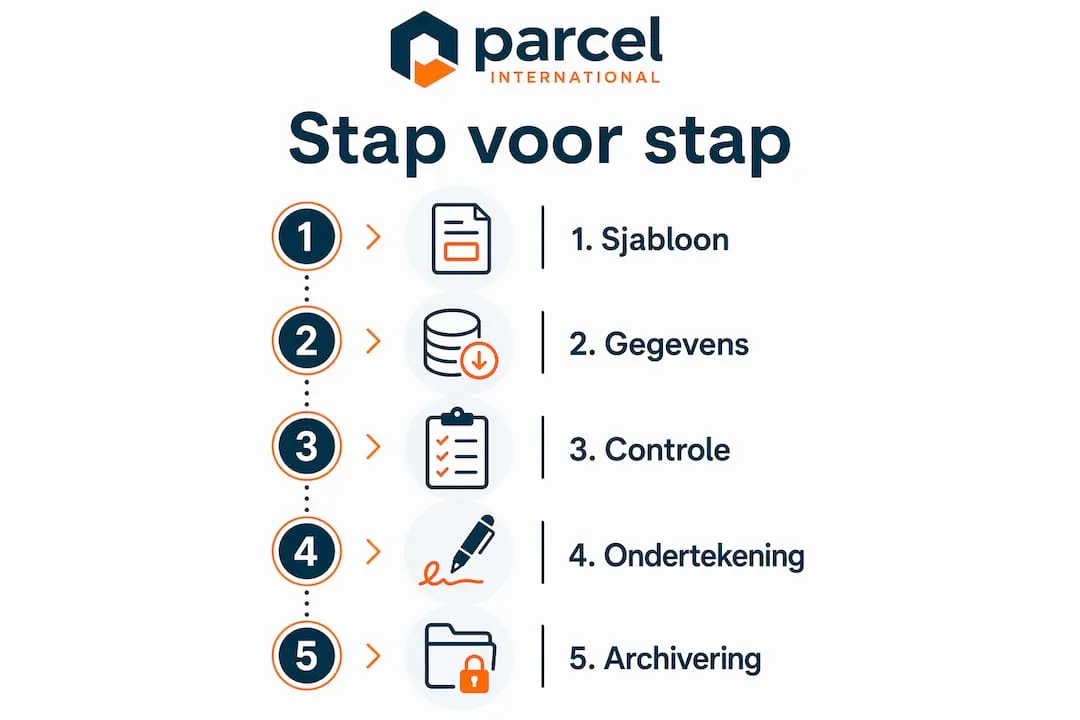
Creating a shipping document correctly requires a standardized approach. The steps below apply to both paper and digital versions.
- Choose the right template. Use an official CMR form, a standard B/L template from the shipping line, or an AWB form from the airline. Self-made formats rarely meet legal requirements.
- Fill in all mandatory fields. Complete the checklist: sender, recipient, goods description, weight, packages, Incoterms®, customs code, and special instructions. Do not leave any field blank; write “not applicable” if a field is truly irrelevant.
- Verify consistency. Information on shipping documents must exactly match the commercial invoice and packing list. Check weights, addresses, and goods descriptions across all three documents simultaneously.
- Consider digital documents. E-CMR and e-AWB are gaining traction and offer practical benefits, such as faster processing and reduced paperwork. However, check whether the destination country accepts digital documents before using them.
- Obtain a signature upon receipt. The recipient signs the shipping document upon delivery. Keep the signed copy as proof of delivery.
- Archive all documents. Invoices and shipping documents must be retained for at least 3 years in accordance with EU customs regulations; the tax authority requires a retention period of 7 years. Store digital copies in a secure system.
Step | Action | Key Consideration |
|---|---|---|
1. Template | Choose an official form | No self-made formats |
2. Fill in | All mandatory fields | No blank fields |
3. Verify | Compare with invoice and packing list | Exact wording matters |
4. Digital | Consider E-CMR or e-AWB | Check country acceptance |
5. Sign | Recipient signs upon delivery | Keep signed copy |
6. Archive | Retain for at least 3 years | Digital and secure |
Pro tip: Use a logistics documents checklist for each shipment. This ensures you never miss a mandatory field and saves time for repeated shipments to the same country.

Which Mistakes Should You Avoid with Shipping Documents?
Errors in transport documents cost time and money. The most common issues can be prevented with proper preparation.
- Inconsistent data. Discrepancies in weights, addresses, or descriptions of goods between the transport document, invoice, and packing list will almost certainly lead to a customs inspection. Verify all three documents side by side.
- Missing original Bill of Lading. Some non-EU countries require an original B/L for customs clearance. Angola, Brazil, and Argentina are well-known examples. An electronic version will be rejected, potentially delaying the shipment by weeks.
- Unclear Incoterms®. Who prepares the documents and who pays the customs costs must be contractually defined via Incoterms®. Without this agreement, disputes over liability for damage or delays may arise.
- Submitting too late. The ENS declaration for EU imports has mode-specific deadlines. Late submission results in fines and possible shipment refusal.
- Not retaining documents. Discarding transport documents after delivery leaves you without proof in case of a tax audit or dispute with the carrier.
“The sender is ultimately responsible for the accuracy of customs data on the waybill. Errors can lead to fines and delays.” This is explicitly stated by the Dutch Human Environment and Transport Inspectorate (ILT) . This responsibility does not shift to the carrier, even if they complete the document.
A practical consideration for the logistics sector: ensure everyone involved in preparing documents uses the same templates and procedures. Inconsistency among employees is an underestimated cause of errors.
Key Insights
Accurate transport documents require the correct document per transport mode, exact consistency across all related documents, and a retention period of at least 3 years in accordance with EU customs regulations.
Point | Details |
|---|---|
Document per mode | Choose CMR, B/L, AWB, or CIM based on the transport method and destination. |
Maintain data consistency | Weights and descriptions must match exactly on the invoice, packing list, and transport document. |
Define Incoterms® | Contractually establish document responsibility and customs costs using Incoterms® 2020. |
Monitor original B/L | Check per destination country whether an original paper copy is required. |
Comply with retention requirements | Retain all transport documents for at least 3 years for tax and customs audits. |
What I’ve learned about documentation after years in logistics
After years of working with international shipments, my most honest advice is this: most customs issues arise not from complex regulations, but from carelessness in communication between sender, carrier, and recipient. Everyone assumes someone else has checked. No one has.
What I consistently see overlooked is the step between filling out and verifying. Completing a document takes five minutes. Comparing it with the commercial invoice and packing list takes another five. People skip this second step because they assume it’s correct. That’s precisely when a weight of 120 kg appears on the waybill and 102 kg on the invoice.
Digital documents like e-CMR speed up the process, but they don’t solve the human problem. The data still needs to be accurate. What digitalization does is make it easier to reuse templates and copy errors from previous shipments. Therefore, even for repeated shipments, verify each field again.
My practical recommendation: assign one person per shipment who is ultimately responsible for the documentation. Not a team, not “everyone.” One person who signs off on the accuracy of all documents before the truck departs. It sounds simple, but it makes a noticeable difference.
— Pascal
Parcelinternational makes international shipping simpler
Preparing transport documents correctly is one part of the process. The other is finding a reliable partner who handles your shipment properly. Parcelinternational has been active since 2007 and manages shipments to over 220 countries and territories.

With Parcelinternational, you can compare shipping options, select the right carrier, and send packages worldwide without hidden costs. For those who want to get started quickly, Parcelinternational also offers practical shipping tips per transport method. Calculate your shipping costs directly on our platform.
Can't find your question? Our support team is here for you 24/7 via the help centre.
What is the meaning of a transport document?
A transport document is the official proof of the agreement between the shipper and carrier. It confirms that the goods have been received and outlines the transport conditions.
Which document is used for sea freight?
For sea freight, use a Bill of Lading. This document also serves as a title of ownership: whoever holds the original has the right to the goods upon arrival.
How long should you retain transport documents?
Transport documents must be retained for at least 3 years in accordance with EU customs regulations. For tax purposes, such as proving 0% VAT on exports, you also need the export declaration and payment receipts.
Are digital transport documents valid everywhere?
E-CMR and e-AWB are accepted in many countries, but not all. Some countries, such as Angola, Brazil, and Argentina, still require an original paper Bill of Lading for clearance.
Who is responsible for errors in the waybill?
The shipper is ultimately responsible for the accuracy of the customs data on the waybill. Errors lead to fines and delays, even if the carrier actually completed the document.
Get a grip on your parcel shipping
Compare carriers, choose the best price and keep track of your international shipments. You can calculate and book without an account.
