
TL;DR:
- Incoterms® 2020 are international rules that define responsibilities and risks in transport between seller and buyer. Specifying the correct abbreviation, exact location, and version in contracts prevents legal disputes and ambiguities. The appropriate Incoterms depend on the transport type and the desired distribution of risk and costs.
Incoterms® are international delivery terms that determine who is responsible for transport, risk, and costs at each point in the supply chain. The International Chamber of Commerce (ICC) publishes these rules, with Incoterms® 2020 being the current version. Correct application of Incoterms prevents legal disputes, unclear cost claims, and customs delays. To ensure clarity, every contract must specify three elements: the exact Incoterm abbreviation, the precise delivery location, and the version. While this may seem straightforward, practice shows that errors are consistently made in these areas.
How to Apply Incoterms: Preparation and Required Elements
Before including Incoterms in documents, understand what they do and do not cover. Incoterms® 2020 define responsibilities and risks between seller and buyer. They do not regulate when ownership transfers or how payment occurs. These aspects belong in separate contract provisions. This distinction is crucial: confusing Incoterms with ownership transfer can lead to contracts built on incorrect assumptions.
The three mandatory elements for every application are:
- The official abbreviation: always use the recognized ICC abbreviation such as FCA, DAP, DDP, or CIF. Self-invented variants have no legal basis.
- The exact delivery location: not “Rotterdam” but “Wilhelminakade 909, Rotterdam, Netherlands”. The location specification is the most critical factor in determining the risk transfer point.
- The version: always write “Incoterms® 2020” to avoid confusion with older versions.
The distinction between transport modes is a second critical preparation point. Sea-specific Incoterms such as FOB, CFR, CIF, and FAS are only suitable for maritime transport without containerization. For container transport, road transport, air freight, or combined transport routes, use the “any-mode” terms: EXW, FCA, CPT, CIP, DAP, DPU, or DDP. This is not a preference but a functional requirement.
The documents you need before application include the purchase contract or quotation, general terms and conditions, commercial invoice, and any Letter of Credit instructions. Ensure your customs department or external customs agent knows which Incoterm you are using, as the chosen Incoterm directly affects who is responsible for customs formalities and documentation for export and import.

Pro tip: Create an internal checklist per shipment with the three mandatory elements (abbreviation, location, version) and link it to your ERP system to ensure no document leaves without the correct Incoterm specification.
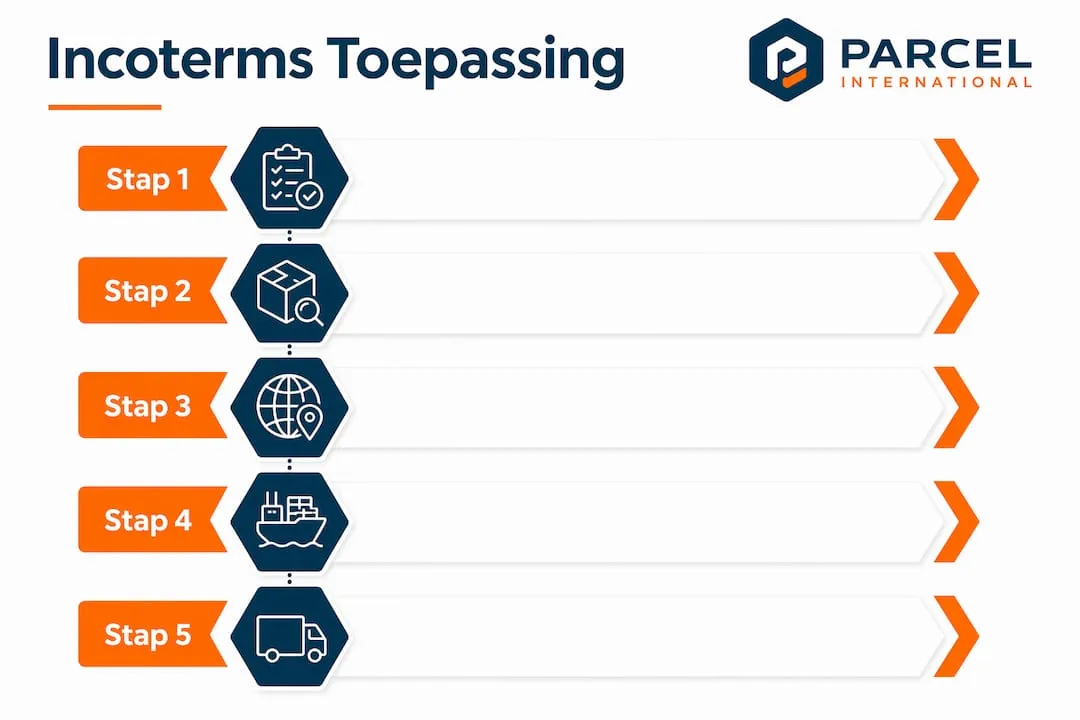
Step-by-Step: Incorporating Incoterms into Contracts and Processes
Correctly incorporating Incoterms begins with selecting the right term based on the transport type and the desired distribution of responsibilities. This is followed by documenting them and integrating them into your operational processes.
Step 1: Select the Right Incoterm
First, determine who will bear which responsibilities. A seller who wants to handle everything up to the buyer’s door chooses DDP. A seller who only makes goods available at their own warehouse chooses EXW. Everything in between requires a conscious assessment of risk, costs, and operational capacity.
Step 2: Formulate Correctly in the Contract
The standard formulation according to Maak Advocaten is: “FCA Industrieweg 12, Eindhoven, Netherlands, Incoterms® 2020”. Use this structure in every document: purchase contract, quotation, general terms and conditions, and commercial invoice. Inconsistency between documents is a common cause of claims.Step 3: Integrate into ERP and Documentation
Configure your ERP system (SAP, Oracle, Microsoft Dynamics, or similar) to make Incoterm fields mandatory when creating a sales order. Link the Incoterm to the associated document flow: commercial invoice, packing list, bill of lading, and certificate of origin.
Step 4: Coordinate with Carriers
Always provide your carrier with the full Incoterm formulation. For FCA, the carrier must know that risk transfers when goods are handed over at the specified location. For DAP or DDP, the carrier knows the seller remains responsible until the destination.
Step 5: Communicate Risk and Cost Transfer Internally
Ensure sales, logistics, finance, and customs all use the same Incoterm definition. A sales team promising DAP while the logistics department expects FCA creates internal chaos and external claims.
The following table provides an overview of the most commonly used Incoterms and their application:
Incoterm
Transport Mode | Risk Transfer from Seller at… | EXW |
|---|---|---|
All modes | Pickup at seller’s location | FCA |
All modes | Handover to carrier at named location | CPT |
All modes | Handover to first carrier | CIP |
All modes | Handover to first carrier (including insurance) | DAP |
All modes | Arrival at destination, before unloading | DPU |
All modes | Arrival at destination, after unloading | DDP |
All modes | Arrival at destination, including customs clearance | FOB |
Sea only | On board the ship at port of shipment | CIF |
Sea only | On board the ship (including insurance) | Pro tip: |
Include a standard Incoterm in your general terms and conditions for orders where the buyer does not specify a preference. This prevents accidentally delivering under EXW when the buyer expects DAP. Common Mistakes When Applying Incoterms
The most costly mistakes in applying Incoterms are systematic and recurring. They do not stem from unwillingness but from insufficient knowledge of the details.
The five most common mistakes are:
The five most common errors are:
- Inaccurate Location Specification: “Rotterdam” as a delivery location is insufficient. An inaccurate location specification causes issues during claims because it determines when risk and costs transfer. Always use a full address or a specific terminal.
- Maritime Terms in Container Shipping: FOB and CIF are still used for container shipments, even though they are operationally ineffective. In container shipping, risk transfers under FOB when the container is loaded on board, but the carrier already has control over the container earlier. FCA resolves this.
- Missing Version Reference: A contract that only states “FOB Rotterdam” without a version year can be interpreted based on Incoterms® 2010 or even older versions, leading to ambiguity.
- Inconsistency Across Documents: The quote states DAP, the invoice states FOB, and the bill of lading states nothing. Under a Letter of Credit, this is grounds for immediate rejection by the bank.
- Using Incoterms as a Substitute for Full Contract Agreements: Incoterms do not regulate when ownership transfers or payment terms. Those who assume an Incoterm covers the entire contract miss critical protections.
“The greatest practical benefit of Incoterms is that they provide clarity upfront and prevent disputes during transport.” Sonja van Hall, Jurimpex, via KVK
The solution to all these errors is procedural. Implement a standard documentation protocol where every shipment undergoes a mandatory Incoterms check before documents are sent. Integrate this into your quality process, not the goodwill of individual employees.
Which Incoterm Fits Your Logistics Situation?
The choice of the right Incoterm depends on four factors: transport mode, desired risk allocation, customs capacity, and the relationship with your trading partner. Systematically reviewing these four factors leads to an informed decision.
Scenario | Recommended Incoterm | Reason |
|---|---|---|
Container shipping, seller handles everything | DDP or DAP | Seller retains control until destination |
Container shipping, buyer handles transport | FCA | Risk transfers at a logical point during carrier handover |
Air freight, shared responsibility | CPT or CIP | Seller arranges transport, risk transfers upon handover |
Bulk goods by sea, no container | FOB or CFR | Suitable for maritime transport without containerization |
Road transport within Europe | DAP or FCA | Flexible and suitable for all modes |
Under DDP, the seller bears maximum responsibility, including customs clearance and payment of import duties. This is attractive to buyers but requires sellers to have a strong customs infrastructure in the destination country. Those without this infrastructure are better off choosing DAP, where the buyer handles customs clearance.
For multimodal transport, a strict rule applies: always use “any-mode” Incoterms such as FCA and CIP to prevent risks and costs from transferring at illogical moments. A container traveling from Eindhoven via Rotterdam to Shanghai passes through multiple transport modes. FOB does not work well here because risk only transfers when the container is loaded on the ship, even though the seller no longer has control over the container.
The impact on insurance is an underestimated aspect. Under CIP, the seller is required to take out insurance that meets the ICC A clause, the most comprehensive coverage. Under CIF, the minimum ICC C clause applies. This difference can have significant financial consequences in the event of damage.
Pro tip: Always discuss the Incoterm choice with your logistics service provider before issuing a quote. An international shipping method that you do not master can cost you more than the margin on the order.
Key Insights
The correct application of Incoterms® 2020 requires three elements in every document: the official abbreviation, an exact delivery location, and the version reference.
Point | Details |
|---|---|
Three Mandatory Elements | Always include the abbreviation, exact location, and version (Incoterms® 2020) in every document. |
Transport Mode Determines the Choice | Use “any-mode” terms for container and multimodal transport; maritime terms only for bulk shipping. |
Location Is Legally Critical | A vague address causes claims; always use a full address or a specific terminal. |
Incoterms Do Not Replace a Full Contract | Ownership transfer and payment terms fall outside Incoterms and must be specified separately. |
Consistency Across All Documents | The quote, invoice, bill of lading, and general terms and conditions must all state the same Incoterm. |
What I’ve Learned from Years of Working with Incoterms
After years in international logistics, one thing stands out: most Incoterms issues do not arise with large, complex shipments. They occur with routine shipments where no one pays attention to the details anymore.
A seller who has been delivering DAP to a regular customer in Germany for years eventually stops explicitly stating the version in their invoices. Then, when damage occurs during transport and the buyer invokes a different interpretation of the risk transfer moment, it turns out that “DAP Hamburg” without a version year is legally ambiguous.
What I see working in practice: organizations that treat Incoterms as a compliance issue, not a sales condition. This means the logistics department, customs department, and sales team all use the same definition, and this is embedded in processes, not the knowledge of one individual.
The role of customs is consistently underestimated. Those who do not consider customs formalities in the Incoterm choice run into problems with DDP deliveries outside the EU. I always advise checking first whether you, as the seller, can even act as the importer of record in new destination countries.
Training is not a luxury. A half-day internal training session per year, focused on employees who work with Incoterms daily, prevents more issues than a legal procedure afterward. The explanation of international Incoterms doesn't need to be complicated, but it must be concrete and repeatable.
— Pascal
Ship internationally without the hassle of responsibility disputes
Applying Incoterms correctly is one part of the puzzle. The other part is having a logistics partner who knows how to handle those agreements in practice.

Parcel International has been handling international shipments to over 220 countries and territories since 2007. The platform lets you compare carriers, manage documents, and track shipments without extra fees per transaction. For businesses that ship internationally on a regular basis, this means less administrative burden and more certainty about who handles what. Want to learn how to prevent delays in international shipments through smart logistics choices? Parcel International explains it.
Can't find your question? Our support team is here for you 24/7 via the help centre.
What are Incoterms® 2020?
Incoterms® 2020 are international delivery terms published by the ICC that define who is responsible for transport, risk, and costs between seller and buyer. They do not regulate transfer of ownership or payment agreements.
How do you correctly specify Incoterms in a contract?
Always use the official abbreviation, an exact delivery location, and the version, for example: “FCA Industrieweg 12, Eindhoven, Netherlands, Incoterms® 2020”. An incomplete specification can lead to legal ambiguity in claims.
Which Incoterm is best for container transport?
For container transport, use “any-mode” Incoterms such as FCA, DAP, or CIP. Sea-specific terms like FOB and CIF are unsuitable for container shipments because the risk transfer moment does not align with the actual logistics reality.
What is the difference between DAP and DDP?
Under DAP, the buyer arranges customs clearance and pays import duties. Under DDP, the seller assumes all responsibility, including customs clearance and duties in the destination country. DDP requires the seller to have customs infrastructure in the destination country.
Why is the delivery location so important in Incoterms?
The delivery location precisely determines where risk and costs transfer from seller to buyer. A vague location, such as only a city name, allows for interpretation and can lead to costly claims in case of damage or delay.
Get a grip on your parcel shipping
Compare carriers, choose the best price and keep track of your international shipments. You can calculate and book without an account.
