
TL;DR:
- Customs documents are essential papers for the legal and secure transport of goods across international borders. Properly completing and retaining documents such as commercial invoices, packing lists, and transport documents prevents delays and fines. For complex shipments or special regulations, engaging a customs broker is recommended.
Customs documents are the official papers required to transport goods legally and securely across international borders. Without correct documentation, you risk delays, fines, or even seizure of your shipment. Whether you're sending a package to the United States, China, or a neighboring country outside the EU, the rules always apply. This guide to customs documentation explains which documents you need, how to complete them correctly, and which mistakes to avoid. Think of documents like the commercial invoice, packing list, CMR waybill, and electronic export declaration.
What Types of Customs Documents Are There?
Customs documents fall into several fixed categories, each with its own role in the export and import process. Understanding this structure helps reduce errors and significantly speeds up customs clearance.

Commercial Invoice and Packing List
The commercial invoice is the most commonly used document for international shipments. It includes the value of the goods, the names of the buyer and seller, and a description of the contents. The packing list complements this with weights, dimensions, and packaging details per item. Together, they form the basis for every customs inspection.
Transport Documents
For road transport, the CMR waybill is the standard document. The mandatory fields on the CMR include the sender, recipient, goods description, and signatures of all involved parties. For air freight, you use an Air Waybill (AWB), and for sea freight, a Bill of Lading (B/L). Each transport type has its own document, and submitting the wrong one directly leads to delays.
Certificate of Origin and Export Certificates
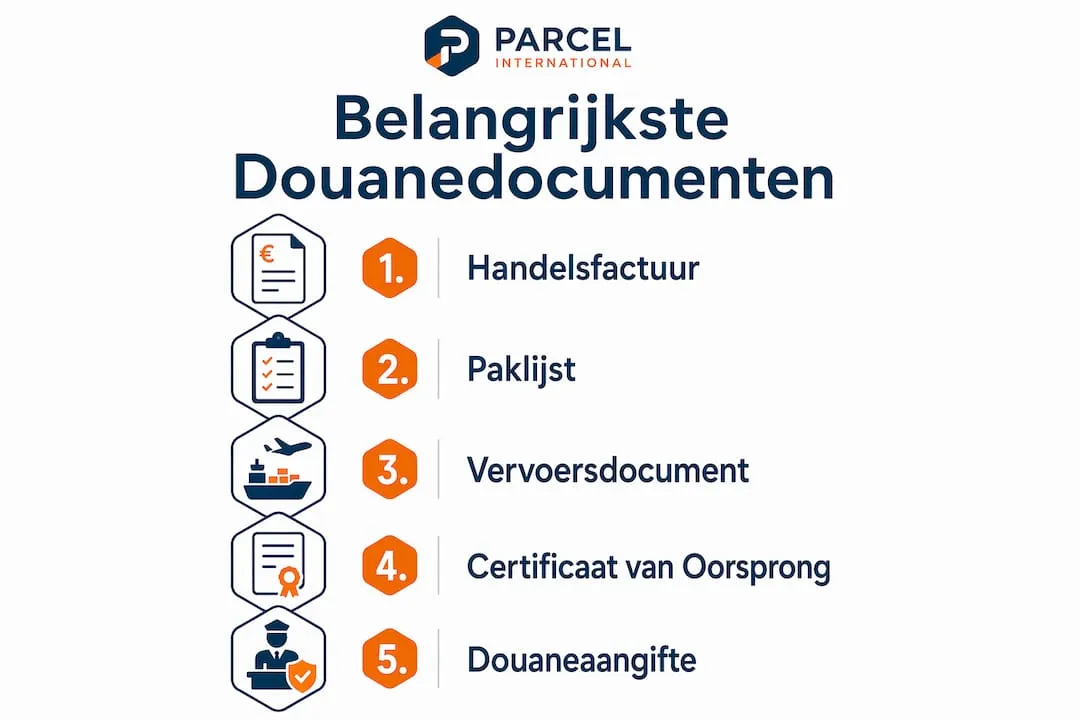
The certificate of origin proves in which country the goods were produced. This document partly determines which tariff applies upon import into the destination country. Some trade agreements, such as those between the EU and Canada (CETA), require a specific proof of origin to benefit from reduced import duties.
Customs Declaration and Electronic Export Declaration
For exports outside the EU, an electronic export declaration is mandatory, along with the commercial invoice, packing list, and transport documents. In the Netherlands, this is processed via the Customs' AGS (Declaration System). Other EU countries use similar national systems, but the underlying EU regulations are the same everywhere.
Specific Documents: T2, CN22, and CBAM
The T2 document proves the EU status of goods when transported via non-EU countries, so you don’t pay import duties upon return. The CN22 form is used for small postal packages outside the EU, with a simplified goods description and value declaration. From 2026, the CBAM declaration (Carbon Border Adjustment Mechanism) will apply to certain product categories, introducing a new environmental levy on the import of carbon-intensive goods.
Pro Tip: Create a fixed template for your commercial invoice with all mandatory fields pre-filled. This saves time and reduces the chance of errors for every new shipment.
How to Submit Customs Documents Correctly
Submitting customs documents correctly is a process with fixed steps. Knowing this process helps avoid the most common delays.
- Check which documents are required. Requirements vary by destination country and product type. Use the instructions for international shipments as a starting point to ensure nothing is overlooked.
- Complete all documents fully and accurately. Ensure the value on the commercial invoice matches the actual transaction value. The customs value is the product price including transport and insurance costs up to the EU border. Underdeclaring leads to additional charges.
- Submit the export declaration via the national system. In the Netherlands, this is AGS; in Belgium, it’s PLDA. Electronic systems vary by EU country, but the substantive requirements are based on the same EU legislation. Make sure you have access to the correct system before exporting.
- Attach all supporting documents. Include the certificate of origin, any permits, and for dual-use goods, the required export certificates. Missing attachments are a common cause of delays at the border.
- Retain all documents after clearance. Customs documents must be kept for at least 3 years for potential inspections, and sometimes longer based on national regulations. This applies to invoices, packing lists, and export declarations.
Pro Tip: Save digital copies in cloud storage like Google Drive or Microsoft OneDrive, organized by shipment and date. This ensures you’re always prepared for a customs inspection, even years later.
For exports within the EU, customs documents are generally not required, as the internal market guarantees the free movement of goods. However, there are exceptions: when transporting via non-EU countries or in special areas like the Canary Islands or Ceuta and Melilla, additional rules apply. Also, review the customs-forms-explanation for a practical guide per document type.
What Are the Most Common Pitfalls in Customs Documentation?
Errors in customs documents cost time and money. The most common issues can be easily avoided if you know where they originate.
- Incorrect HS Code. The Harmonized System code (HS code) determines the tariff and regulations applicable to your product. An incorrect code leads to wrong import duties and potential fines. Import duties vary by product and depend on the HS code. Always verify the code via the official EU tariff classification on the European Commission’s website.
- Unclear Task Division. Who is responsible for customs clearance: the exporter or the importer? Responsibilities for documents and clearance must be contractually agreed. Insufficient coordination is a frequent cause of shipment issues. Specify this in your sales contract or through the Incoterms you use.
- Incomplete or contradictory documents. If the value on the commercial invoice does not match the packing list, or if the goods description is vague, customs will hold the shipment. Customs may detain shipments in case of doubt, and in complex cases, engaging a customs broker is the most sensible step.
- Missing permits for VGEM products. When exporting products subject to safety, health, and environmental regulations, additional export documents such as permits are mandatory. Consider phytosanitary certificates for plant-based products or export licenses for dual-use goods.
- Submitting too late. The export declaration must be submitted before the goods leave EU territory. Failing to do so or submitting it late risks the shipment being held at the border.
Trade lawyers always recommend engaging a customs broker for complex or high-risk shipments. This prevents additional charges and fines through correct classification of goods.
How to adjust documents for special situations?
Not every shipment is standard. Some routes, product types, and regulations require extra attention and additional documents.
Situation | Required document or action |
|---|---|
Transport via non-EU country | T2 document to prove EU status of goods |
Import of carbon-intensive goods (CBAM) | CBAM declaration mandatory for over 50 tons per year from 2026 |
Export of VGEM products | Phytosanitary certificate, export license, or other sector-specific document |
Small postal parcels outside the EU | CN22 form with value declaration and goods description |
Trade via special EU territories | Additional customs formalities, depending on the territory |
For customs documents within the EU, there are several exceptions where documentation is still required, such as transport via non-EU countries or special territories. This surprises many shippers who assume trade within the EU is always free of customs formalities.
The CBAM regulation is a good example of how environmental legislation directly impacts customs documentation. For imports of products like steel, aluminum, cement, and electricity from outside the EU, authorization requirements apply from 2026. This means importers must submit a CBAM declaration and purchase emission allowances. Failure to comply in time risks high fines.
Always coordinate in advance with your importer about who performs which tasks. The European Commission emphasizes that task distribution must be contractually agreed to prevent issues. Use Incoterms such as DDP (Delivered Duty Paid) or DAP (Delivered At Place) to clearly define responsibilities.
For a complete overview of the rules per shipping route, the import and export guide from Parcel International provides a practical starting point.
Key insights
Correct customs documentation requires the right documents, clear task distribution between exporter and importer, and a retention period of at least three years.
Point | Details |
|---|---|
Mandatory basic documents | Commercial invoice, packing list, and transport document are usually required for business exports outside the EU; for small parcels, a CN22/CN23 with invoice is often sufficient. |
Electronic export declaration | Submit the declaration via the national system before goods leave EU territory. |
Three-year retention obligation | Keep all customs documents for at least three years for possible inspections by the tax authority or customs. |
Define task distribution | Contractually specify who is responsible for customs clearance, preferably using Incoterms. |
Special situations require extra documents | CBAM, VGEM products, and transport via non-EU countries require additional certificates or declarations. |
What I’ve learned after years of shipping about customs documents
After years of working with international shipments to over 220 countries, my most honest advice is this: most customs issues are not a matter of bad luck, but of preparation.
What I see time and again is that shippers treat the commercial invoice as an afterthought. They enter a value that “roughly matches” or use a vague description like “gift” or “sample” to avoid import duties. That no longer works. Customs authorities worldwide use increasingly advanced risk profiling, and an unclear invoice immediately draws attention.
What does work: a strict template per product category, a fixed checklist per destination country, and a clear agreement with your importer about who handles customs clearance. I’ve seen shipments worth thousands of euros held up for weeks because no one had considered who would pay the import duties.
My advice for anyone who regularly ships internationally: invest once in a conversation with a customs broker. Not because you can’t do it yourself, but because the rules change per country, product type, and year. The CBAM regulation in 2026 is a good example of this. Those who don’t keep up will pay the price—literally.
The role of customs in shipments is underestimated by many shippers until something goes wrong. Make sure you know the rules before you ship, not after.
— Pascal
Shipping international parcels? Parcel International helps you move forward
Parcel International has been guiding shippers since 2007 with international shipments to over 220 countries and territories. Whether you’re sending a one-time parcel or exporting regularly, the platform makes it easy to compare shipping services and choose the right carrier.

For those who want to prepare their documentation properly, Parcel International offers a practical international logistics checklist that guides you step-by-step through the process. From commercial invoices to export declarations: everything is clearly organized in one place.
Can't find your question? Our support team is here for you 24/7 via the help centre.
What are customs documents exactly?
Customs documents are official papers required to legally transport goods across international borders. The most commonly used are the commercial invoice, packing list, transport document, and electronic export declaration.
Which documents do I need for exports outside the EU?
For exports outside the EU, an electronic export declaration, commercial invoice, packing list, and transport document are mandatory. Depending on the product, a certificate of origin or additional permits may also be required.
How long should I retain customs documents?
Customs documents must be retained for at least three years after clearance, including invoices, packing lists, and export declarations. National regulations may require a longer retention period.
What is an HS code, and why is it so important?
An HS code is an internationally standardized product code that determines the applicable import duties and regulations for a good. An incorrect HS code results in wrong tariffs and potential fines during inspections.
When do I need a customs broker?
A customs broker is recommended for complex shipments, high-value goods, or products with special regulations, such as dual-use items or CBAM goods. A broker helps prevent classification errors and saves time during clearance.
Get a grip on your parcel shipping
Compare carriers, choose the best price and keep track of your international shipments. You can calculate and book without an account.
