
Shipping internationally from the Netherlands presents recurring challenges for many e-commerce businesses. A small error on a customs form can directly result in fines or delays. That’s why gathering and accurately completing all shipping and product information is crucial for seamless delivery. In this article, you’ll discover what to watch for so your package clears customs effortlessly—and you avoid costly stress.

Quick Summary
- 1. Gathering Shipping InformationEnsure accurate product descriptions, commodity codes, value, and origin to prevent customs issues.
- 2. Choosing the Right Customs FormsSelect the correct form (CN22 or CN23) based on shipment value and type to avoid delays.
- 3. Accurately Completing FormsFill in all details carefully, verify legibility and accuracy to prevent customs problems.
- 4. Verifying AccuracyCross-check all entered information with your documents to prevent delays or returns.
- 5. Properly Attaching the FormSecure the customs form to the outside of your package with protection to avoid confusion at customs.
Step 1: Gather Required Shipping and Product Information
For international shipments, collecting accurate product and shipping information is critical for smooth customs clearance. Proper documentation prevents delays and potential fines.
Gather the following essential details for your international shipment:
- Product Description: Detailed description of the goods
- Commodity Code: Specific classification code for your product
- Total Shipment Value: Exact value of the shipped products
- Weight and Dimensions: Precise physical specifications
- Country of Origin: Location where the products were manufactured
Especially for e-commerce businesses, it is essential to accurately record customs information. Correctly gathering this data prevents potential delays or financial risks.
For some products, additional documents such as import permits or specific certificates are required. Always check the specific requirements for your destination country to avoid surprises.
__Pro Tip:__ Save digital copies of all your documentation and gather this information well in advance to avoid last-minute stress.
Step 2: Select the Correct Customs Form for Your Shipment
When shipping internationally, choosing the correct customs form is essential for smooth processing. Different shipments require specific forms to ensure seamless customs procedures.
The two most common customs forms are:
- CN22: Suitable for small postal packages with low value
- CN23: Required for larger shipments and commercial packages
Customs Declarations CN22 and CN23 have specific applications depending on shipment characteristics. Choose carefully to avoid delays.
Consider the following selection criteria for your customs form:
- Determine the total shipment value
- Measure the weight of your package
- Identify the type of shipment (personal or commercial)
- Check specific country requirements
For commercial shipments, the CN23 form is mandatory, while personal shipments with low value can typically use the CN22 form.
Below is an overview of the most common customs forms and their specific applications:
Form | Audience | Maximum Value | Key Application |
|---|---|---|---|
CN22 | Individuals, small businesses | Up to 300 SDR | Use for low-value shipments |
CN23 | Commercial, business shipments | Above 300 SDR | Required for large or business packages |
Import Permit | Specific product categories | Product-dependent | Required for restricted goods |
Certificate of Origin | All shipments | N/A | Required for some countries/regions |
__Pro Tip:__ Always keep blank forms on hand and save digital copies to prepare for different shipping scenarios.

Step 3: Accurately Complete the Required Information
Correctly filling out customs forms is crucial for smooth international shipping. A single mistake can lead to delays, additional costs, or even the return of your package.
Carefully gather all necessary information in advance for accurate completion:
- Full Product Description: Provide a detailed description of the contents
- Exact Value Calculation: State the precise value of the goods
- Country of Origin: Specify where the product was manufactured
- Quantity and Weight: Note the exact specifications accurately
- Harmonized System Code: Use the correct commodity classification
Practical Customs Clearance Tips highlight the importance of accuracy when completing international documents.
Pay attention to these critical details when filling out forms:
- Use blue or black ink
- Write legibly without cross-outs
- Verify all information before submitting the form
- Provide a clear signature
Note: Incomplete or incorrect information may result in delays or the return of your shipment.
__Pro Tip:__ Always make a copy of your completed customs form and keep it with your shipping records for documentation.
Step 4: Verify Data for Accuracy and Completeness
Carefully reviewing your customs forms is the final critical step before sending your international shipment. Errors can lead to costly delays or even the return of your package.
Use this detailed verification method to ensure the accuracy of your information:
- Personal Information: Check name, address, and contact details
- Shipping Details: Verify sender and recipient information
- Product Information: Confirm description, quantity, and value
- Document Numbers: Check EORI number and other identification codes
Customs Information and Legal Requirements emphasize the importance of complete and accurate documentation.
For a thorough review, we recommend the following steps:
- Carefully read each field twice
- Compare the data with your original documents
- Use a second person as an additional verification method
- Create a digital copy for reference
Note: Even minor typos can lead to significant delays in your international shipment.
__Pro tip:__ Create a personal checklist with the most common verification points and systematically review it before submitting your forms.
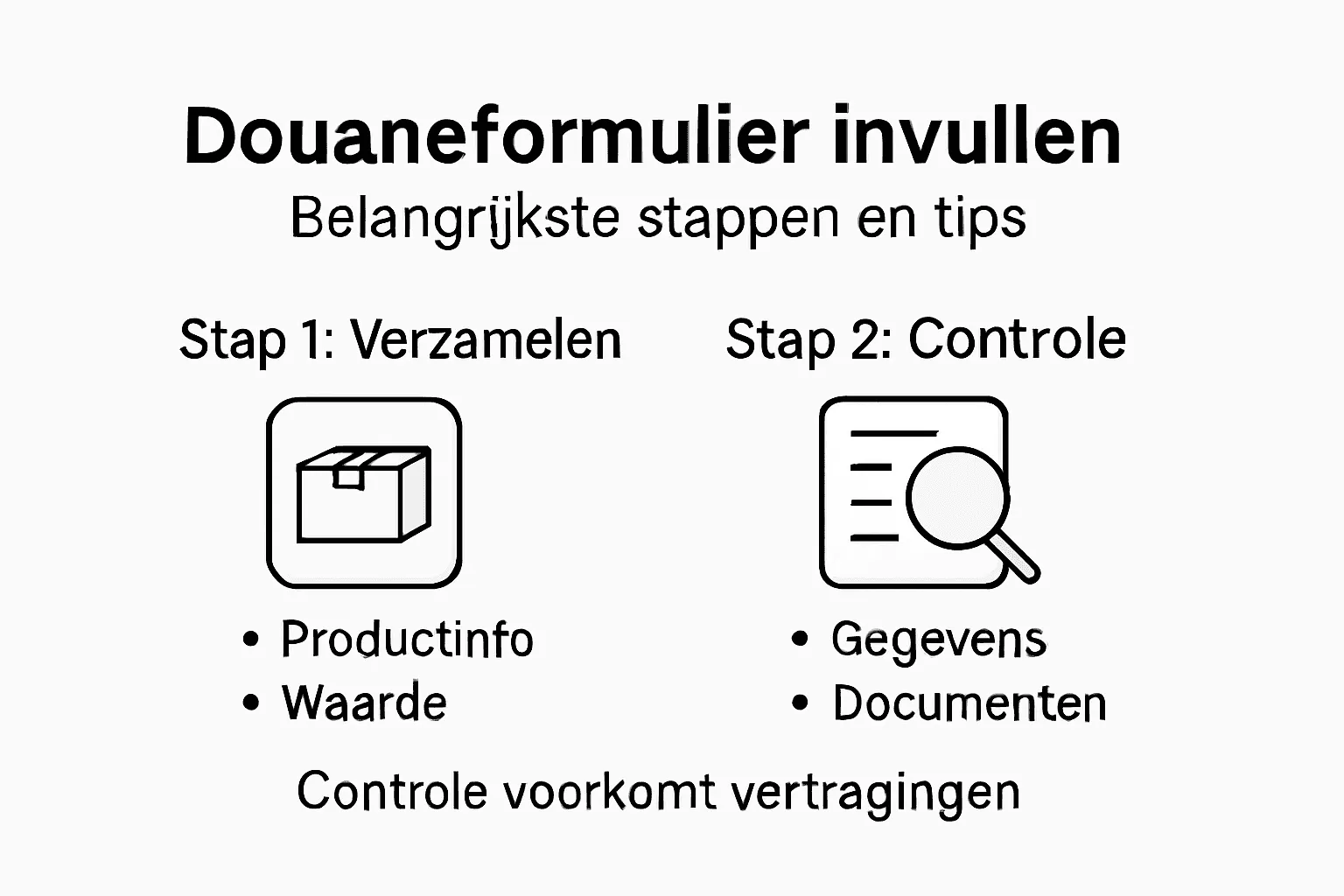
The diagram below helps systematically verify your customs documentation:
Checkpoint | Why It Matters | Potential Consequence of Error |
|---|---|---|
Contact Details | Delivery Contact | Shipment cannot be delivered |
Product Values | Calculation of Import Duties | Fine or Additional Tax |
Document Numbers | Customs Identification | Delayed Clearance |
Signature & Legibility | Legal Validity | Document Rejected |
Step 5: Confirm and Attach the Form to Your Package
Properly attaching your customs form is the final critical step in the international shipping process. Careful placement prevents confusion and potential delays during customs inspection.
Follow these steps for professional and accurate document attachment:
- Original Form: Use the original document, not copies
- Protected Attachment: Use a waterproof plastic sleeve
- Visible Placement: Attach the form to the outside of your package
- Protection: Ensure a sturdy, undamaged document holder
Practical Shipping Tips provide additional guidelines for smooth international shipping.
The most effective attachment methods are:
- Use a transparent, waterproof document holder
- Attach with specialized shipping tape on the outside
- Ensure all details remain clearly legible
- Verify the document is securely fastened
Note: Improperly attached documentation may result in delays or return of your shipment.
__Pro tip:__ Always take a digital photo of your fully completed and attached customs form as a backup for your records.
Simplify International Shipping with Parcel International
Filling out customs forms requires precision and understanding. Many businesses and individuals experience stress due to uncertainties around product descriptions, customs forms CN22 and CN23, and verifying all details. This often leads to delays and unnecessary costs. With Parcel International’s extensive experience, your international shipping becomes simple and transparent.
We support you at every stage from selecting the right carrier, comparing shipping options, and safely guiding your package to over 220 countries worldwide. This helps you avoid errors when completing customs documents. Discover how our logistics solutions save you time and money immediately.
Do you want to send international shipments without worries and need help choosing the right customs forms? Visit Parcel International today and experience our reliable service and clear communication. Take control of your international shipping and start optimizing your logistics now.
filling-out-customs-forms
Can't find your question? Our support team is here for you 24/7 via the help centre.
What are the key documents for international shipments?
For international shipments, accurate customs documentation is essential, such as the CN22 or CN23 form, depending on the value of the shipment. Ensure all required information, including sender and recipient details, product description, and value, is filled out correctly to avoid customs issues.
What documentation is required for shipping to the EU?
For shipments to the EU, documents such as a commercial invoice, certificate of origin, and standardized shipping forms are required to ensure accurate customs declarations.
What key information do I need to collect for customs forms?
Gather detailed product descriptions, commodity codes, total shipment value, weight, dimensions, and country of origin. Ensure this information is accurate to prevent customs delays.
How do I choose the right customs form for my shipment?
Determine whether your shipment needs a CN22 or CN23 form, depending on the value and type of shipment. Use the CN22 form for shipments worth up to €425 and the CN23 form for larger shipments.
How do I fill out customs forms correctly?
Accurately complete customs forms by providing a detailed description, actual value, and HS codes for each item. Thoroughly review your form to avoid errors; this can reduce processing time by several days.
How do I attach the customs form to my parcel?
Use a waterproof document pouch and attach the original form to the outside of your parcel in a visible place. Make sure all details are clearly legible to avoid problems during customs handling.
What is an export declaration?
An export declaration is a customs document that confirms goods may leave the customs territory of the European Union. It is essential for international shipments.
What are the key details required in an export declaration?
The export declaration must include, among other details, the exporter's information, recipient details, a description of the goods, customs value, and the countries of origin and destination.
What are the consequences of not having an export declaration?
Shipments may be held without an export declaration, financial penalties may apply, and the exporter could face legal complications.
What is a waybill?
A waybill is a legal document that establishes the transport agreement between a shipper and a carrier, containing essential information about the goods to be transported.
Why is a waybill required for international shipments?
A waybill is mandatory as it provides legal protection and clarifies the agreements between the shipper and carrier, which is essential for cross-border transportation.
What information should be included on a waybill?
A waybill must include the name and contact details of the sender and recipient, loading and unloading locations, a detailed description of the goods, quantity and weight, and any special transport instructions.
How do I prepare shipping labels and documents?
Ensure you gather all required documents for each parcel, such as shipping forms and customs documentation. Fill out these documents accurately and use a computer for a professional appearance.
How can I best manage shipping costs for international orders?
Optimize packaging to minimize dimensional weight, consolidate shipments to the same region, and negotiate volume discounts with carriers. Use a mix of shipping services tailored to product value and urgency instead of one expensive option for everything. Automate your shipping process to prevent errors that lead to additional reprocessing costs.
Which shipping services offer the best balance of speed and affordability?
Standard courier services provide the best balance between speed and cost, with delivery within 5-10 business days at moderate prices. For European destinations, road freight is often faster and more cost-effective than expected, with delivery within 7-14 days. Express services are only cost-efficient for high-value products where customers are willing to pay a premium.
How can I prevent my shipments from getting held up at customs?
Ensure complete and accurate customs documentation with correct HS codes, product descriptions, and declared values before shipping. Avoid vague descriptions like 'gift' or 'sample' and be specific about contents and value. Partner with a logistics provider that has customs expertise and proactively communicates in case of any customs inquiries.
What role does a logistics service provider play in international shipping?
A logistics service provider acts as your expert for international shipping, with knowledge of customs regulations, transport options, and local requirements per country. They negotiate volume discounts with carriers, offer integrated tracking, and ensure correct documentation. For small to medium-sized businesses, a good partner is essential to make international shipping scalable and profitable.
When is insurance for international shipments worth it?
Insure shipments valued above €200 or fragile products that are difficult to replace. For standard e-commerce items below this value, insurance premiums often exceed the risk of loss or damage. Analyze your damage history over six months to determine if insurance is cost-effective for your specific situation.
Where can I upload export documents digitally?
You can upload export documents via the Chamber of Commerce portal or through a freight forwarder or software. The best route depends on the frequency and complexity of your shipments.
What if my document is rejected after uploading?
Carefully read the error message, adjust the document based on the feedback, and re-upload the corrected file for approval.
How do I know if my upload was successful?
You will receive immediate digital confirmation via the platform or by email from the freight forwarder. Also, check the status overview in the platform dashboard.
What is the difference between a standard shipping label and a carrier-specific label?
A standard label is generically applicable, while a carrier-specific label complies with the strict formatting and barcode requirements of carriers like DHL or PostNL. Using the wrong type may result in your package being rejected or delayed.
When should I use thermal roll labels?
Thermal roll labels are ideal if you ship large daily volumes and work with printers like Zebra or Dymo. They print faster, fade less, and are more reliable than standard paper labels.
How can I prevent errors in the address or weight on the shipping label?
Automate label data through shipping software to pull information directly from your order system, preventing human input errors and stranded shipments.
What are the consequences of an incorrect shipping label?
An incorrect label leads to delays, additional storage costs, or complete return of the package. In the worst case, you lose both the package and the customer.
Which details are mandatory on a shipping label for international shipments?
An international shipping label always requires the correct recipient and sender addresses, a unique tracking number, a scannable barcode, and for cross-border shipments, customs information such as an HS code and item description. The shipping label, as a machine-readable link, enables automated processing in the carrier network.
Can incorrect placement of the shipping label cause delays?
Yes, a misplaced label, such as over a fold or seam, can make the barcode unscannable, leading to manual processing and delays. The logistical impact of placement is as significant as the content of the label itself.
Why is scanning shipping labels so important for e-commerce?
Scanning enables automated tracking, correct routing, and fast delivery. Without a successful scan, the sorting center won’t know where your package should go. The label, as a machine-readable link, is the foundation of every modern logistics network.
What are the consequences of an error in the barcode or tracking number?
Errors in barcodes or tracking numbers directly lead to misrouting, additional manual processing, and in the worst case, non-delivery. Improvements in label processes are therefore critical for compliance and exception management, where scan success rate and misroute ratio are the key metrics.
How can I efficiently test and optimize shipping labels?
Use test shipments with a barcode scanner to verify readability, automate label generation from your order system, and monitor your scan success rate per carrier. The shipping label, as a machine-readable link, only works optimally if you structurally monitor the generation and placement process.
How can I create a shipping label without a printer?
Many carriers offer a QR code as an alternative to home printing. You can have the code scanned at the pickup point or post office, and they will print the label for you. Check in advance if your pickup location supports this.
What is the standard size of a shipping label?
The most commonly used format is 4×6 inches (100×150 mm), but carriers like DHL sometimes use 100×210 mm. Always check the required format with your carrier before printing.
Can I create multiple shipping labels at once?
Yes. Using label software linked to a spreadsheet, you can generate bulk shipping labels for multiple shipments simultaneously. Ensure addresses are correctly formatted and barcode columns are set as text to avoid errors.
What are customs documents exactly?
Customs documents are official papers required to legally transport goods across international borders. The most commonly used are the commercial invoice, packing list, transport document, and electronic export declaration.
Which documents do I need for exports outside the EU?
For exports outside the EU, an electronic export declaration, commercial invoice, packing list, and transport document are mandatory. Depending on the product, a certificate of origin or additional permits may also be required.
How long should I retain customs documents?
Customs documents must be retained for at least three years after clearance, including invoices, packing lists, and export declarations. National regulations may require a longer retention period.
What is an HS code, and why is it so important?
An HS code is an internationally standardized product code that determines the applicable import duties and regulations for a good. An incorrect HS code results in wrong tariffs and potential fines during inspections.
When do I need a customs broker?
A customs broker is recommended for complex shipments, high-value goods, or products with special regulations, such as dual-use items or CBAM goods. A broker helps prevent classification errors and saves time during clearance.
When is a waybill mandatory?
A waybill is mandatory for professional road transport of goods in the Netherlands. The ILT actively enforces this, and the absence of a valid waybill can result in fines or legal action.
What is the difference between a CMR and a national waybill?
A national waybill applies exclusively to domestic road transport in the Netherlands. The CMR waybill is the mandatory document for international road transport between countries that have ratified the CMR Convention and must be issued in at least three original copies.
How long should I retain a waybill?
Waybills must be retained for at least 5 years for transport purposes and 7 years for tax audits. The carrier’s copy is the most critical in case of audits or legal disputes.
What is the difference between a waybill and a packing slip?
A waybill is a legally binding document and forms the transport contract. A packing slip is merely an internal administrative document without contractual force and offers no legal protection in case of damage or loss of goods.
What are logistics documents exactly?
Logistics documents are the papers that legally record a shipment. They serve as the transport contract, proof of receipt, and evidence for customs.
Which document do I use for international road transport?
For cross-border road transport, use a CMR. This document applies only to international transport, not domestic shipments.
What is the difference between a packing list and a commercial invoice?
A commercial invoice records the financial value of the goods. A packing list is a physical overview of the contents and has no legal status as a contract.
When do I need ADR documents?
ADR documents are mandatory for the transport of dangerous goods. They include UN numbers and emergency instructions per hazard class and are strictly enforced by European authorities.
Why does an error on my invoice cause customs delays?
Customs compares all documents with each other. A discrepancy in weight, quantity, or description between the invoice, packing list, and transport document is grounds for inspection and detention of the shipment.
What is the meaning of a transport document?
A transport document is the official proof of the agreement between the shipper and carrier. It confirms that the goods have been received and outlines the transport conditions.
Which document is used for sea freight?
For sea freight, use a Bill of Lading. This document also serves as a title of ownership: whoever holds the original has the right to the goods upon arrival.
How long should you retain transport documents?
Transport documents must be retained for at least 3 years in accordance with EU customs regulations. For tax purposes, such as proving 0% VAT on exports, you also need the export declaration and payment receipts.
Are digital transport documents valid everywhere?
E-CMR and e-AWB are accepted in many countries, but not all. Some countries, such as Angola, Brazil, and Argentina, still require an original paper Bill of Lading for clearance.
Who is responsible for errors in the waybill?
The shipper is ultimately responsible for the accuracy of the customs data on the waybill. Errors lead to fines and delays, even if the carrier actually completed the document.
What is the difference between an airway bill and a Bill of Lading?
An airway bill applies to air freight and is not a document of title. A Bill of Lading applies to sea freight and grants the holder the right to the goods.
Can I fill out an airway bill myself?
Yes, but in practice, the airline or freight forwarder typically prepares the airway bill. You provide the details: addresses, weight, description, and value of the goods.
What is an e-AWB?
An e-AWB is the electronic version of the airway bill, based on the IATA Cargo-IMP FWB/16 standard. It replaces the paper form with digital messages that are processed automatically.
How long should I retain an airway bill?
Retain the airway bill for at least five years after the shipment date. Customs authorities may request documentation retroactively, and in case of damage claims, the AWB serves as proof of the transport agreement.
What happens if the airway bill contains incorrect information?
Incorrect information results in customs delays, additional costs, and potential seizure of goods. Verify all details before handing over the shipment to the carrier.
Get a grip on your parcel shipping
Compare carriers, choose the best price and keep track of your international shipments. You can calculate and book without an account.
