
E-commerce is electronic commerce: the online buying and selling of products and services via webshops, marketplaces, and social channels. It revolves around four components that must work together: a sales platform, a payment system, logistics, and customer service. Businesses use e-commerce to reach customers without a physical store, consumers use it to shop from their couch, and marketplaces earn by facilitating those transactions.
In short:
- Using multiple sales channels like marketplaces and social commerce impacts logistical complexity and control over customer data.
- Mobile checkout offers the most improvement for conversion, especially since mobile traffic often drops off due to slow checkout pages.
- International shipping requires proper customs documentation and optimized logistical workflows to prevent delays and extra costs.
- Offering payment methods like iDEAL measurably increases conversion, highlighting the connection between logistics and payment options.
- By 2026, e-commerce is projected to grow to approximately €38 billion, with a focus on mobile, international, and AI-driven solutions for further scaling.
What is e-commerce? The components that form the system
E-commerce is an umbrella term. It includes a sole proprietorship selling T-shirts via its own webshop, a multinational selling through a marketplace, and an influencer promoting products via a link in an Instagram post. The format differs, but the principle remains the same: a purchase that is fully initiated and completed digitally.
A functioning e-commerce operation consists of a few building blocks that are inextricably linked. If one is missing, the entire system falters.
- Product catalog: the digital representation of your offering, including photos, descriptions, prices, and stock status.
- Sales platform: the software that powers the store, from an e-commerce platform like a webshop system to a marketplace account.
- Payment system: the infrastructure that securely transfers money from customer to seller.
- Fulfillment and shipping: the process of picking, packing, and dispatching orders.
- Customer service: the layer that handles questions, complaints, and returns.
Take a simple example: someone orders a pair of sneakers via a webshop. The catalog shows stock, the payment system processes the credit card, the fulfillment process prints the shipping label, and customer service sends a track & trace email. Four systems, one seamless customer experience—if it works well.
Where does e-commerce take place: webshop, marketplace, or social commerce?
The choice of sales channel determines almost everything: your margins, control over the customer, and logistical complexity. An own webshop gives full control over branding, customer data, and pricing, but you must generate traffic yourself. A marketplace, like a large platform, provides ready-made reach in exchange for commission and less ownership of the customer relationship. Social commerce, where you sell directly via a social media platform, is gaining ground because it removes the barrier between discovery and purchase.
Every choice has logistical consequences. If you sell via multiple marketplaces simultaneously, you must synchronize inventory in real time to prevent overselling. If you sell internationally, customs come into play as soon as you cross the European Union border, and you must set up return processes per country. If you handle fulfillment yourself for ten orders a day, you’ll often hit a wall when that number reaches a hundred.
Checkout is where many webshops leave money on the table. Mobile now accounts for the majority of e-commerce traffic but consistently converts at a lower rate than desktop. You won’t close that gap with a prettier homepage—you need a faster, shorter checkout process.
- Own webshop: full control, higher marketing costs, own customer data.
- Marketplace: instant reach, commission per sale, limited brand experience.
- Social commerce: low barrier to purchase, highly mobile-focused, growing but still fragmented.
- Payment options: local methods like iDEAL dominate in the Netherlands, and offering multiple payment methods measurably increases conversion.
Which e-commerce business model fits your product?
Not every model works for every product. The choice determines how you manage inventory, set prices, and which systems you need to integrate.
- B2C (business-to-consumer): you sell directly to the end user. Inventory management revolves around many small orders, and marketing focuses on emotion and convenience.
- B2B (business-to-business): you sell to other businesses, often in bulk and with negotiated prices. This requires integrations with customers’ procurement systems and flexible pricing structures per account.
- C2C (consumer-to-consumer): consumers sell to each other via a platform that facilitates the transaction. Here, you are the marketplace, not the seller, and your revenue model relies on commission or ads.
- D2C (direct-to-consumer): a brand that bypasses intermediaries and sells directly to consumers, usually via its own webshop. This requires heavier investments in brand building, as you must create visibility without a retail partner.
Many growing companies combine models: a brand sells D2C via its own site while also establishing a B2C presence on a marketplace to reach new customers. This hybrid approach is often smarter than relying on a single channel, as long as you centrally manage inventory and pricing.
How to start a webshop: the step-by-step guide
Starting a webshop is less complicated than it sounds, but the order of decisions determines whether you’ll still be standing in three months.
- Define your niche and target audience. An offering that’s too broad will drown in advertising costs.
- Choose a platform. For startups, a ready-made e-commerce platform is sufficient; if you grow quickly, consider a solution that scales with integrations.
- Register your business. Register with the Chamber of Commerce and arrange your VAT number before going live.
- Build your catalog. Good photos and clear product descriptions sell more than an expensive design.
- Set up payments. Integrate a payment provider that supports local methods alongside credit cards.
- Configure logistics. Decide whether to handle shipping yourself or outsource it, and connect a shipping solution to your platform.
- Test the full customer journey. Order a product yourself, from search to delivery.
- Launch and measure. Start with a limited marketing budget and closely monitor initial conversions.
The realistic timeline for a simple online store is four to eight weeks, provided your platform and payment provider integrate quickly. Costs vary widely, from a few hundred euros for a ready-made solution to thousands of euros for a custom-built system.
Pro tip: Test your checkout on a low-cost Android phone with a slow connection, not just on your fast laptop. This reveals exactly where mobile customers drop off.
Logistics and shipping: where startups struggle
Logistics is where most new online stores lose money without realizing it. The choice between handling fulfillment yourself, partnering with a 3PL provider, or working with a specialized international shipping partner depends on volume and destination. For a handful of orders per day, self-fulfillment is manageable. For hundreds of orders per week—or once you ship internationally—outsourcing often becomes cheaper than trying to manage it yourself.
A few key steps determine whether a shipment arrives without issues:
- Package products with the correct protection level for the shipping method (air, road, sea).
- Print labels with accurate weight and dimension details, as discrepancies lead to surcharges.
- Enable track & trace by default—customers will ask for it anyway.
- Set up a clear returns workflow before your first return arrives.
For shipments outside the European Union, documentation is everything. An incomplete invoice or incorrect commodity code causes days of customs delays and often extra costs for the customer. Industry-wide consolidation and a focus on logistical efficiency are among the key themes in e-commerce by 2026, precisely because shipping costs and delivery times increasingly determine whether a customer becomes a repeat buyer or a one-time purchaser.
Statistic: Offering multiple local payment methods measurably increases conversion, demonstrating that logistics and payment choices together drive revenue—not independently.
If you struggle with customs documentation, use a fixed checklist before a shipment leaves. For recurring returns, a documented returns-workflow works better than improvising for each case.

Marketing and conversion: where to invest in 2026
Not every marketing channel delivers equal returns, and the balance is shifting. SEO and Google Shopping remain solid for sustained traffic with relatively low marginal costs, while social advertising delivers faster results but becomes more expensive as more brands compete. Email marketing remains undervalued: re-engaging existing customers is cheaper than acquiring new ones.
You rarely win conversions with a big new campaign. More often, it’s by removing small friction points:
- Shorten the checkout steps to the minimum.
- Display reviews and customer ratings directly with the product image, not at the bottom of the page.
- Ensure mobile load times stay under two seconds.
- Offer guest checkout alongside account creation.
Automation and artificial intelligence are changing how personalization works. The number of people using AI tools is growing rapidly worldwide, and online stores leverage this growth for product recommendations, dynamic pricing, and automated customer service. For smaller stores, this is often unnecessary, but once your catalog contains hundreds of products, manual personalization becomes unsustainable.
Pro tip: Start with one simple automation, like an email after an abandoned cart. This often delivers more than an expensive AI personalization tool you don’t yet need.
Legal basics: Chamber of Commerce, VAT, and customer rights
An online store without a legal foundation is a ticking time bomb—not because the rules are complicated, but because they’re easy to overlook. Registration with the Chamber of Commerce and obtaining a VAT number belong in step one, not step eight.
- Clearly state the right of withdrawal: consumers in the European Union generally have a 14-day cooling-off period.
- Publish a clear return policy, including who bears the return shipping costs.
- Provide a valid privacy policy explaining what customer data you collect and why.
- Secure the site with a valid SSL certificate—both customers and search engines require it.
These measures don’t just prevent fines. They also determine whether a customer trusts you enough to enter their credit card details.
E-commerce in 2026: the numbers driving your strategy
The Dutch e-commerce market reached approximately €35.4 billion in revenue in 2025, with a forecast of €38 billion for 2026. This growth isn’t evenly distributed: marketplaces continue to capture a large share of global revenue, and global e-commerce has now crossed the $5 trillion mark .
Trend | What it means for you |
|---|---|
Mobile traffic dominates, conversion lags behind | Invest in mobile checkout before increasing ad spend |
Marketplaces grow faster than standalone stores | Consider a presence alongside your own site |
AI adoption rises rapidly | Automate where volume makes it cost-effective |
Headless commerce gains traction at scale | Relevant once you manage multiple channels and integrations |
Statistic: With a market size growing toward €38 billion, the question for startups isn’t whether to participate, but through which channel they’ll see the fastest return.
For smaller players, it makes sense to start with mobile checkout and a single marketplace, and only later invest in heavier infrastructure like headless commerce.
Start, test, or wait: the quick decision check
Still unsure? Test first via a marketplace before investing in your own platform, especially if your product isn’t proven yet. If you already have confirmed demand, starting now makes more sense than waiting. The first ninety days revolve around three things: a working checkout, a reliable shipping partner, and a returns process that doesn’t deter customers. Get those three right, and you can build the rest of your strategy as you go.
Why logistics is the silent killer of young e-commerce stores
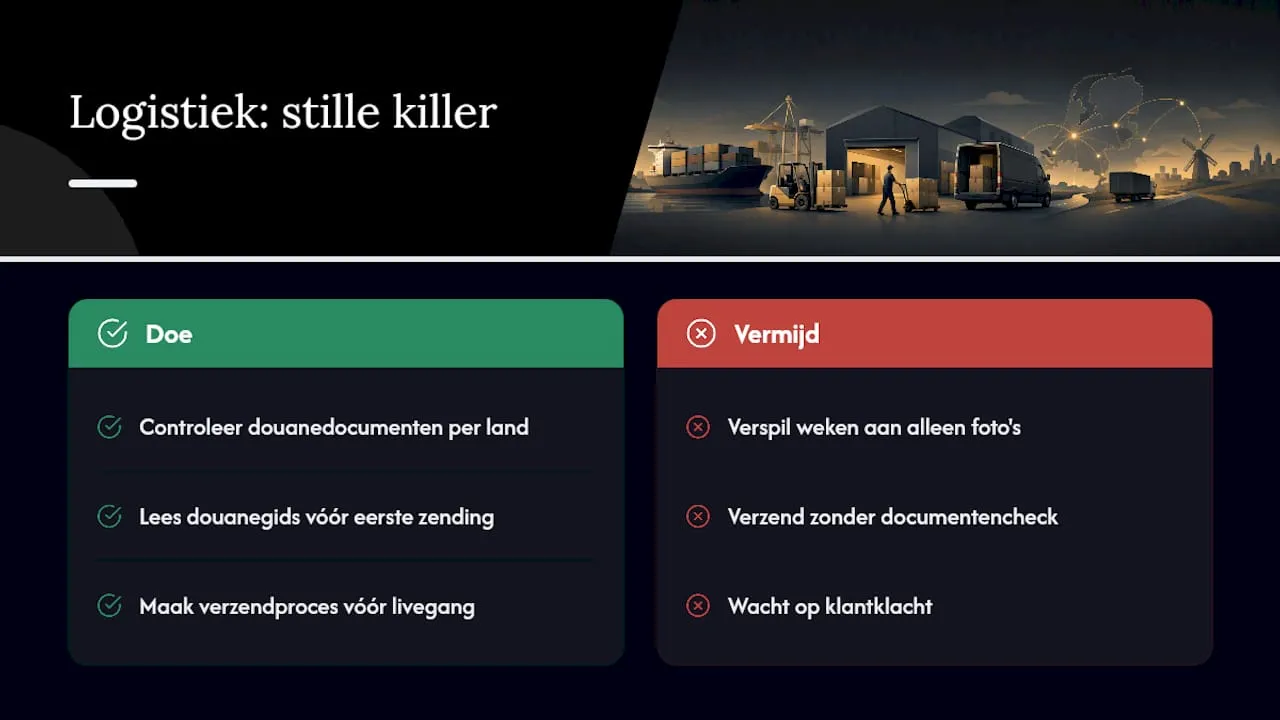
Most new e-commerce stores spend weeks on their product photos and an afternoon on their shipping process. That’s the reverse of what works. A customer may forgive a mediocre photo, but not a package that arrives two weeks late or gets stuck at customs due to an incorrectly filled-out invoice.
The most common mistake I see: entrepreneurs start shipping internationally without first figuring out which documents a specific country requires, and only discover the rules when a customer sends an angry email about a shipment that’s been held up. To break that pattern, read our guide on customs documentation before the first international order goes out—not after.
— Pascal
International shipping without the hassle
Other options exist: negotiating directly with individual carriers or handling everything manually via postal services. Both take time that a growing e-commerce store doesn’t have.

Parcel International compares shipping options from multiple carriers in one overview, with no mandatory account and no hidden costs, so you can choose the cheapest and fastest option per shipment instead of blindly sticking with one carrier. For e-commerce stores just starting to ship internationally, the combination of rate comparison and customs documentation is especially valuable: you see in one step what a shipment costs and what paperwork is required. Once your volume grows or you ship to multiple countries outside the European Union, it’s worth discussing automation for your logistics workflow directly.
Check out the guide-to-logistics-automation and request a rate comparison for your next international shipment.
Recommendations
Get a grip on your parcel shipping
Compare carriers, choose the best price and keep track of your international shipments. You can calculate and book without an account.
