
TL;DR:
- Fulfilment logistics involves precise order processing and fast returns handling.
- The choice between in-house, outsourcing, or a hybrid model depends on volume and growth.
- Reliable fulfilment is the key to successful international e-commerce growth.
The best fulfilment providers achieve an order accuracy above 99.5% and process returns within 48 to 72 hours. Yet, many small and medium-sized online stores still struggle with delays, incorrect shipments, and dissatisfied customers on the other side of the world. Fulfilment logistics is the invisible engine behind successful international e-commerce, but few entrepreneurs understand how to optimize it. In this article, you’ll learn exactly what fulfilment logistics entails, which models exist, and how to make the right choice for your growing online store.
Key Insights
Point | Details |
|---|---|
Fulfilment Enhances Reliability | Order accuracy and fast returns processing ensure satisfied customers. |
International Growth Requires Smart Logistics | The right fulfilment partner enables scalable international sales. |
Compare Fulfilment Models | In-house, outsourcing, or hybrid: choose what fits your business. |
Monitor Performance Metrics | Order accuracy, returns processing, and delivery reliability are decisive. |
What Is Fulfilment Logistics Exactly?
Fulfilment logistics encompasses all operational processes that take place after a customer places an order, up to the moment the package arrives at their doorstep. And in the case of a return: the journey back. It’s much more than just 'sending a package.' It involves a chain of closely connected steps that together determine how reliably and quickly your online store performs.
Let’s walk through the core processes step by step:
- Inventory Receipt: Products arrive at a warehouse. They are checked, counted, and registered in the system.
- Storage: Items are organized and stored in a way that enables efficient picking. Poor storage costs time and money.
- Picking: Once an order is received, the correct product is retrieved from the warehouse. This sounds simple, but with hundreds of SKUs (Stock Keeping Units, or unique product codes), accuracy is crucial.
- Packing: The product is packaged, labeled, and provided with the correct documentation, including for international shipments.
- Shipping: The package is handed over to the carrier. The choice of carrier, track and trace, and delivery time start here.
- Returns: A customer sends a product back. The return is received, checked, and processed, after which the product is restocked or disposed of.
Leading fulfilment providers achieve a perfect order rate above 95% and process returns within 48 to 72 hours. These aren’t just impressive numbers for a report; they’re the benchmark by which your customers measure you.
The difference between fulfilment logistics and general logistics lies in the focus. General logistics focuses on moving goods, often in bulk from A to B. Fulfilment logistics is consumer-oriented: it’s about individual orders, speed per package, and direct communication with the end customer. This makes it particularly relevant for online stores aiming for international growth.
If you want to understand how fulfilment fits into the bigger picture of international logistics, you’ll quickly see that fulfilment is the link that delivers your product from warehouse to customer, whether that customer lives in Amsterdam, Berlin, or Tokyo.
Reliability and speed are non-negotiable in fulfilment. An error in the picking phase can lead to the wrong product reaching the customer, resulting in a return, a negative review, and a loss of customer trust. One mistake per 200 orders might sound acceptable, but that’s precisely the industry standard’s lower limit of 99.5% accuracy. For an online store with 1,000 orders per month, that still means 5 incorrect deliveries per month. That makes a noticeable difference.
The Impact of Fulfilment on International E-Commerce
Now that you know what fulfilment logistics entails, it’s time to see how it directly affects your international e-commerce. Because the stakes are high. The cross-border market is set to grow significantly in the coming years. This isn’t a trend you can ignore as an e-commerce entrepreneur.
Cross-border sales introduce additional complexity. Customs forms, local tax regulations, varying delivery time expectations per country, and return logistics across borders. All these factors together determine whether a foreign customer makes a second purchase from you or turns to a competitor. Fulfilment plays a key role in this.
The impact on customer satisfaction is direct and measurable:
- Fast Delivery: Customers in Europe often expect delivery within 2 to 5 business days, even from foreign online stores. A slow fulfilment link breaks that promise.
- Accurate Orders: Receiving the wrong item is especially frustrating for international customers, as returns require more effort.
- Smooth Returns: A complicated returns process can deter international buyers from purchasing at all.
- Transparent Tracking: Customers want to know where their package is. Systems that provide real-time updates significantly improve the customer experience.
Pro tip: Don’t just track your shipping performance—actively measure your perfect order rate. This is the percentage of orders delivered correctly, on time, and without issues. Aim for over 95% and link this to your returns workflow to quickly identify bottlenecks.
If you’re actively working on optimizing e-commerce logistics, you’ll notice that small improvements in fulfilment have major effects on customer satisfaction and repeat purchases. A customer who has one bad experience rarely returns. But a customer who receives flawless delivery every time becomes a loyal buyer and recommends your store.
Reliable partners and systems are crucial in this process. No matter how well you plan, if your carrier consistently delivers late or your warehouse system makes errors during picking, your performance will suffer. Choosing proven carriers and integrated software isn’t a luxury—it’s a fundamental requirement for serious international growth. Want to learn more about how you can reduce delivery times ? It starts with gaining a clear insight into your fulfillment chain.
Fulfillment models: in-house, outsourced, or hybrid
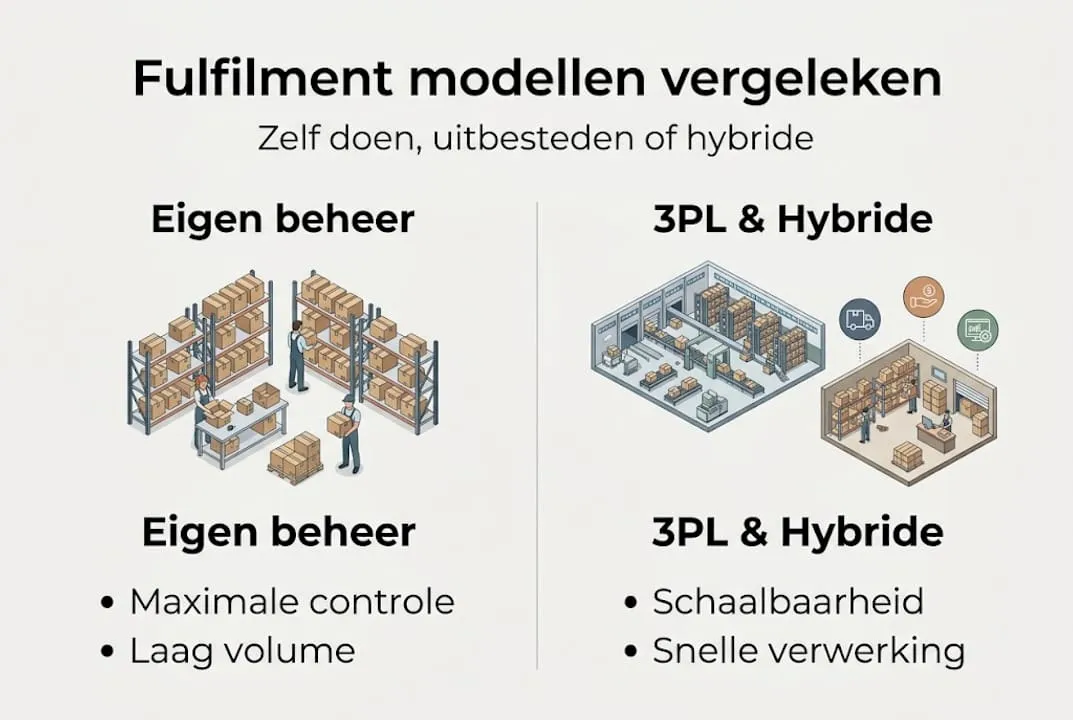
To further optimize your e-commerce, it’s essential to determine which fulfillment model best suits your business. There are three main models, each with its own advantages and disadvantages depending on your volume, products, and growth ambitions.
1. Managing fulfillment in-house (In-house fulfillment)
You handle everything yourself: storage, picking, packing, and shipping. This gives you maximum control over every aspect of the order process. You see exactly how products are packaged and can quickly respond to issues. For startups with a limited order volume, this is often the most cost-effective choice.
2. Outsourcing to a fulfillment partner (3PL)
A Third Party Logistics provider, or 3PL, takes over the entire fulfillment process. You send your inventory to their warehouse, and they handle the rest. This model scales well with growing volume and provides access to professional infrastructure without large investments in your own storage and staff.
3. Hybrid fulfillment
A combination of in-house fulfillment for certain product categories or markets, supplemented by a 3PL partner for specific destinations or peak periods. This is a flexible approach that’s becoming increasingly popular among mid-sized e-commerce businesses expanding internationally.
Here’s a comparison based on the key criteria:
Criteria | In-house | Outsourced (3PL) | Hybrid |
|---|---|---|---|
Costs at low volume | Low | High | Moderate |
Costs at high volume | High | Low per order | Low to moderate |
Scalability | Limited | High | High |
Control over processes | Full | Limited | Partial |
Return processing speed | Variable | Standardized | Mixed |
International coverage | Limited | Broad | Broad |
Return processing deserves extra attention in this comparison. The industry standard for return processing is 48 to 72 hours. In-house fulfillment sometimes falls short if the team is small or returns are processed manually. A 3PL with automated systems almost always meets this standard.
Want to see practical fulfillment examples of how other e-commerce businesses approach this? You’ll notice that many growing online stores start with in-house fulfillment, transition to hybrid as volume increases, and eventually outsource entirely when internationalization becomes a priority.
Setting up a solid international return shipping workflow is important for all three models. Returns management is one of the biggest cost drivers in e-commerce, but it’s also an opportunity to surprise customers with a seamless experience.
How to choose the right fulfillment logistics solution
Now that you know your options, it’s time to determine how to select the right fulfillment logistics solution. This starts with a clear understanding of your own situation.
Step 1: Assess your current situation
Critically evaluate your current volume, product type, and destinations. Do you ship 50 orders per month or 5,000? Are your products small and lightweight or large and fragile? Do you primarily deliver within the Netherlands, or also in Germany, the United Kingdom, and beyond Europe? The answers to these questions will largely determine which model and partner are right for you.
Step 2: Define your minimum performance requirements
Use industry benchmarks as a starting point and determine which metrics are critical for you:
Metric | Industry benchmark | Your minimum |
|---|---|---|
Order accuracy | Above 99.5% | Set your own |
Perfect order rate | Above 95% | Set your own |
On-time shipping | Above 98% | Set your own |
Return processing | 48 to 72 hours | Set your own |
Step 3: Ask the right questions to potential partners
Use the following checklist when evaluating a fulfillment partner:
- Which countries and regions do they cover? Are these your target markets?
- What is their average order accuracy over the past year?
- How long does their return processing typically take?
- Do they offer real-time tracking and reporting?
- How do they scale during peak periods like Black Friday or the holiday season?
- What are the costs per order at your volume, including storage and handling?
- How is communication and issue resolution handled?
Pro tip: Ask each potential partner specifically about their average return processing time, backed by evidence from their system. A partner who can’t provide this transparently is likely less transparent about other performance metrics as well.
A good international logistics checklist helps ensure you don’t overlook any criteria during the selection process. Especially when serving multiple markets, structure is indispensable.
In addition to the partner, also consider the best international shipping practices applicable to your specific product category and target markets. What works for fashion may not necessarily work for electronics or nutritional supplements.
Our perspective: Why fulfillment logistics makes the difference for growth
After all these practical tips, we want to share something we see repeatedly in practice: most small e-commerce businesses consistently underestimate fulfillment. They view it as a cost center, not a growth accelerator.
The most persistent misconception is that a low price per shipment equals a good fulfillment decision. A cheap carrier that consistently delivers late will ultimately cost you more in customer service, negative reviews, and lost customers than a more expensive but reliable option. Price is just one variable in a complex equation.
What smart entrepreneurs do is focus on the role of the logistics service provider as a strategic partner, not just a supplier. They evaluate quarter over quarter based on measurable metrics. They communicate proactively about expected volumes and peak periods. And they adjust based on return data, because return patterns reveal a lot about product quality, packaging, and customer communication.
Fulfilment logistics is the invisible engine behind your international reputation. Those who maintain this engine well grow faster than competitors who only pay attention when it stalls.
Ready to optimize your fulfilment logistics?
You now understand what fulfilment logistics entails, which models exist, and how to make the right choice. The next step is practical: which services and partners fit your situation?

At Parcel International, you can quickly and easily compare parcel services without creating an account. Over 220 countries and regions are covered, and you choose the carrier that matches your volume, budget, and delivery time expectations. Whether you're just starting with international shipping or looking to optimize your existing fulfilment, our platform provides immediate insight into the available options. Also, check out the overview of international delivery services to understand which type of service aligns with your e-commerce model.
Can't find your question? Our support team is here for you 24/7 via the help centre.
What are the key benefits of fulfillment logistics?
Fulfillment logistics ensures faster and more reliable order processing and improved customer satisfaction, thanks to high order accuracy and quick returns handling.
How long does returns processing take in fulfillment logistics?
According to industry benchmarks, returns processing is completed within 48 to 72 hours by professional fulfillment providers.
What fulfillment models are available for e-commerce businesses?
You can handle fulfillment in-house for full control, outsource to a 3PL partner for scalability, or choose a hybrid combination of both models.
Why is fulfillment logistics important for international e-commerce?
It optimizes the entire order chain from picking to returns, which is essential for growth in a rapidly expanding cross-border market.
Get a grip on your parcel shipping
Compare carriers, choose the best price and keep track of your international shipments. You can calculate and book without an account.
