
In short:
- A freight contract is a written agreement between a shipper and a carrier outlining transport conditions. It specifies liability, pricing, and responsibilities, helping to prevent disputes. For international transport, the CMR Convention serves as the legal framework governing liability and limits.
A freight contract is the written agreement between a shipper and a carrier regarding the terms for transporting goods. For small businesses and individuals shipping internationally, this contract determines who is liable in case of damage, what price applies, and what is expected from both parties. Without clear freight contracts, disputes over costs, delays, and liability can arise. The freight contract explanation in this article provides the knowledge to make sound agreements and avoid pitfalls.
What are the types of freight contracts and how do they work?
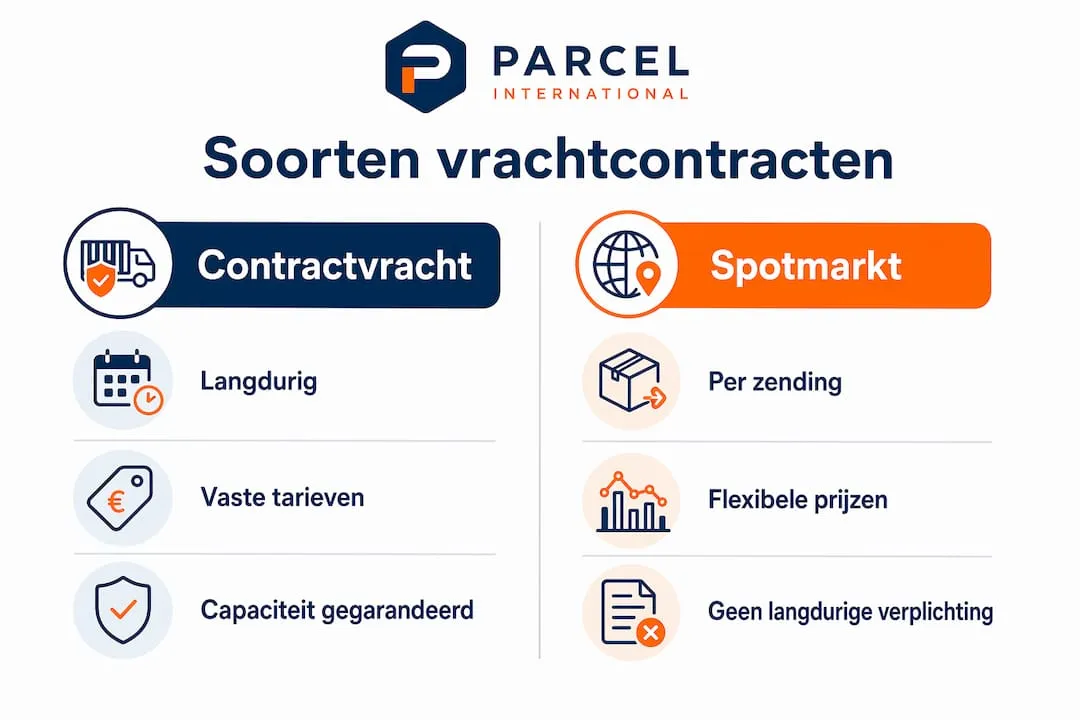
Freight contracts fall into two main categories: contract freight and the spot market. With contract freight, you enter into a long-term agreement with a carrier for a fixed period, often six months to two years. You agree on fixed rates, volumes, and capacity guarantees. In the spot market, you book per shipment at the current price, without long-term commitments.

The price difference between the two forms is smaller than many shippers realize. Contract rates in late 2025 stood at an index of 136.9 compared to 135.1 for spot prices. Contracts are therefore not inherently cheaper. What they *do* offer is certainty about capacity and pricing, which is particularly valuable if your volumes are predictable.
Long-term contracts, framework agreements, and one-off assignments
In addition to choosing between contract and spot, there are also different contract types:
- Long-term freight contract: fixed agreements on rates, volumes, and routes for an extended period. Suitable if you regularly use the same routes.
- Framework agreement: an overarching contract without fixed volumes, where you place an order per shipment within the agreed terms. More flexible than a long-term contract.
- One-off assignment: a single agreement per shipment, comparable to the spot market but with written confirmation of the terms.
Pro tip: Choose a framework agreement if your monthly volumes fluctuate significantly. You retain the benefits of fixed rate agreements without committing to minimum volumes.
How do pricing mechanisms work in freight contracts?
Good freight contracts include price adjustment mechanisms for fluctuating costs, such as fuel indexation. A fuel surcharge automatically links the freight price to the diesel price via an agreed index. This way, as a shipper, you share in fuel costs when prices rise but also benefit when prices fall. This prevents carriers from having to renegotiate rates with every price increase.
What is the legal framework for international freight transport?
The CMR Convention is the central legal framework for cross-border road transport. CMR stands for the French name *Convention relative au contrat de transport international de Marchandises par Route*. The convention has been ratified by over 55 countries, including all EU member states, Switzerland, and Turkey. It applies automatically once a shipment crosses the border between two contracting states.
The CMR Convention is mandatory law. This means that contractual deviations to the detriment of the shipper are not valid. For example, if a carrier includes a lower liability in their general terms than the CMR limit, that clause is null and void under Article 41 of the CMR. The statutory limit still applies.
Liability limits under CMR
The carrier’s liability for loss or damage is limited to 8.33 SDR per kilogram of damaged or lost weight. SDR is the accounting unit of the International Monetary Fund. For a shipment of 100 kg, this means a maximum compensation of approximately 833 SDR, roughly equivalent to 1,000 euros (depending on the exchange rate). If your cargo has a higher value, additional cargo insurance is necessary.
Another important point: the main carrier remains liable for subcontractors. Article 3 of the CMR states that the carrier you hire remains responsible for damage caused by a subcontractor. You do not need to pursue a subcontractor yourself.
Waybill and General Transport Conditions
A waybill is legally required for professional road transport. In the absence of a waybill , the Human Environment and Transport Inspectorate (ILT) can issue a fine. The waybill is also the primary evidence for customs and liability claims. A packing slip or delivery note does not replace the waybill. Learn more about the rules regarding this document in the explanation of waybills-for-international-shipments.
The General Transport Conditions (AVC) supplement the CMR Convention for national transport and topics not covered by CMR. For example, the AVC governs responsibility for loading and unloading, which CMR does not explicitly address.
Pro tip: Always check whether your carrier uses the AVC and request a copy. The AVC contains agreements that directly affect your rights in case of damage.
What practical pitfalls should you avoid in a freight contract?
The most common mistake in freight contracts is failing to define responsibilities for loading and unloading. Under the AVC, loading and unloading are the responsibility of the shipper, unless the contract states otherwise. If the driver assists with loading and damage occurs, determining liability without explicit agreements can be difficult.
Other practical considerations:
- Define pricing mechanisms: Discuss how rates are adjusted for rising fuel prices, translation costs, or currency fluctuations. A contract without an indexation clause leaves you vulnerable to unilateral rate increases.
- Secure capacity guarantees: Request written confirmation from the carrier on the guaranteed loading space. Without a guarantee, the carrier may refuse your shipment during peak times.
- Verify the waybill for every shipment: A properly completed and signed waybill serves as your proof for customs and claims. Always check the name, address, weight, and description of the goods.
- Use hybrid sourcing: Combine a base contract for your fixed volumes with spot market bookings for peak periods. This provides capacity certainty without paying for unused space.
Pro tip: Always request a trial period of one or two months when signing a contract. This allows you to test whether the carrier fulfills their promises before committing long-term.
How can small businesses effectively use freight contracts?
Small businesses and individuals often opt for the spot market for international shipments, assuming contracts are only for large shippers. This is not true. Contract logistics is a strategic partnership that works for smaller volumes as well, provided you make the right agreements on KPIs and governance.
The key is finding the right balance between capacity certainty and cost savings. Small businesses with predictable volumes benefit from a framework agreement. Companies with fluctuating volumes are better off with a hybrid approach: a base contract for core shipments and the spot market for the rest. Gaining insight into the cost structure for international freight helps you determine this balance.
Practical steps for small businesses:
- Define KPIs: Establish measurable agreements, such as maximum delivery time, percentage of on-time deliveries, and maximum damage frequency. This allows you to objectively assess your carrier's performance.
- Request transparent pricing breakdowns: A reliable carrier will explain the base freight cost, fuel surcharge, and any additional fees. Non-transparent pricing is a red flag.
- Arrange customs documentation in advance: For international shipments, customs documents are required in addition to the waybill. Agree on who prepares these and who is responsible in case of errors.
- Evaluate the contract annually: Markets change. Review annually to ensure rates and terms remain competitive.
Pro tip: Ask your carrier for a monthly overview of your shipping performance. Carriers unable to provide this lack the systems for professional collaboration.
Key insights
A freight contract outlines the rights and obligations of the shipper and carrier, with the CMR convention setting legal boundaries for international road transport.
Point | Details |
|---|---|
Choose the right contract type | Opt for a framework agreement for fluctuating volumes and a long-term contract for fixed routes and volumes. |
CMR liability | The limit is 8.33 SDR per kg; take out cargo insurance if your shipment is more valuable. |
Waybill required | A waybill is legally required for professional transport and serves as proof for customs and claims. |
Define loading and unloading responsibilities | Explicitly state in the contract who is responsible for loading and unloading to avoid liability disputes. |
Hybrid sourcing | Combine a base contract with spot market bookings for flexibility and capacity certainty. |
Why clear freight contracts deliver more than you think
I see the same pattern among small businesses: they focus heavily on the price per shipment but pay little attention to the contract terms. Only when something goes wrong—a damaged shipment, a delayed delivery, or an unexpected surcharge—do they realize the agreements were too vague.
The focus will clearly shift from price to capacity certainty by 2026. Carriers with full schedules choose their customers. Without a contract, you’re the first to be dropped when the market tightens. A good contract isn’t just bureaucratic formalism—it’s your ticket to reliable capacity.
My advice to small businesses: don’t start by negotiating the price. Start by asking what happens if the carrier is late, if there’s damage, or if capacity disappears. The answers to these questions determine the value of the contract. A carrier that provides clear answers takes their responsibility seriously.
Finally: you don’t need to be a lawyer to sign a good freight contract. You just need the right questions and the willingness to put the answers in writing.
— Pascal
Parcelinternational helps you with international shipments
Organizing international shipments without the right partner costs time and money. Since 2007, Parcel International has provided transparent shipping solutions for over 220 countries and territories, with access to multiple carriers through a single platform.

Whether you need to send a one-time shipment or ship internationally on a regular basis, through Parcel International you can compare shipping options for international shipments and choose the option that fits your budget and delivery time. For pallets and freight, you can request a quote from Parcel International. This way, you always know where your shipment is and what it costs.
Can't find your question? Our support team is here for you 24/7 via the help centre.
What exactly is a transport agreement?
A freight contract is a written agreement between a shipper and a carrier outlining the terms for transporting goods, including price, liability, and responsibilities.
Does the CMR Convention always apply to international shipments?
The CMR Convention automatically applies to cross-border road transport between two contracting states. Over 55 countries have ratified the convention, including all EU member states.
What is the difference between contract freight and the spot market?
With contract freight, you lock in rates and capacity for an extended period. With the spot market, you book per shipment at the current market price, without long-term commitments.
Is a waybill always mandatory?
A waybill is legally required for professional road transport. Without it, the ILT (Inspection Authority) may issue a fine. The waybill also serves as evidence for customs and liability claims.
How can I protect myself if my cargo is worth more than the CMR limit?
CMR liability is limited to 8.33 SDR per kilogram. Take out additional cargo insurance if the value of your shipment exceeds this amount.
Get a grip on your parcel shipping
Compare carriers, choose the best price and keep track of your international shipments. You can calculate and book without an account.
