
In a nutshell:
- Export regulations ensure goods cross borders legally and without delay.
- They require correct documentation, customs procedures, product requirements, and VAT compliance.
Export regulations are the legal obligations businesses must meet to send goods across borders legally and without delay. Key export regulations include proper documentation, customs procedures, product requirements, and VAT compliance. Authorities such as the Chamber of Commerce (KVK), the Netherlands Food and Consumer Product Safety Authority (NVWA), and Customs set and enforce these requirements. Ignoring these rules risks delays, fines, and even seizure of shipments. Proper compliance not only protects your business but also your customer relationships.
1. Which documents are crucial for international export?

Export documentation is the foundation of every international shipment. Without the correct paperwork, your parcel won’t clear customs, regardless of the destination.
The most commonly required documents are:
- Commercial Invoice: contains the value, description, and quantity of the goods.
- Packing List: provides a detailed overview of the contents per package.
- Transport Documents: such as a waybill (CMR), air waybill (AWB), or bill of lading (B/L), depending on the mode of transport.
- Certificate of Origin (CO): proves the country in which the goods were produced.
- EUR.1 Certificate: grants preferential tariff treatment for exports to countries with which the EU has a trade agreement.
For food, plants, and animals, veterinary and phytosanitary certificates are also required. These documents prove that the products meet the health requirements of the destination country.
Newer additions include PEM declarations and REX declarations. As of January 1, 2026, the revised PEM rules apply to exports to Pan-Euro-Mediterranean countries, with the traditional EUR-MED certificate largely phased out. Exceptions apply to Algeria, Lebanon, and Syria, which have specific transition rules until February 2026. This means your documentation package may vary by destination.
Pro tip: Check the specific document requirements for each new destination via the Chamber of Commerce or Access2Markets. What applies to Germany may not apply to Morocco or Japan.
2. What are the requirements for products and origin markings?
A CE marking is not sufficient for exports outside the EU. CE marking does not automatically comply with foreign import regulations, and additional requirements for labeling and technical adjustments are often necessary.
Consider the following:
- Language requirements: labels must be in the language of the destination country.
- Technical adjustments: voltage, plug types, and safety standards vary by region.
- Origin markings: the origin of your product determines which tariffs and preferences apply.
- PEM rules: the revised Pan-Euro-Mediterranean origin rules determine whether your product qualifies as “of EU origin.”
Additionally, in 2026, a new EU product liability directive will take effect. This directive mandates stricter risk analyses and traceability for businesses. Consumers can more easily file damage claims, including for digital products. This directly impacts your export preparation: you must be able to prove where your product comes from and how it was produced.
Practically, this means maintaining a technical dossier before shipment. This dossier should include test results, material specifications, and production data. Exporters who fail to keep this in order risk liability claims abroad.
3. How does VAT work for exports within and outside the EU?
VAT for exports is simpler than it seems, but the burden of proof lies entirely with you as the business owner. For exports to non-EU countries, you apply the 0% VAT rate, but only if you can fully substantiate this in your records.
The rules vary significantly by situation:
- Export within the EU: goods move freely. You apply the 0% intra-community rate and include the buyer’s VAT number on the invoice.
- Export outside the EU: you apply the 0% export rate. Proof is provided with an official export declaration and transport documents.
- Mixed shipments: if part of your shipment stays within the EU and part goes outside, different rates apply to each part.
Export procedures and required documents differ fundamentally between the EU and non-EU countries. Exports to non-EU countries always require an export declaration to Customs. Without this declaration, you cannot apply the 0% rate and risk additional assessments. Export procedures and required documents differ fundamentally between the EU and non-EU countries. Exports to non-EU countries always require an export declaration to Customs. Without this declaration, you cannot apply the 0% rate and risk additional assessments.
Pro tip: Always keep your export declaration (EX-A) and transport documents for at least seven years. The Tax Authority may check years later whether you correctly applied the zero rate.
4. What role do Incoterms play in international shipments?
Incoterms determine who is responsible for transport, risk, and customs costs. Responsibilities for customs clearance in the destination country must be contractually defined using Incoterms. Without clear Incoterms agreements, disputes may arise over who pays import duties or who is liable in case of damage.
The most commonly used Incoterms for exports are:
- EXW (Ex Works): the buyer handles everything from your warehouse. You bear minimal responsibility.
- DAP (Delivered at Place): you deliver to the buyer’s door, but the buyer handles import duties.
- DDP (Delivered Duty Paid): you handle everything, including import duties and local taxes in the destination country.
Many new exporters underestimate the necessity of contractual agreements via Incoterms.Typically, the buyer is responsible for import duties and local taxes in the destination country, but this must be explicitly stated. If you choose DDP, you, as the seller, take on all customs obligations. This provides certainty to the buyer but significantly increases your administrative burden.
5. What export regulations apply to special product categories?
Not all products are allowed to cross borders without restrictions. Specific categories are subject to additional regulations that cannot be ignored.
- Plants and plant-based products: The NVWA verifies whether businesses are listed on the correct phytosanitary company registers. Supervisory authorities such as NAK or KCB check whether businesses comply with the conditions and provide the required export documents. Shipments are inspected before departure.
- Animal products: veterinary certificates are mandatory. The NVWA issues these after inspection.
- Strategic goods: for military technology, dual-use products, and certain chemicals, you need an export license from the Netherlands Enterprise Agency (RVO).
- Protected animal and plant species: for products covered by the CITES treaty, a CITES certificate is mandatory. Without this certificate, export is illegal.
This is particularly relevant for e-commerce entrepreneurs. Those selling cosmetics, dietary supplements, or electronics to consumers outside the EU must check the regulations for each product category. A supplement that is freely available in the Netherlands may be classified as a medication in the US or Australia, triggering import bans.
Comparison of certificate requirements by product group:
Product group | Required certificate | Issued by |
|---|---|---|
Plants and seeds | Phytosanitary certificate | NVWA / NAK / KCB |
Animal products | Veterinary certificate | NVWA |
Protected species | CITES certificate | RVO |
Strategic goods | Export license | RVO |
Food products | Health certificate | NVWA |
6. How to use the HS code for correct classification?
The Harmonized System code, or HS code, is the key to accurate export documentation. Determining the product type and HS code is crucial for identifying the required documents and product requirements for each destination country. An incorrect HS code leads to wrong tariffs, missed preferences, and potential fines.
How to use the HS code effectively:
- Find the correct code via the European Access2Markets database or the Dutch Customs tariff classification.
- Check trade agreements: with the HS code, you can immediately see which preferential tariffs apply to your destination.
- Check import restrictions: some HS codes are linked to sanctions or import bans in specific countries.
- Register as an authorized exporter: for invoice declarations, there is a value threshold of 6,000 euros. If exceeded, registration as a Registered Exporter (REX) or Approved Exporter (AE) is required. This status sometimes replaces the formal EUR.1 certificate.
Pro tip: Use the international shipments checklist from Parcel International to verify per shipment whether your HS code, documents, and customs obligations are correct. This helps avoid last-minute surprises at the border.
Proper document management starts with the HS code and ends with a complete dossier per shipment. Store all documents digitally and in a structured way so you can immediately provide what is requested during a customs inspection.
7. How to prepare for export regulations by destination?
Each destination has its own rules. What applies to Canada does not apply to Saudi Arabia. Good preparation starts with mapping the specific requirements for each country.
Practical steps for export preparation:
- Consult Access2Markets: the European Commission provides free insights into tariffs, import requirements, and trade agreements per destination via this platform.
- Check sanctions lists: the EU and the US enforce sanctions against specific countries, companies, and individuals. Exporting to sanctioned parties is prohibited and results in heavy fines.
- Coordinate with your carrier: a good carrier flags documentation issues before the shipment departs. Use customs clearance tips to structure your process.
- Communicate with your customer: inform buyers outside the EU about potential import duties and local taxes. Transparency prevents complaints and returns.
- Stay updated on regulations: export rules change. The 2026 PEM revision is a good example of how quickly rules can change.
Those selling internationally via an online store should document a standard export procedure for each region. This way, you don’t have to reinvent the wheel for each shipment and reduce the risk of errors.
Key insights
Accurate export documentation, a valid HS code, and clear Incoterms agreements form the foundation of every successful international shipment.
Point | Details |
|---|---|
Documentation by destination | Always check which documents are required, as this varies by country and product type. |
PEM rules 2026 | The EUR-MED certificate has largely been phased out; use PEM declarations for Pan-Euro-Mediterranean export. |
Proving zero VAT rate | Keep export declarations and transport documents to substantiate the 0% VAT rate with the Tax and Customs Administration. |
REX registration above 6,000 euros | Invoice declarations above 6,000 euros require registration as a Registered Exporter or Approved Exporter. |
HS code as a starting point | The correct HS code determines tariffs, preferences, and required certificates for each destination. |
Export rules in practice: what I always tell entrepreneurs
Most export problems I see are not due to unwillingness but to underestimation. Entrepreneurs think a good invoice and a carrier are enough. That is rarely the case.
What stands out the most: the 2026 PEM revision caught many exporters by surprise. Companies that had worked with EUR-MED certificates for years suddenly had to switch to a different system. Those who didn’t adapt in time saw shipments held up at the customs of Tunisia or Jordan. The lesson is simple: regulations change, and you must keep up.
A recurring issue I encounter: Incoterms are treated as a formality. Business owners choose EXW because it sounds easy, without realizing that the buyer is then responsible for the export declaration in the Netherlands. This leads to problems when the buyer fails to arrange that declaration, yet you still want to apply the 0% VAT rate.
My advice: invest once in a solid export procedure per region. Document which paperwork you need, which HS codes you use, and which Incoterms you apply. It takes an afternoon of work and saves you months of trouble. Exporting isn’t rocket science, but it does require discipline and up-to-date knowledge.
— Pascal
Parcel International helps you manage your export shipments properly
International shipping becomes simpler when your logistics and documentation are in order. Since 2007, Parcel International has supported entrepreneurs and e-commerce businesses in shipping to over 220 countries and territories.
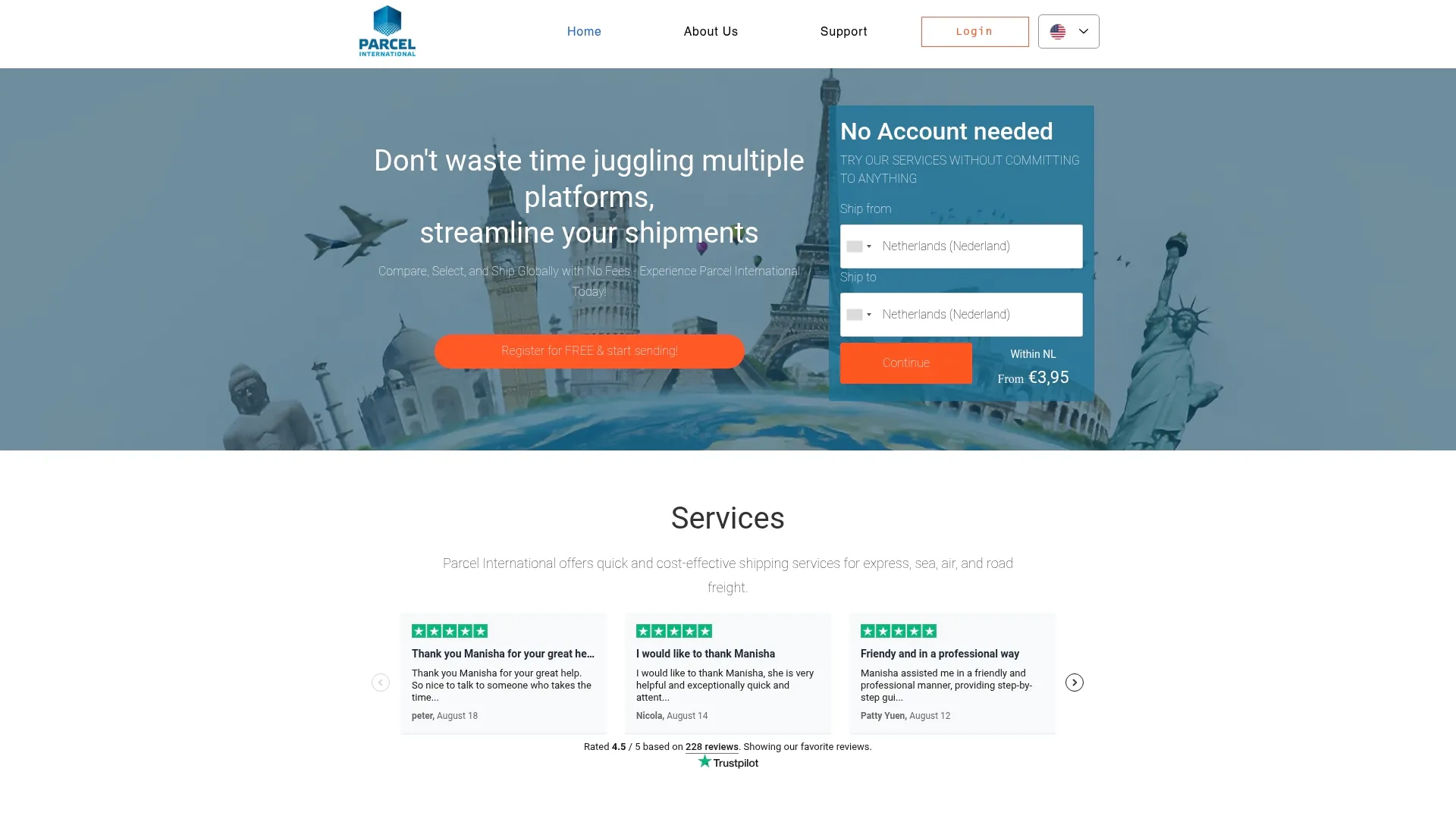
Through Parcel International, you can compare and book shipments with multiple carriers. Ready to get started? Calculate the cost of your next international shipment directly in the shipping calculator. Parcel International compares carriers for you and ensures your shipment arrives without unexpected surprises.
Can't find your question? Our support team is here for you 24/7 via the help centre.
What documents do I need for exports outside the EU?
Key documents include the commercial invoice, certificate of origin, packing list, transport documents, and import permits.
How do I apply the 0% VAT rate for exports?
Proof consists of the export declaration and transport documents such as a waybill (CMR or airway bill). Without this evidence, you may not apply the 0% VAT rate and risk penalties during a tax audit.
What are export regulations exactly?
Export regulations are the legal obligations a business must comply with when shipping goods abroad. They include documentation, customs procedures, product requirements, and VAT compliance.
What is an HS code, and why is it important?
An HS code is an international product classification code that determines the applicable tariffs, preferences, and certification requirements for each destination. An incorrect code leads to inaccurate customs duties and potential fines.
What are the new PEM rules effective from 2026?
The revised PEM rules replace the EUR-MED certificate for exports to Pan-Euro-Mediterranean countries. As of January 1, 2026, PEM declarations are used to prove the origin of goods, except for Algeria, Lebanon, and Syria, which have transitional rules.
Get a grip on your parcel shipping
Compare carriers, choose the best price and keep track of your international shipments. You can calculate and book without an account.

Recommendation
- Preparing for export control measures in 2026 – Send with Parcel International
- Customs rules explained: Smooth international shipping – Send with Parcel International
- Calculating import duties: A practical guide for 2026 – Send with Parcel International
- Understanding import and export controls in 2026 – Send with Parcel International