
TL;DR:
- Many e-commerce entrepreneurs opt for the cheapest shipping option without considering the consequences. Standard shipping offers reliability, full tracking, and predictable delivery times, while economy is cheaper but provides inferior service. Choosing the right shipping option depends on product value, customer expectations, and urgency.
Many e-commerce entrepreneurs choose the cheapest option for international shipping without understanding the trade-offs. The difference between economy and standard shipping may sound simple, but in practice, there’s more nuance than most carriers reveal. The wrong choice can cost you not just in euros, but also in complaints, returns, and missed repeat purchases. In this article, we explain exactly what both options entail, how they compare in price, speed, and service, and when each is the smartest choice for your online store.
Key Insights
Point | Details |
|---|---|
Clear Definition | Economy shipping is cheaper but slower; standard shipping is faster and offers more service. |
Customer Expectations Matter | For customer satisfaction, standard shipping is often the better choice, especially for high-value or time-sensitive shipments. |
Cost Isn’t Always Decisive | Consider the total costs, including risks and customer satisfaction, before opting for economy. |
Context Determines Choice | Analyze the type of package and recipient each time to select the right shipping option. |
What Do Economy and Standard Shipping Actually Mean?
Now that the importance of the choice is clear, let’s first explain what these shipping options actually entail.
A standard shipment is the basic package offered by nearly every carrier. Within the Netherlands, this typically means delivery within one business day, with active track & trace so both you and your customer can monitor the shipment. Within the EU, delivery times are slightly longer, but the service remains comparable. Standard shipments are always available, well-documented, and form the backbone of most e-commerce logistics.
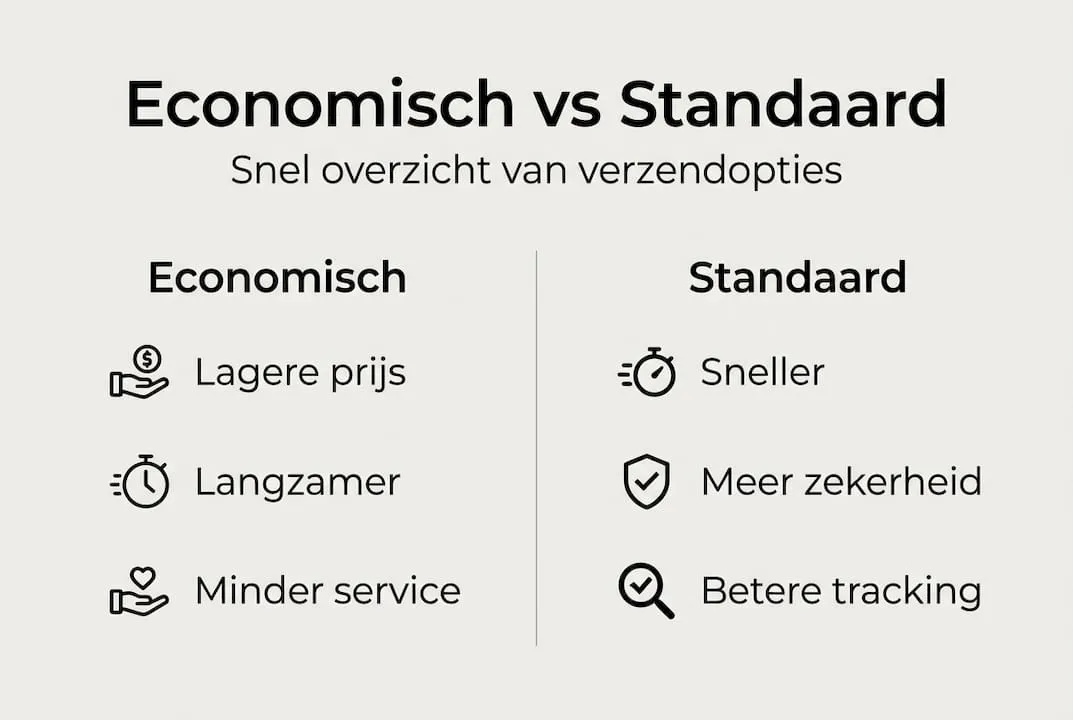
An economy shipment works differently. For international shipping, this is often offered as ‘economy international,’ where the carrier partners with local providers in the destination country. The price is lower, but this comes with longer delivery times and more limited service. At PostNL, a ‘standard shipment’ is the basic package, often delivered within one business day in the Netherlands, while international economy shipments via partners are slower and cheaper.
A common misconception is that ‘economy’ automatically means ‘basic’ or ‘slow.’ That’s not always true. In some cases, the difference in delivery time is only a day or two. However, the service differences are more structural: less detailed tracking, fewer guarantees in case of loss or damage, and lower priority during peak periods.
Here are the key differences at a glance:
- Standard: fixed delivery time, full track & trace, widely available, higher price
- Economy: lower price, longer and less predictable delivery time, limited tracking
- Standard International: suitable for EU and non-EU destinations, with clear service levels
- Economy International: via partner networks, less visibility in the process
Economy shipping isn’t the same as poor shipping. However, it does require you to know what you’re giving up—and that your customers are aware of those trade-offs.
When you compare the different shipping options for international shipments side by side, you’ll see that economy and standard are just two points on a broad spectrum of services. Understanding where they stand helps you make better choices for each order.
Comparison: Cost, Speed, and Service
With these definitions in mind, how do the options stack up against the key shipping criteria?
Criteria | Economy | Standard |
|---|---|---|
Price | Lower | Higher |
Delivery Time (NL) | 2 to 5 business days | 1 business day |
Delivery Time (EU) | 5 to 14 days | 3 to 7 days |
Track & Trace | Limited | Full |
Guarantee for Loss | Limited | Better |
Availability | Not always | Always |
Priority During Peak Times | Low | High |
A standard package with PostNL often has an acceptable base price for many online stores; the current rate can be found in the shipping calculator. Economy options may be cheaper, but that price difference can quickly disappear when you factor in the additional costs of potential issues.
What many entrepreneurs underestimate is the risk during peak periods. Around holidays, major sale events, or customs delays, economy shipments receive lower priority. Economy shipments have more limited tracking and a higher chance of delays during those moments when customers expect the fastest delivery.
The advantages of standard shipping summarized:
- Predictable delivery times, even during busy periods
- Full tracking for you and your customer
- Better handling of complaints or loss
- More certainty for high-value or time-sensitive products
When choosing the right options for international package shipping, it’s wise to look beyond the base price and consider the total risk profile of your shipment. If you want to structurally optimize shipping costs, start by understanding what each option truly costs.
Pros and Cons for E-Commerce Entrepreneurs
After comparing the criteria, let’s look specifically at the pros and cons for your business.
Standard shipments offer better tracking and reliability, making them ideal for e-commerce. However, that doesn’t mean economy is never a good choice. The decision strongly depends on your product type, customer profile, and the expectations you set at checkout.
Here are the key considerations at a glance:
- Customer Satisfaction: Customers who can’t track their package are more likely to contact your customer service. That costs time and money. Standard tracking reduces this issue structurally.
- Returns: Delays or loss via economy shipping make returns handling more complex. Standard shipping provides more support for return processes and claims.
- Reviews and Repeat Purchases: A late or lost shipment leads to negative reviews. A single bad experience costs you an average of multiple potential repeat purchases.
- Compliance: For shipments outside the EU, customs regulations apply. Economy shipping via partner networks offers less control over how that process is handled.
- Reputation: Online stores that consistently deliver on time build a loyal customer base faster.
A customer who cannot track their parcel is a customer who hesitates. And hesitation costs conversion, even on the next purchase.
Pro tip: Use economy shipments only if your customer has explicitly chosen the cheapest option upfront and understands the longer delivery time. Transparency at checkout prevents disappointment later.
For more practical examples of how logistics choices impact your online store, explore the logistics services for e-commerce that show how other online retailers have optimized their shipping.
Which shipping option to choose and when? Practical scenarios
Now that the pros and cons are clear, here’s the practical application: what do you choose in which situation?
Scenario | Recommended option | Reason |
|---|---|---|
Urgent delivery requested | Standard | Speed and reliability |
High-value product | Standard | Better guarantee and tracking |
Non-urgent, low value | Economy | Cost savings justified |
Outside EU, customs-sensitive | Standard | More control and documentation |
Peak period (holidays) | Standard | Lower risk of delay |
Large volumes, loyal customer | Economy possible | If expectations are aligned |
For small and medium-sized e-commerce businesses: choose economy for low-cost, non-urgent international shipments and standard when customer satisfaction is key.
The decision model works in practice as follows. For each order, ask yourself three questions:
- Is the customer willing to wait longer, and do they know it?
- What is the value of the product and the risk of loss?
- Is it a new customer or a loyal customer who trusts your brand?
Pro tip: At checkout, always offer two options: economy with a clear delivery time indication and standard with a small premium. Many customers will choose standard when they see the difference, increasing your margin and customer satisfaction at the same time.
If you want to ship internationally at consistently low costs without compromising on quality, combining both options per customer segment is the smartest approach. And if you want to know how to reduce-delivery-times-for-international-shipments, there are more factors at play than just the choice between economy and standard.
Our perspective: Why standard is sometimes cheaper than you think
Here’s an insight that surprises many business owners: the cheapest shipping option is rarely the most cost-effective solution.
An economy shipment that arrives two days later than expected costs you, on average, one customer service call, a risk of a negative review, and a lower chance of a repeat purchase. Multiply that by several shipments per month, and the price difference with standard is long gone.
The hidden costs of economy are real: extra customer contact, higher return rates due to dissatisfaction, and the operational time you or your team spend on follow-up. Standard shipping with volume discounts, strong agreements with a dedicated carrier, and a clear return policy often outperforms the seemingly cheaper economy option in practice.
The myth that the lowest rate is always the best choice doesn’t hold up when you examine the full cost chain. By optimizing shipping costs through volume agreements and smart routing, you can offer standard shipments at costs close to economy, but with far better results for your customer and your reputation.
Smart shipping? Discover the best shipping options
Ready to get started with better shipping? The right choices and partners are essential.
At Parcel International, we compare the best shipping options in over 220 countries and regions for you, so you always find the right balance between price, speed, and service. Whether you choose economy or standard, our platform gives you instant insight into rates, delivery times, and tracking options per carrier.

Want to know which factors can delay your shipments? Read more about the most-common-causes-of-delay in international shipments. Or discover which international-shipping-methods best suit your product type and customer profile. Take a look today and send your first parcel smarter around the world.
Can't find your question? Our support team is here for you 24/7 via the help centre.
What is the main difference between economy and standard shipments?
Economy shipments have lower costs and longer delivery times, while standard shipments are faster and offer better tracking and reliability. The service level differs significantly, especially for international shipments.
When is an economy shipment a smart choice for my online store?
Choose economy for non-urgent, lower-value international shipments to save costs. Economy is particularly useful for shipments where the customer is aware of the longer delivery time upfront.
Is a standard shipment always faster than economy?
Generally, yes: within the Netherlands, standard packages are typically delivered the next business day, while economy shipments may take longer, especially for international destinations.
What are the risks associated with economy shipments?
Economy shipments have limited tracking and a higher chance of delays during peak periods or customs inspections, which adds risk for valuable or time-sensitive products.
Get a grip on your parcel shipping
Compare carriers, choose the best price and keep track of your international shipments. You can calculate and book without an account.
