
Dropshipping is an e-commerce model where your online store sells products without holding inventory. The supplier ships directly to the customer. You are legally the seller, meaning customer service, returns, and product safety are entirely your responsibility—even if the issue lies with the supplier.
Three things you need to know right away:
- You are the seller. Consumers buy from you, not the supplier. Complaints, returns, and warranties go through you.
- You may also be the importer. For products from outside the EU, you are legally responsible for product safety and CE marking.
- Pre-purchase information requirements apply. Delivery time, shipping origin, and return address must be visible on your online store—not buried in the fine print.
What is dropshipping exactly, and who does what?
Dropshipping is a sales model where the online store owner (the dropshipper) accepts and receives payment for orders but leaves the physical fulfillment to a supplier. That supplier, a wholesaler or manufacturer, packs the product and ships it directly to the end customer.
The parties involved at a glance:
The dropshipper is you: the owner of the online store. You manage product presentation, pricing, customer service, and legal obligations. You are the 'seller of record,' the party legally responsible for the transaction.
The supplier is the party that physically holds and ships the product. This can be a wholesaler, manufacturer, or distributor. The supplier has no direct relationship with your customer.
The end customer buys from you and expects service, accurate information, and smooth delivery from you. That the supplier ships the package is irrelevant to the customer.
The carrier handles the transport from supplier to customer. Who this is and under what terms depends on the agreements you or your supplier make with a courier service.
In dropshipping, the online store owner remains the primary point of contact for consumers. Issues with delivery or quality cannot be shifted to a foreign supplier. That is the core of the model—and the biggest risk for those who underestimate it.
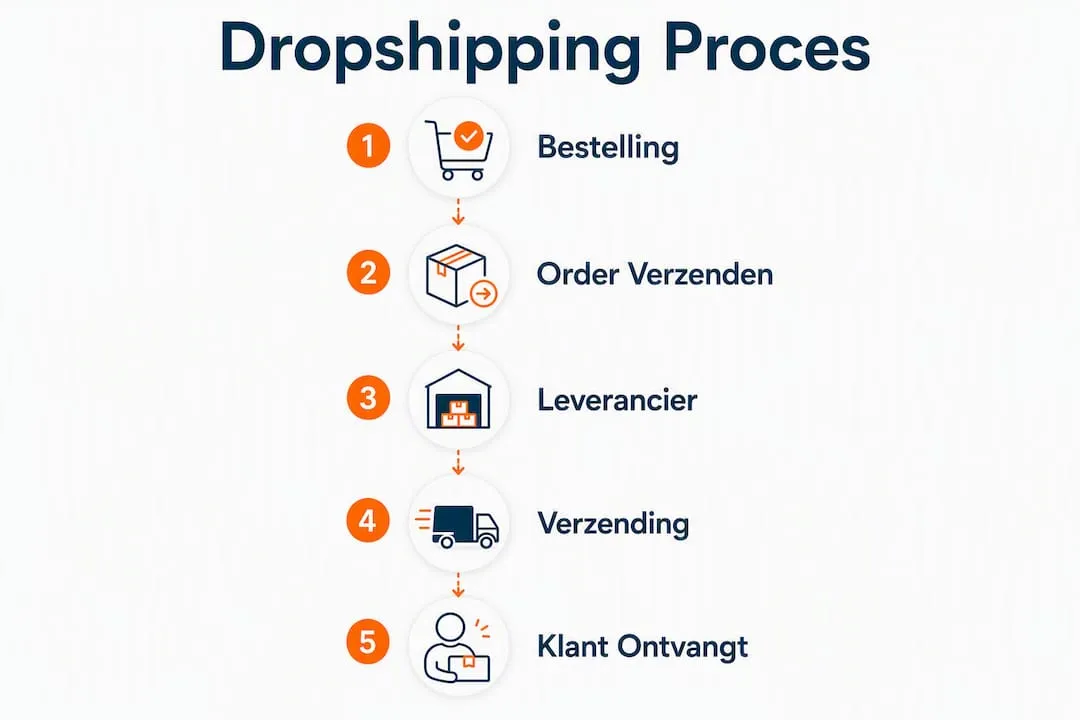
The flow at a glance: Customer places an order on your online store → you forward the order to the supplier → supplier ships the package → customer receives the product. You receive the payment, pay the supplier the purchase price, and keep the difference as your margin.
How does dropshipping work step by step?
The practical process is simpler than it sounds, but the details make the difference between a smooth operation and a customer service nightmare.
- Customer places an order on your online store and pays the selling price, including shipping costs.
- You receive the order and forward it manually or automatically to the supplier, including the customer’s delivery address.
- The supplier processes the order, packs the product, and ships it. Depending on the agreement, your company name appears on the package or invoice (white-label shipping).
- Tracking is shared. A good supplier sends a track-and-trace code that you forward to the customer.
- The customer receives the package. For questions, complaints, or return requests, the customer turns to you, not the supplier.
- Returns handling goes through you. You arrange whether the product is returned to you, to the supplier, or if you offer another solution.
Automation via platforms
Manually forwarding orders works for five orders a week. Beyond that, you need automation. Shopify and WooCommerce are the most used e-commerce platforms for dropshipping, partly because they integrate with apps that automatically forward orders to suppliers. Syncee and Spocket are two platforms specifically focused on European suppliers and offer direct integration with Shopify and WooCommerce. Syncee has a broad range of EU suppliers with shorter delivery times; Spocket focuses on suppliers in Europe and the US with filtered product quality.

The integration typically works like this: Your e-commerce platform receives an order → the app (Syncee, Spocket, or a similar tool) automatically forwards the order to the supplier → the supplier confirms and ships → tracking is automatically fed back to the online store.
Pro tip: Always place a test order with a new supplier before going live. Check the packaging, delivery time, invoice, and whether your company name is correctly listed. Also, verify that your online store’s inventory status is synchronized in real time—a common beginner’s mistake is selling an out-of-stock product.
What are the advantages and disadvantages of dropshipping?
Dropshipping has a low barrier to entry, but that is precisely why competition is fierce and margins are slim.

Advantages:
Low startup investment is the most cited advantage. You don’t need a warehouse, inventory, or a large capital injection to begin. You can quickly offer a wide assortment and test products without financial risk on unsold stock. This makes the model attractive for entrepreneurs who want to explore a market before investing further.
Disadvantages:
Margins are structurally lower than with bulk purchasing, as you buy per unit. Quality control is difficult if you never see the product. Delivery times, especially with suppliers outside the EU, are often longer than customers expect. And liability remains with you, even if the supplier makes the mistake.
A concrete example of what can go wrong: the ACM fined a dropshipper €90,000 for unclear information about delivery times and return options. Dropshipping is allowed, but compliance is mandatory.
When does it work? If you choose a niche with limited competition, find suppliers that deliver quickly and reliably, and are willing to invest in customer service and compliance. When doesn’t it work? If you expect to achieve high margins with minimal effort on generic products that everyone is already selling.
What types of suppliers and business models are there?
Your choice of supplier largely determines your margin, delivery time, and legal risk.
Wholesalers sell in bulk to retailers. In dropshipping, they sell per item, which increases the price. They typically have a broad assortment and professional documentation.
Manufacturers supply directly, which lowers the price but increases the minimum order quantity. Some manufacturers offer dropshipping, but this is less common.
Local European suppliers are more expensive to purchase from but offer shorter delivery times, fewer customs issues, and simpler CE documentation. For webshops in the Netherlands, this is often the better choice for customer satisfaction.
Chinese suppliers and marketplaces offer low purchase prices but longer delivery times (sometimes 2–4 weeks), higher customs risks, and more complex product safety requirements. CE documentation is not always available or reliable.
- Branded or white-label dropshipping is a variant where you sell products under your own brand name. The supplier produces the product, and you apply your own label. This increases margins and reduces price competition but requires more collaboration with the supplier and clear agreements on quality control.
- Classic dropshipping sells existing branded or generic products without your own branding. Low barrier to entry, but also the most competition.
- Traceability and CE documentation are required for every supplier. Always request the Declaration of Conformity and manufacturer details. Without these documents, you could face issues during an NVWA inspection.
- Trusted Shops is a European trustmark that gives consumers confidence in online purchases. As a dropshipper, you can apply for this certification if you meet the quality requirements, which increases conversion.
Platforms like Shopify and WooCommerce provide the technical foundation; Syncee and Spocket connect you with suppliers that are already filtered for EU compatibility.
## What legal obligations apply to dropshippers in the Netherlands?
The law does not distinguish between a dropshipper and a regular webshop owner. You sell, you are responsible.
According to the Dutch Government fines for violations can amount to nearly €1 million per offense. This is not a theoretical risk: the ACM actively enforces these rules.
Pre-purchase information obligation
The ACM requires that you clearly inform consumers before purchase about:
- The expected delivery time
- The country of shipment
- The shipping costs
- The return address
Information only in the general terms and conditions is insufficient. If you do not communicate this correctly, the cooling-off period for the consumer may be extended, and the ACM may impose a fine.
Consumer rights
The statutory cooling-off period is 14 days. After cancellation, you must refund within 14 days. This also applies if your supplier is in China and the return process takes weeks.
CE marking and product safety
When importing from outside the EU, you are the importer. The NVWA conducts random checks and can impose mandatory recalls and fines if products are unsafe. CE marking is mandatory for many product categories, and you must be able to demonstrate that the products comply with these requirements.
The NVWA explicitly warns: dropshippers must be able to demonstrate traceability. This means knowing who the manufacturer is, having declarations of conformity, and being able to provide these documents during an inspection. Many beginners underestimate this administrative burden.
Checklist of documents to request from suppliers:
- Name and address of the manufacturer
- Declaration of Conformity per product
- CE marking documentation for relevant product categories
- Country of shipment and, if applicable, the supplier’s EORI number
- Test reports from accredited laboratories (for electronics, toys, children’s products)
The Dutch Chamber of Commerce (KVK) advises to check VAT implications and import regulations early. Unexpected additional charges or goods held at customs are common risks in cross-border dropshipping. If in doubt, consult a tax advisor.
How to start with dropshipping: a step-by-step checklist
Administrative
- Register with the Dutch Chamber of Commerce (KVK). Without registration, you are not allowed to sell commercially. The KVK registration is the basis for your VAT number and your business bank account.
- Set up a business bank account. Keep business and personal finances separate from day one.
- Check your VAT obligations. When selling to consumers in other EU countries, threshold values apply for VAT remittance. Above a certain amount, you must remit VAT in the customer’s country via the OSS system (One Stop Shop).
- Check import regulations. For products from outside the EU, import duties and import VAT apply. Shipments under €150 fall under simplified regulations, but these change frequently. Check the current rules via the Dutch Tax and Customs Administration.
Technical
- Choose a platform. Shopify is quick to set up and has many dropshipping integrations. WooCommerce (on WordPress) offers more control but requires more technical knowledge.
- Link a payment method. iDEAL, credit card, and PayPal are standard for Dutch consumers.
- Set up product feeds. Via Syncee or Spocket, you import product information directly into your webshop, including descriptions, photos, and prices.
- Automate order processing. Ensure that orders are automatically forwarded to the supplier and that tracking is automatically fed back. Also, review how to manage shipping-orders-for-international-webshops to prevent errors.
Operational
- Select suppliers carefully (see the checklist in the next section).
- Place a test order with every new supplier before going live.
- Set up a return process. Determine whether returns go to you or the supplier and communicate this clearly on your webshop.
- Define a customer service SLA. Respond to inquiries within 24 hours. Customers expect this from an online store, regardless of whether you are the supplier or not.
Simple margin formula:
Selling price minus purchase price minus shipping costs minus payment fees (typically 1.5–3%) minus marketing costs equals net margin.
Example: selling price €39.95, purchase price €14.00, shipping €6.50, payment fees €0.80, marketing €5.00. Net margin: €13.65, or approximately 34% of the selling price. That sounds good, but returns and customer service costs quickly eat into this.
What to look for when choosing a dropshipping supplier?
A poor supplier is the fastest way to negative reviews and ACM fines. Use these criteria for every supplier selection.
Basic criteria:
- Catalog quality: Are product descriptions, photos, and specifications complete and accurate?
- Inventory synchronization: Is the stock status updated in real-time or at least daily in your webshop?
- Delivery times: What is the average delivery time to the Netherlands, and is it realistic to communicate to customers?
- Shipping countries: Does the supplier ship from within the EU or outside the EU? This determines customs and CE obligations.
- Return policy: Does the supplier accept returns, and under what conditions?
- CE documentation: Can the supplier provide declarations of conformity and manufacturer details?
- Communication SLA: How quickly does the supplier respond to inquiries and issues?
Technical criteria:
- API integration or direct integration with Shopify, WooCommerce, or a comparable platform
- Automatic tracking and order status updates
- Support for white-label shipping (your company name on the package)
Red flags to avoid immediately:
- No Dutch or European return address available
- Unclear or fluctuating delivery times without explanation
- No or incomplete product safety documentation
- Supplier refuses to share declarations of conformity
- Poor or slow communication during the orientation phase
In which industries does dropshipping work well, and where does it not?
The product category largely determines whether dropshipping is feasible.
Categories with realistic opportunities:
- Home accessories and decor: low safety requirements, wide selection from EU suppliers, limited return issues
- Non-food gadgets and lifestyle products: high margin potential, easy to test via small campaigns
- Seasonal items: garden accessories, party decor, sports accessories for specific seasons
- Pet supplies: growing market in the Netherlands, relatively simple regulations
Categories with structural issues:
- Electronics with safety requirements: CE marking is mandatory, documentation is complex, NVWA inspections are frequent
- Children's products and toys: strict safety standards (EN 71), high liability in case of incidents
- Custom and personalized products: dropshipping works poorly for products that vary per customer
- Luxury items and branded products: high return rates, authenticity risks, brand protection
A concrete example for the Netherlands: an online store selling garden accessories with suppliers in Poland or the Czech Republic combines short delivery times, EU-compliant products, and limited customs complexity. That is a realistic starting point. An online store selling cheap electronics from Chinese suppliers is not, unless you have the CE documentation fully in order.
Is dropshipping profitable? Costs, margins, and common mistakes
Most beginners underestimate the number of cost items.
Cost item | Description | Indicative share of selling price |
|---|---|---|
Product purchase price | Price you pay to the supplier | — |
Shipping costs | Depends on weight, distance, and carrier | 10% |
Import VAT and customs | For products from outside the EU | 5–15% |
Payment fees | iDEAL, credit card, PayPal | 1.5–3% |
Return costs | Processing, reinspection, potential write-off | 2–8% |
Marketing costs | Google Ads, social media, SEO | 10% |
Net margin | What remains | 5% |
A net margin within a limited range is realistic for dropshipping. At the lower end, you are competing on price with generic products. At the upper end, you have found a niche with little competition and EU suppliers that deliver quickly.
Common mistakes:
Incorrect pricing is the most common. Entrepreneurs forget to account for return costs, payment fees, and marketing budget, setting the selling price too low. No buffer for returns is the second mistake: with a return rate of 10–15% (normal for clothing or electronics), the margin disappears quickly. No CE check for products from outside the EU is the third, with potentially the most severe consequences. And poor customer service leads to negative reviews that deter new customers, increasing the marketing cost per conversion.
DDP or DAP: How to choose the right delivery terms for the EU?
The choice between DDP and DAP is one of the most underestimated decisions in dropshipping from non-EU countries.
Term | Full name | Who pays customs and VAT? | Customer experience |
|---|---|---|---|
DDP | Delivered Duty Paid | Seller (you) | No surprises upon delivery |
DAP | Delivered at Place | Buyer (the customer) | Customer pays extra upon delivery |
EXW | Ex Works | Buyer arranges everything | Only for B2B, not suitable for B2C |
With DDP, you bear the customs costs and import VAT. The customer receives the package without additional costs. This is the standard expectation of a consumer buying from an online store. With DAP, the customer receives an invoice from the carrier or customs upon delivery. This leads to complaints, refusals, and negative reviews, even if the price on your webshop was correct.
For B2C sales in the EU, DDP is almost always the better choice. The higher upfront costs are offset by the customer service costs and reputational damage from DAP surprises.
Practical checklist for customs and import:
- Ensure you have an EORI number if you regularly import from outside the EU
- Use correct HS codes (commodity codes) on the commercial invoice; incorrect codes cause delays
- Include on the invoice: product description, value, country of origin, and EORI number
- Agree with your supplier on who will handle the customs declaration and who will bear the costs
- Check if your carrier offers DDP services and what the associated costs are
Proper customs clearance significantly reduces the risk of delays and additional charges. Agree on this early in the supplier relationship, not just when a problem arises.
Pro tip: Explicitly ask your carrier if they can handle DDP shipments, including VAT declaration in the destination country. Not all carriers offer this, and the difference in customer experience is substantial. Parcelinternational can help you compare carriers based on this specific criterion.
Is dropshipping right for you? A quick decision checklist
Answer these three questions honestly before you start.
1. Do you have time for customer service and compliance?
Dropshipping is not passive income. You manage customer inquiries, returns, supplier relationships, and legal obligations. Expect to spend at least 10–15 hours per week in the startup phase.
2. Do you have a niche or product category with a realistic margin?
Generic products that everyone already sells rarely provide sufficient margin. A specific niche with EU suppliers and limited competition is a better foundation.
3. Are you willing to invest in compliance?
Requesting CE documentation, setting up return processes, and adhering to ACM regulations take time and sometimes money. Skipping this risks fines that can wipe out months of profit.
First three action steps if you decide to start:
- Register with the Chamber of Commerce (KVK) and open a business bank account.
- Choose one product category and find two or three EU suppliers who can provide CE documentation.
- Build a test webshop on Shopify or WooCommerce, place a test order, and verify the complete flow from order to delivery.
When should you wait? If you don’t have a budget for marketing (at least €200–500 per month to gather data), if your product category has complex safety requirements you don’t yet understand, or if you expect the supplier to solve all problems. That expectation is incorrect.
Key insights
Dropshipping only works if you take legal responsibility as a seller seriously, select suppliers based on documentation and delivery time, and make informed logistical choices (DDP vs. DAP).
Point | Details |
|---|---|
You are always the seller | Customer service, returns, and product safety are your responsibility, even with foreign suppliers. |
Compliance is not optional | ACM and NVWA actively enforce regulations; fines can reach nearly €1 million per violation. |
Supplier selection determines success | Always request CE documentation, declarations of conformity, and manufacturer details before going live. |
DDP prevents customer issues | For B2C sales in the EU, DDP is the standard expectation; DAP leads to complaints and returns. |
Parcelinternational for shipping comparison | Parcelinternational compares carriers based on DDP capabilities, costs, and delivery times for dropshippers in the Netherlands. |
Dropshipping requires more courage than most beginners think
Many people start dropshipping because it seems low-threshold: no inventory, no warehouse, just build a webshop and make money. That expectation looks good on paper, but in practice, the model is more demanding than it appears.
What I find remarkable: most beginners spend weeks building a beautiful webshop and dedicate just one afternoon to supplier selection. That’s exactly the opposite of what’s needed. The webshop is replaceable. The supplier determines whether your customers are happy, whether you’re CE-compliant, and whether your margin survives returns.
The compliance side is also consistently underestimated. A €90,000 fine for unclear return information sounds extreme, but the ACM has actually imposed it. The rules aren’t complicated, but you must know and follow them before receiving your first order, not after.
My practical advice: start small, start compliant, and start with EU suppliers. This limits customs complexity, shortens delivery times, and makes CE documentation much easier to manage. Once you understand the operation, you can expand to suppliers outside the EU, provided you’ve properly addressed the logistical and legal consequences. For questions about shipping, customs, or DDP options, you can always turn to Parcelinternational.
Parcelinternational helps you with shipping and customs for your webshop
Dropshipping without a reliable shipping partner is like a webshop without a payment system. You can have everything in order on the front end, but if delivery fails, the customer pays the price—and you pay the reputational damage.
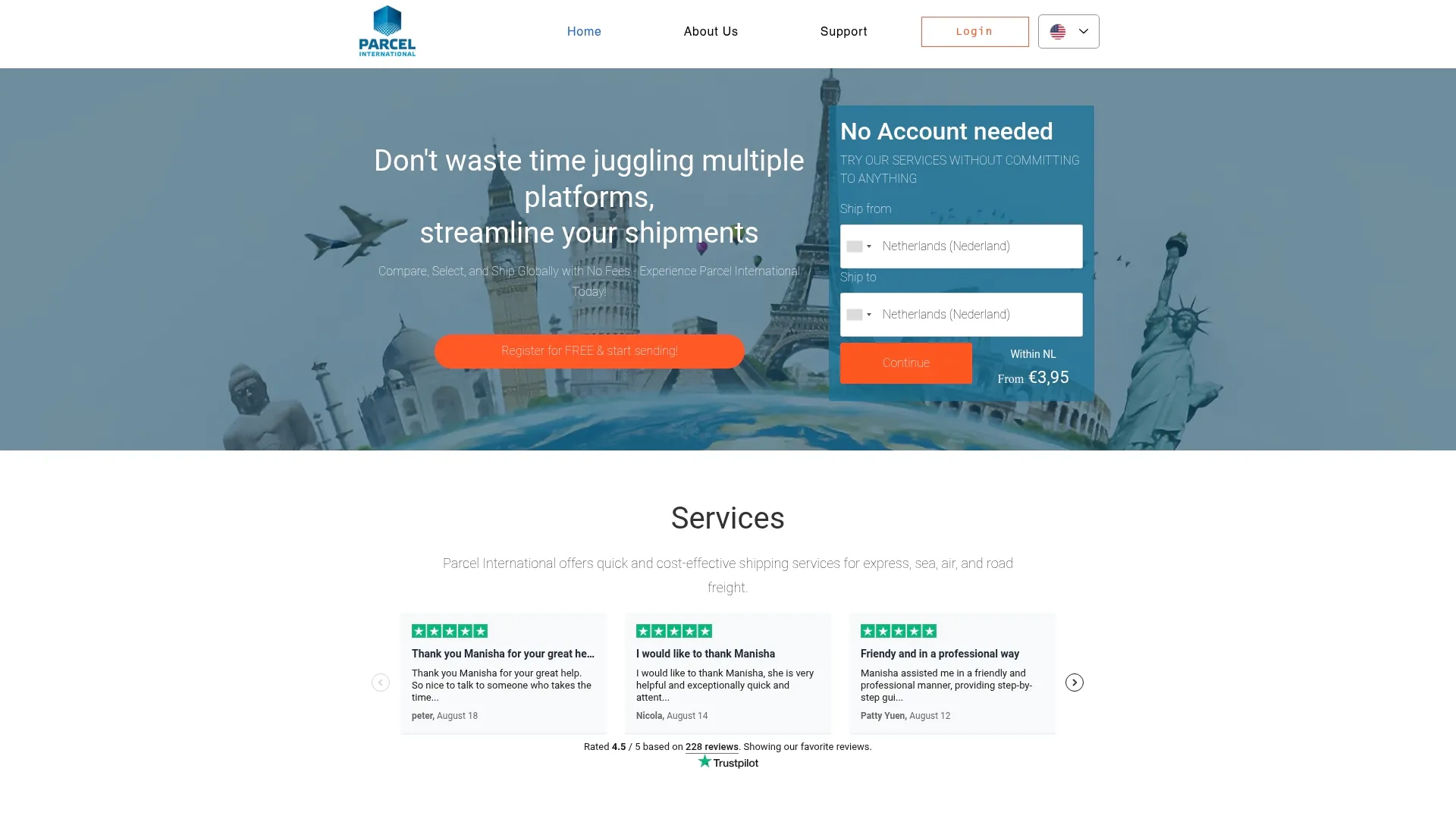
Parcelinternational compares carriers based on price, delivery time, and DDP capabilities, specifically for webshops shipping internationally from or to the Netherlands. No account needed to get started: you can immediately compare shipping options and see which carrier best fits your product category and destination country. Active since 2007, with coverage in over 220 countries and territories. Whether you ship one package a day or a hundred, the comparison gives you immediate insight into costs and transit times. This way, you make an informed choice instead of going with the first carrier you find.
Helpful official resources and recommended tools
Official authorities and regulations:
- Dutch government: dropshipping for entrepreneurs: overview of legal obligations and fine limits
- ACM dropshipping checklist: specific pre-purchase information requirements
- ACM fine case dropshipper: real-world example of enforcement
- NVWA product safety for webshops: CE marking and importer obligations
- NVWA traceability: documentation requirements for suppliers
- Chamber of Commerce (KVK) dropshipping: practical startup advice including VAT and import
- Business Portal: product safety for importers: step-by-step guide for CE compliance
Platforms and tools:
Parcelinternational logistics resources:
- customs-clearance-tips-for-ecommerce: practical advice on HS codes, EORI, and imports
- Cross-border e-commerce checklist: compliance and logistics combined
- 7 tips for e-commerce shipping: efficient shipping processes for online stores
Recommendation
- Customs clearance tips for e-commerce: save time – Send with Parcel International
- Importing goods for e-commerce: step-by-step guide and costs – Send with Parcel International
- 7 Practical Tips for E-commerce Shipping – Send with Parcel International
- Start international shipping: Step-by-step guide for successful deliveries – Send with Parcel International
Get a grip on your parcel shipping
Compare carriers, choose the best price and keep track of your international shipments. You can calculate and book without an account.
