
Sending international parcels via DHL typically starts at low double-digit rates for lightweight shipments to neighboring countries. For an exact quote, use the live rate calculator or request a label directly. Exact DHL international shipping rates depend on weight, volumetric weight, destination, and chosen service level. According to journalistic comparisons international shipments with comparable services often start around €10, while domestic shipments can be as low as €3.70.
Rough estimates for frequently requested weight classes:
- 0–2 kg to neighboring countries (Belgium, Germany): starting at lower-end prices (economy)
- 2–5 kg to countries further in Europe (e.g., Poland, Czech Republic): starting at mid-range prices (economy)
- 5–10 kg to France or beyond: starting at higher prices, depending on weight and destination (economy/standard)
Note: these are indicative price ranges. The actual price depends on volumetric weight, exact destination, service level, and any surcharges. Always use a live rate calculator for the definitive price.
Key Insights
DHL international shipping rates typically start at around €10 for lightweight parcels to neighboring countries. Volumetric weight, destination, and service level determine the final price, and a live rate calculator always provides the most reliable result.
Point | Details |
|---|---|
Starting rates are indicative | Economy shipments to neighboring countries typically start around €10; the exact price depends on volumetric weight and surcharges. |
Volumetric weight matters significantly | A box measuring 40 × 30 × 30 cm with a physical weight of 1.5 kg is billed as 7.2 kg volumetric weight. |
Customs apply outside the EU | Shipments outside the EU require a commercial invoice, HS code, and sometimes an EORI number. Check the EU country list via the Dutch government. |
Express is significantly more expensive | For non-urgent shipments, DHL eCommerce is the affordable choice; express is worthwhile for deadlines or valuable goods. |
Parcelinternational compares live rates | With Parcelinternational, you can compare multiple carriers without an account and book the best rate directly. |
Which DHL Shipping Services Are Available for International Shipping?
DHL offers two main services for international shipments: DHL eCommerce (also known as DHL Parcel International) and DHL Express. They cater to different needs and budgets.

DHL eCommerce is the economy option for non-urgent parcels. Delivery times typically range between 3 and 8 business days, depending on the destination. The price is lower, but you drop off at a ServicePoint or schedule a pickup. Ideal for e-commerce businesses and individuals prioritizing cost over speed.
DHL Express is the premium service for time-sensitive shipments. Delivery to most European destinations takes 1–3 business days, with home pickup and extensive track & trace. The price is higher, but you gain reliability and speed.
Comparison by Service Level:
- Economy/Standard: lower price, longer delivery time, drop-off at ServicePoint, basic insurance included
- Express: higher price, shorter delivery time, home pickup, comprehensive insurance and guarantee
- ServicePoint Drop-off: available for both services; convenient if you’re not home for pickup
- Door-to-Door: standard with Express, optional with eCommerce
Dutch shippers most often choose DHL eCommerce for non-urgent shipments to countries further in Europe. For business deadlines or valuable goods, Express is the safer choice.
Pro Tip: Compare both service levels using a rate calculator before booking. The price difference between economy and express for a 2 kg parcel to Germany can be significant, but express provides a guaranteed delivery window.
How Are DHL Rates Calculated?
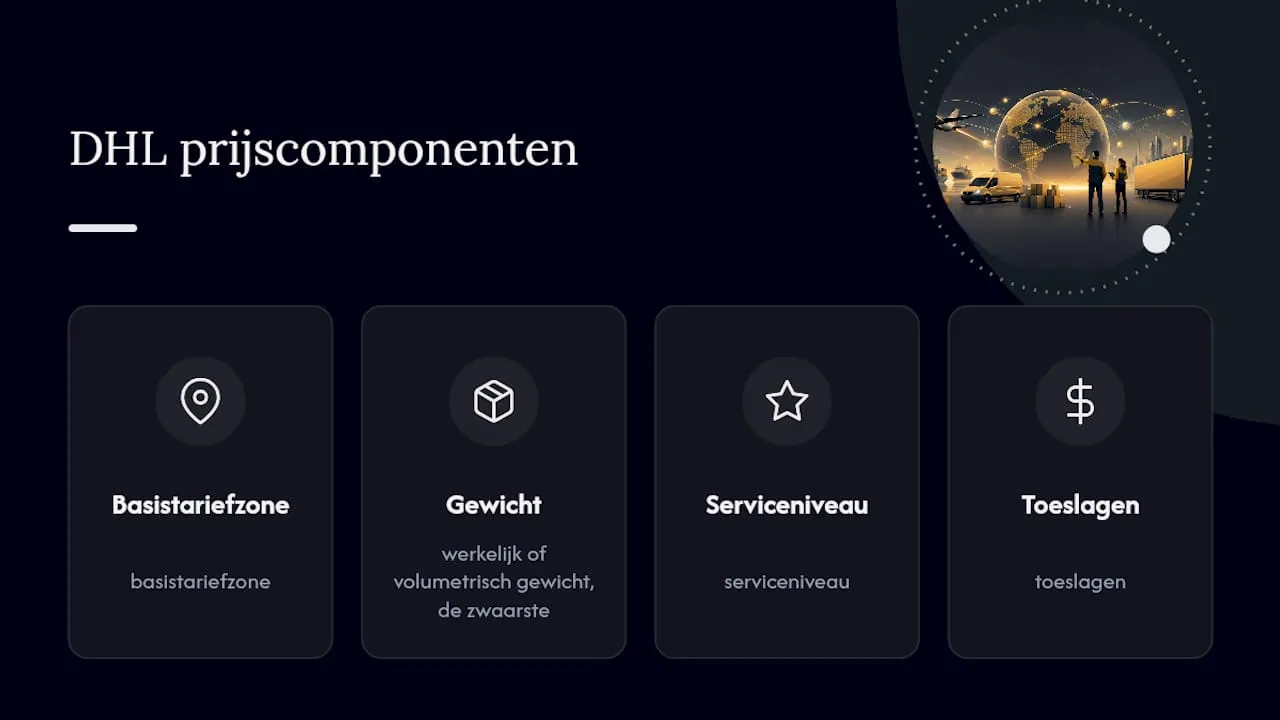
The basic formula: price = base rate zone + (actual or volumetric weight, whichever is higher) + service level + surcharges.
Volumetric Weight: The Most Underestimated Factor
Volumetric weight applies when a parcel is light but large. The standard formula DHL uses is:
(length × width × height in cm) ÷ 5,000 = volumetric weight in kg

Concrete example: A box measuring 40 × 30 × 30 cm physically weighs 1.5 kg. Volumetric weight: (40 × 30 × 30) ÷ 5,000 = 7.2 kg. You pay for 7.2 kg, not 1.5 kg. This surprises many shippers the first time.
Common Surcharges
- Fuel Surcharge: a percentage added to the base rate, varies by period
- Dimensional Surcharge: for parcels approaching maximum dimensions
- Remote Area Surcharge: for hard-to-reach postal codes or regions
- Customs Clearance Surcharge: for shipments outside the EU, covering clearance costs
- Pickup Fee: when your parcel is picked up at home instead of dropped off at a ServicePoint
Zones determine the base rate: neighboring countries (Belgium, Germany) fall into a lower zone than destinations like Poland or the Czech Republic, and countries outside Europe cost more.
Pro Tip: Choose a box that fits your product as snugly as possible. An oversized box increases volumetric weight and thus the price, without making your product larger or heavier. Use filler material sparingly and purposefully.
What Are Indicative Prices for Popular Destinations?
Belgium and Germany are cheaper due to the short distance and DHL’s dense networks in those countries. Poland and the Czech Republic fall into a higher rate zone and sometimes require additional processing time, increasing the price.
For DHL Express, rates for the same weight classes are significantly higher, but delivery times are then 1–2 business days to all mentioned destinations.
What to Expect in Terms of Delivery Time per Service?
Delivery times are guidelines, not guarantees. Customs delays, local holidays, and peak periods (such as the December holidays) can extend the transit time.
- DHL Express to neighboring countries (Belgium, Germany): 1–2 business days
- DHL Express to countries further in Europe (e.g., Poland, Czech Republic, France): 2–3 business days
- DHL eCommerce to neighboring countries: 2–4 business days
- DHL eCommerce to other European countries: 4–7 business days
- Shipments outside the EU (e.g., Switzerland, UK): allow 1–2 extra business days for customs clearance
Always choose Express for urgent shipments, commercial deadlines, or when the recipient must be present on a specific date. For regular webshop orders without time pressure, eCommerce is the affordable standard. Learn more about reducing delivery times in the Parcel International guide.
When do you pay import duties and VAT for shipments outside the EU?
Shipments within the EU fall under the internal market: no import duties, no customs declaration. As soon as you send a package to a country outside the EU, such as the United Kingdom, Switzerland, or the US, different rules apply. The Dutch government publishes which countries belong to the EU; this is the quickest way to check if your destination requires customs clearance.
According to Customs import duties and VAT are due once the commercial value of an e-commerce shipment exceeds the applicable threshold. For e-commerce, the seller or their appointed importer is typically responsible for the declaration and payment, depending on the delivery terms.
Which documents do you need?
- Commercial invoice: required for every shipment outside the EU; states value, contents, and parties involved
- Commodity code (HS code): required for correct tariff classification; the Dutch Tax and Customs Administration provides an overview of commodity codes for cases of doubt
- EORI number: mandatory for businesses that regularly ship outside the EU
- Clear description of contents: in English or the language of the destination country; vague descriptions cause delays
An incorrect HS code is one of the most common causes of customs delays and additional costs. Take the time to look up the correct code.
Pro tip: Small private gift shipments (low value, non-commercial) may sometimes qualify for an exemption. Commercial e-commerce shipments, even small ones, generally do not. Check the current threshold values at Dutch Customs before shipping.
What additional options and extra costs are there?
The base price covers transport. Everything below is optional or situationally applicable.
- Insurance: DHL provides basic coverage; for valuable shipments, you can increase the insured value. The cost is a percentage of the declared value. Worthwhile for electronics, jewelry, or business goods over €100.
- Signature on delivery: extra assurance that the package reaches the right person; additional charge per shipment
- Home pickup: convenient but not free; with DHL eCommerce, dropping off at a ServicePoint is the cheapest option
- Return label: include in advance or create afterward; relevant for webshops with a return policy
- Customs handling fees: for shipments outside the EU, DHL may charge a surcharge for clearance services
Combine multiple packages into one pickup to spread the fixed pickup costs. For regular shippers, scheduling a fixed pickup day can quickly save money.
Business vs. private: what are the differences?
Private individuals pay the standard public rates and can easily purchase a label online via the DHL website or at a ServicePoint. This works well for occasional shipments.
Business accounts offer:
- Volume discounts: lower rates per shipment for higher volumes
- Monthly invoicing: no upfront payment per shipment
- API integration: automatically generate labels from your webshop or ERP system
- Contract terms: fixed agreements on pickup frequency and service levels
Pro tip: Do you ship more than 20–30 packages internationally per month? Then a business account or a comparison platform like Parcel International is almost always worthwhile. The rate differences compared to public prices can be significant per shipment, depending on volume and destination.
For small e-commerce sellers who do not yet have a business account, a shipping comparison platform for international shipments is a quick way to access favorable rates without contractual obligations.
How do you get an exact rate and shipping label in minutes?
- Measure and weigh your package — use a kitchen scale for weight and a measuring tape for the three dimensions (length × width × height in cm).
- Calculate the volumetric weight — (L × W × H) ÷ 5,000. Use the higher value of actual or volumetric weight as the basis.
- Choose your destination and service level — economy for non-urgent shipments, express for time-sensitive packages.
- Enter the details into a rate calculator — on the DHL website or via a comparison platform like Parcel International.
- Pay and print your label — or choose a pickup service if you do not want to drop off the package yourself.
For international shipments, also have the following ready: commercial invoice, HS code of the contents, EORI number (for businesses), and a clear description of contents in English.
Labels and track & trace can also be managed via the DHL Parcel app for Android or the My DHL app for iOS.
Compare and book your shipment via Parcel International to view multiple carriers side by side in one step.
How can you save on international shipping costs?
Comparison is the most direct way to save. Rates for the same shipment can vary significantly between carriers and platforms, and comparative sources confirm that checking volumetric weight and comparing providers are among the most effective cost-saving methods.
Practical cost-saving tips:
- Optimize your packaging: use the smallest possible box that protects your product. Every centimeter less can reduce the volumetric weight.
- Choose economy for non-urgent shipments: the price difference with express can quickly add up to €10–15 for a 3 kg package to Germany.
- Bundle shipments: combining multiple small packages into one larger shipment lowers the average cost per kg.
- Check volumetric weight in advance: Always calculate before you book to avoid surprises from a higher invoice.
- Use a ServicePoint: Home pickup incurs extra costs; dropping off at a ServicePoint is the cheapest option with DHL eCommerce.
Example scenario: A 3 kg package to Germany costs approximately €15–18 via DHL eCommerce. The same shipment via DHL Express costs approximately €28–35. For non-urgent shipments, the price difference of around €13–17 per package adds up to savings of €130–170 for ten shipments per month.
Pro tip: E-commerce sellers with multiple small shipments to the same country can benefit from consolidated clearance: all packages are processed in a single customs declaration, saving time and clearance costs. Ask your carrier or comparison platform if this is available for your volume.
Find more practical tips for affordable international shipping in the Parcel International guide.
Why is a live rate comparison the smartest first step?
DHL rates are not static. Fuel surcharges, seasonal peaks, and contract terms mean the price you see today may differ next month. That makes a live rate calculator not a luxury but a necessity, especially if you ship regularly.
What I’ve seen repeatedly after years in logistics: shippers who look up a rate once and continue using it as a reference consistently overpay. The market fluctuates. A 4 kg package to Poland that cost €22 three months ago could now be €19 or €25, depending on the current fuel surcharge and the platform you choose.
Parcel International has been comparing carriers across more than 220 countries since 2007. The value isn’t in one cheap shipment but in the pattern: those who compare every shipment consistently pay less over a year than those who book based on instinct. Use the live calculator, compare multiple providers for larger volumes, and check the comprehensive rate guide for deeper analysis and example calculations.
Compare carriers and save via Parcel International
Parcel International provides a side-by-side comparison of rates from multiple carriers in one overview, without requiring you to create an account. This is the concrete advantage over booking directly with a single carrier: you immediately see if a cheaper or faster option is available for your specific shipment.
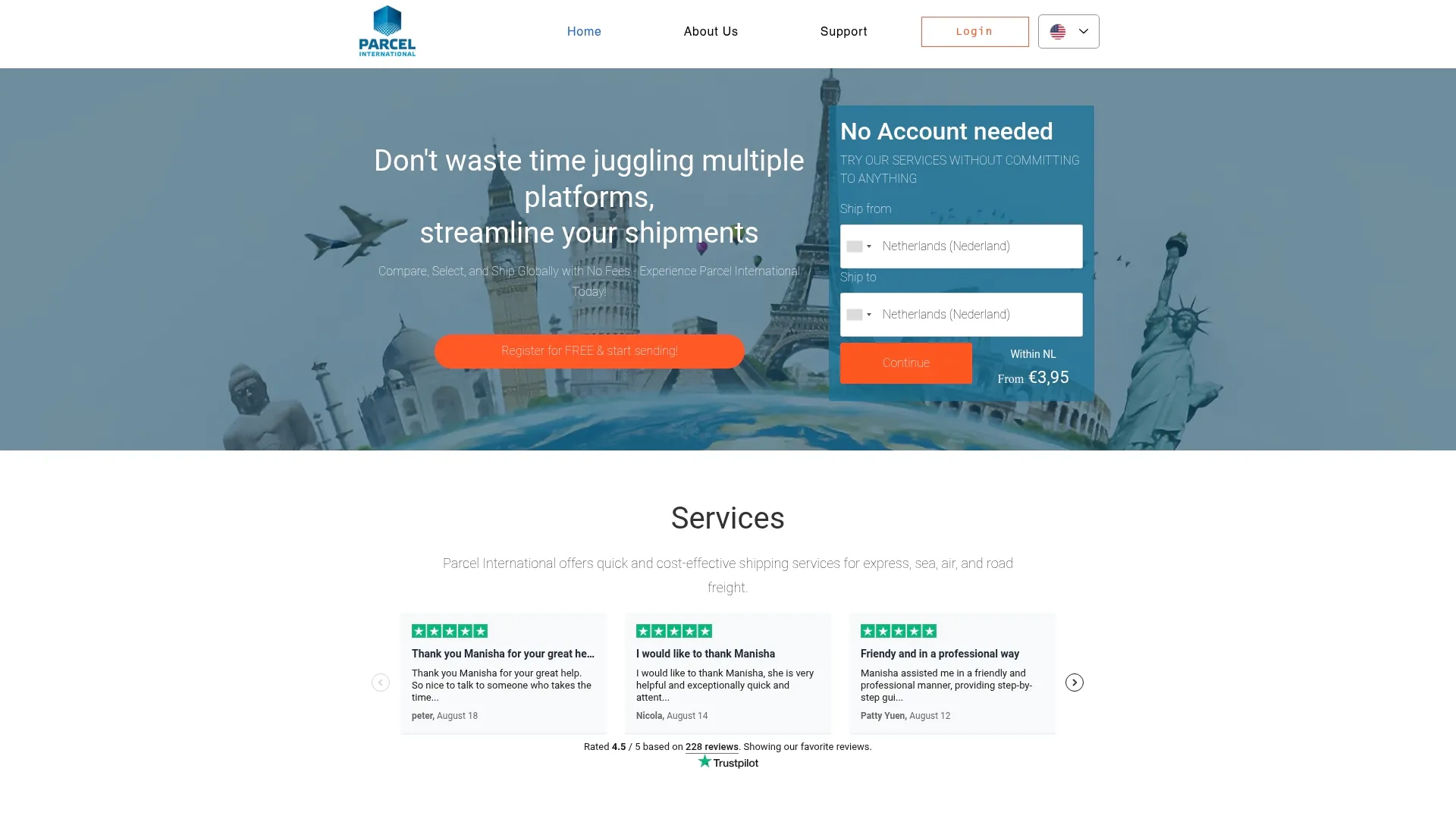
The service is available for both individuals and businesses and works for shipments to over 220 countries. Occasional shippers benefit from transparent comparisons without contractual obligations. Regular shippers can also request business rates and label services through the platform. Parcel International is the publisher of this article and offers the comparison and booking service as a paid service.
Compare carriers now and book your shipment—within five minutes, you’ll have a live rate and a shipping label ready.
Sources
Official and reliable sources to check rates, customs rules, and apps:
Get a grip on your parcel shipping
Compare carriers, choose the best price and keep track of your international shipments. You can calculate and book without an account.
