
TL;DR:
- Many online stores use fixed delivery dates, but international shipments are rarely precise and require realistic time windows. Offering windows increases customer satisfaction, reduces operational pressure, and improves reliability, especially for international shipments. By planning accurately and managing expectations, you achieve a higher OTIF score and a stronger reputation.
Many online stores communicate a fixed delivery date to customers but forget that international shipping is rarely as predictable as domestic delivery. The difference between a fixed date and a realistic delivery time window may seem small, but it has significant consequences for customer satisfaction, operational pressure, and your store's reputation. In this article, you will learn exactly what a delivery time window is, how to measure delivery reliability, the challenges involved, and how to successfully implement time windows for international e-commerce. Concrete examples, step-by-step plans, and practical tips ensure you can apply this immediately.
Key Insights
Point | Details |
|---|---|
Clear Definition of Delivery Time Window | A delivery time window is a specific timeframe in which delivery is promised; this provides more realistic customer communication than a fixed delivery date. |
OTIF as a Success Metric | Delivery reliability and customer satisfaction are linked to the percentage of orders delivered fully within the time window. |
Operational Challenges | Offering delivery time windows requires smart planning and can lead to additional costs due to complex logistics. |
Practical Application | Successfully implementing delivery time windows requires clear internal definitions, capacity management, and transparent customer communication. |
What Exactly Is a Delivery Time Window?
Imagine this: you order a package, and the online store promises delivery on “Wednesday.” Wednesday comes and goes, the package doesn’t arrive, and customer service is flooded with questions. This is the typical result of an overly confident promise. A delivery time window works differently.
A delivery time window is a defined timeframe in which you, as an online store, promise delivery, and within which the carrier attempts to deliver, instead of a single fixed date or “as soon as possible.” This may sound less precise, but it’s actually smarter. You provide customers with a realistic picture, and that expectation management is invaluable.
The explanation of delivery time in e-commerce makes it immediately clear that time windows not only work for the customer but also simplify internal planning. Consider the classic breakdown:
- Morning Window: delivery between 08:00 and 12:00
- Afternoon Window: delivery between 12:00 and 17:00
- End of Day: delivery by 21:00
- Full-Day Window: delivery on an agreed day, without a fixed time
For international shipments, you also add multi-day windows, such as “delivery within 3 to 5 business days.” This is much fairer than “delivery on day 4,” as customs, local carriers, and weather conditions can affect timing.
“Customers who receive a time window instead of an exact promise are, on average, more satisfied when delivery occurs at the end of that window than when a fixed date is missed.” This insight from research on customer expectations in e-commerce underscores why time windows are so effective.
Why does this work so well? Customers understand that delivery is not an exact science. They want to know when they need to be home or when to expect their package at a pickup location. A window provides that information without false promises. Additionally, it reduces pressure on your customer service, as fewer customers will call on day 4 if you’ve promised “3 to 5 business days.”
Now that you understand why delivery time windows are important, let’s take a closer look at how planning and reliability play a role.
Delivery Time Window and Delivery Reliability: What Really Counts?
A delivery time window is only as strong as the extent to which you actually meet it. This is where the concept of delivery reliability comes into play. Delivering within the window depends on delivery reliability: it’s not just about meeting the average but about the percentage of orders that are actually delivered on time and in full, also known as OTIF.
OTIF stands for On Time In Full. The calculation is simple:
OTIF (%) = (Number of orders on time in full / Total number of orders) × 100
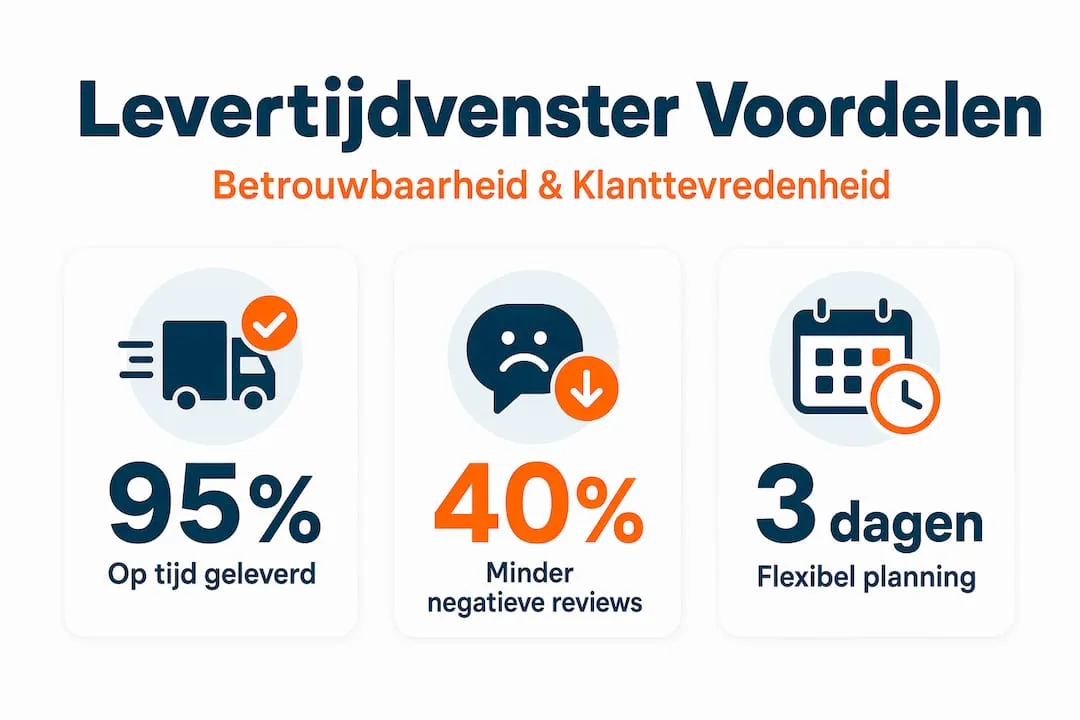
A score of 95% means that 95 out of 100 orders are delivered fully and within the agreed window. That sounds good, but it also means that 5 out of 100 customers are disappointed. For an online store with 10,000 shipments per month, that’s 500 frustrating experiences.
Metric | Example A | Example B |
|---|---|---|
Total Orders Placed | 1,000 | 1,000 |
Orders Delivered On Time | 920 | 870 |
Orders Delivered In Full | 950 | 910 |
OTIF Score | 87% | 82% |
Missed Windows | 130 | 180 |
Online Store A performs better, but even an 87% OTIF score is not good enough for many customers. For luxury or time-sensitive products, customers expect a score above 95%.
How do you, as an online store, formulate your own definition of “on time”? Follow these steps:
- Determine Your Reference Point: Is “on time” the day of promised delivery, or the end of the promised window?
- Set Your Margin: Do you accept a 1-day delay, or is any deviation considered a failure?
- Segment Your Shipments: Distinguish between domestic and international orders, as international routes have more variables.
- Define “In Full”: Does a partial delivery count as successful, or only if all products arrive at once?
- Store Data by Carrier: This way, you can see which partners consistently meet your delivery time windows and which do not.
- Review Monthly: Link your OTIF score back to your operational team and transport partners.
Pro Tip: Link delivery time windows to realistic capacity planning. A “next-day morning” window is only achievable if your carrier can actually guarantee this for your destination. Check tips for avoiding delays and timely-international-delivery to identify which factors cause delays and how to internally manage them with clear agreements.
With these figures and definitions in mind, you can now examine operational challenges and their impact on planning.
Operational Challenges with Delivery Time Windows
Delivery time windows may sound simple, but behind the scenes, they introduce significant complexity—especially in international shipping. Time Window Constraints are treated in route planning and last-mile logistics as time windows per stop, increasing complexity due to potential wait times or the need for additional vehicles.
In practice, this means: if twenty customers in the same residential area all want a morning window, but the courier only has one vehicle, not all customers can be served. Choices must be made, routes adjusted, and sometimes extra capacity deployed.

Compare flexible and strict time windows:
Feature | Flexible Time Window | Strict Time Window |
|---|---|---|
Definition | Broad day window (e.g., all day) | Narrow window (e.g., 2 hours) |
Customer Benefit | Less need for customer to be at home | Customer knows exactly when to expect delivery |
Planning Pressure | Low | High |
Costs | Lower | Higher |
Suitable For | Standard e-commerce | Luxury or time-sensitive products |
Risk of Failure | Lower | Higher during peak days |
Additional Vehicles Needed | Rarely | Regularly during high demand |
Strict windows work well when volumes are predictable and the carrier has sufficient capacity. In international e-commerce, this is rarely guaranteed—especially during peak periods like the holidays.
Common obstacles when offering delivery time windows include:
- Cut-off Times: Orders placed after a certain time will not make the desired window. Communicate this proactively on your product page or during checkout.
- Customs Wait Times: International shipments can be held for days. A strict time window is then unfeasible.
- Carrier SLAs: Not every carrier offers time windows for every destination. Always verify this in advance.
- Seasonal Peaks: During busy periods, capacities fill up, and time windows become less reliable.
- Last-Mile Issues: In rural or hard-to-reach areas, the last mile may take longer than expected.
- Coordination with Logistics Partners: If you use multiple carriers, you must align time slots consistently.
Pro tip: Clearly communicate the limitations of delivery time windows for international orders to customers. Use smart shipping tips and review logistics examples to see how other e-commerce businesses handle this.
Now that you know the practical challenges, it’s time to apply delivery time windows in your store and customer communication.
Successfully Implementing Delivery Time Windows in Your E-Commerce
You understand the theory and the pitfalls. Now the question is: how do you implement delivery time windows in a way that satisfies both your customers and your team? This requires a structured approach.
For small to medium-sized e-commerce businesses, it’s essential to internally define “on time” at the delivery time level—such as exact date versus within a window—and ensure delivery estimates align with your operational reality, including cut-off times, processing time, and carrier SLAs.
Follow this step-by-step plan:
- Map Your Operational Reality: How long does it take to process an order internally? What are your carriers’ cut-off times? Which destinations offer time windows?
- Define Time Slots by Region or Carrier: European orders have different windows than intercontinental shipments. Make this distinction clear to the customer.
- Adjust Your System: Ensure your ordering process, confirmation email, and track-and-trace provide the correct window information. Automated messages reduce manual work and miscommunication.
- Align with Transport Partners: Confirm that your carrier can actually meet the promised windows for each destination, including backup options in case of failure.
- Train Your Customer Service: Staff must understand what a delivery time window entails so they can inform customers accurately and calmly if a window is missed.
- Monitor and Continuously Optimize: Use your OTIF score to identify where windows consistently fail and adjust your offerings accordingly.
Best Practices for Choosing Realistic Time Slots:
- Choose broad windows for international destinations where last-mile delivery is uncertain.
- Use narrower windows only for destinations where your carrier can demonstrably meet them.
- Offer customers choice: some prefer a broader window if it’s cheaper.
- Communicate proactively in case of deviations: send a message as soon as a window is missed—sooner rather than later.
- Link customs-clearance tips to your time window planning so customs delays don’t come as a surprise.
- Consult practical shipping methods to determine which method best fits which time window.
Managing customer expectations goes beyond just stating the window. Display the window on the product page, in the checkout, in the confirmation email, and in your track-and-trace environment. Repeating the same information at every touchpoint reduces unnecessary customer inquiries. Customers reminded of the window at multiple points are less likely to call your customer service.
A concrete example: a Dutch webshop shipping to Belgium and Germany can safely offer a window of “1 to 3 business days.” For shipments to the US or Australia, “5 to 10 business days” is more realistic. By explicitly communicating this on the product page, you reduce complaints. Customers who know what to expect are much more forgiving of minor delays.
Why Delivery Time Windows Are Smarter Than a Delivery Date
After years of experience with international shipping, we at Parcel International see a recurring pattern: e-commerce businesses that stick to a fixed delivery date consistently suffer more reputational damage than those that work with honest delivery windows.
A fixed delivery date has a certain allure. It feels concrete and reliable. “Your package will arrive on Friday” sounds more reassuring than “your package will arrive between Thursday and Monday.” But that apparent clarity is an illusion, especially in international logistics. A one-day customs delay, a full flight, or a holiday in the destination country can disrupt the entire schedule. And then your customer service team is left dealing with the fallout the next day.
What we see in practice: e-commerce businesses that switch to delivery windows report fewer negative reviews, fewer refunds due to “late delivery,” and a noticeable reduction in strain on their customer service. Not because their logistics suddenly became perfect, but because expectations better align with reality.
There’s a common misconception that customers always want the fastest and most specific promise. That’s not true. Customers want reliability. They want to know they’re not waiting at home in vain, and that their package will arrive when you say it will. An honest three-day window that you meet always beats a pinpoint date that you miss.
Our advice is sincere: don’t just look at what competitors communicate, but at what you can *actually* deliver. The importance of timely shipping isn’t about promising the fastest delivery, but about consistently delivering on what you promise. That’s the foundation of customer trust in international e-commerce.
Pro tip: Test your own delivery windows by tracking for a month what percentage of your international shipments arrive within the promised window. If it’s less than 90%, your windows are too narrow. Adjust them before the customer does—via a negative review.
Delivery windows are also operationally appealing. Your logistics team gains more flexibility to optimize routes, handle peaks, and respond to unexpected circumstances. A strict time window forces you to operate at maximum capacity at all times, with all the associated risks. A realistic window provides breathing room, and breathing room leads to fewer mistakes.
The next step: making your international delivery smart and reliable
Delivery windows are only as good as the partners and systems that fulfill them. At Parcel International, we help e-commerce businesses daily to choose the right carriers for each destination, with honest and achievable delivery times.

Want to see which shipping options are available for your products and destinations right away? Through our platform, you can easily compare parcel services without needing an account. This gives you an instant overview of which carriers, delivery times, and prices are available for your destination. Already thinking about the busy holiday season? Discover now how to prepare for peak periods so your customers remain satisfied with reliable delivery windows, even during peak times.
Can't find your question? Our support team is here for you 24/7 via the help centre.
What does a delivery time window mean for my customer?
A delivery time window gives customers a realistic timeframe for when their package will be delivered, such as “morning” or “end of the day,” instead of an exact date, which is rarely guaranteed due to logistical variables.
How do I determine which delivery time window best fits my online store?
Analyze your processing time, cut-off hours, and carrier SLAs, then align your timeframes accordingly for maximum delivery reliability. Start with broader windows and only narrow them if your data shows you can consistently meet them.
Does a delivery time window make planning more expensive or complicated?
It offers greater flexibility for the customer but makes route planning more complex and may require additional costs or vehicles, particularly with strict or narrow time windows combined with high volumes.
What is OTIF, and why is it important for delivery time windows?
OTIF stands for On Time In Full and measures the percentage of orders delivered within the agreed time window in full. It is the most reliable metric to assess whether your delivery time windows are being met in practice.
Get a grip on your parcel shipping
Compare carriers, choose the best price and keep track of your international shipments. You can calculate and book without an account.
