
TL;DR:
- No customs duties are required within the EU, but for distance sales exceeding €10,000, VAT must be declared via OSS.
- For shipments outside the EU, correct documentation and accurate product descriptions are essential to avoid delays.
- From July 2026, a fixed import duty of €3 per product type will apply to imports up to €150, introducing additional costs.
Your package is ready, the address is correct, yet it’s stuck in a customs warehouse. This happens to more businesses and individuals than you might think. Unclear product descriptions, missing forms, or incorrect tariff codes are the most common causes of delays in international shipments. Customs rules may seem complicated, but with the right knowledge, they’re easy to understand. This guide explains step by step what you need to know, whether you’re shipping within the EU, to countries outside the EU, or as an e-commerce entrepreneur active in dropshipping.
Key Insights
Point | Details |
|---|---|
No customs duties within the EU | For packages within the EU, customs declarations and duties are usually not required. |
Documentation for exports outside the EU | For shipments outside the EU, an export declaration, customs declaration, and commercial invoice are mandatory. |
IOSS simplifies imports | The IOSS scheme simplifies the import of goods up to €150 for small e-commerce businesses. |
Fixed import duty in 2026 | From July 2026, a €3 import duty per product type will apply to e-commerce packages up to €150. |
Customs Rules for Shipments Within the EU
Good news if you’re shipping to another EU country: you don’t need a customs declaration, and you won’t pay import duties. Within the EU, the principle of free movement of goodsapplies, meaning packages from the Netherlands to, for example, Spain or Poland can pass through without customs formalities. That saves a lot of paperwork.
But be aware: VAT is a different matter. If you sell goods to consumers in other EU countries as a business, the distance selling rules apply. Once your revenue from such sales exceeds €10,000 per year, you must pay VAT in the buyer’s country. Fortunately, you don’t need to register separately in each country. Through the OSS (One Stop Shop) scheme, you file one return in the Netherlands, and the Tax Authority automatically distributes the VAT to the correct countries.
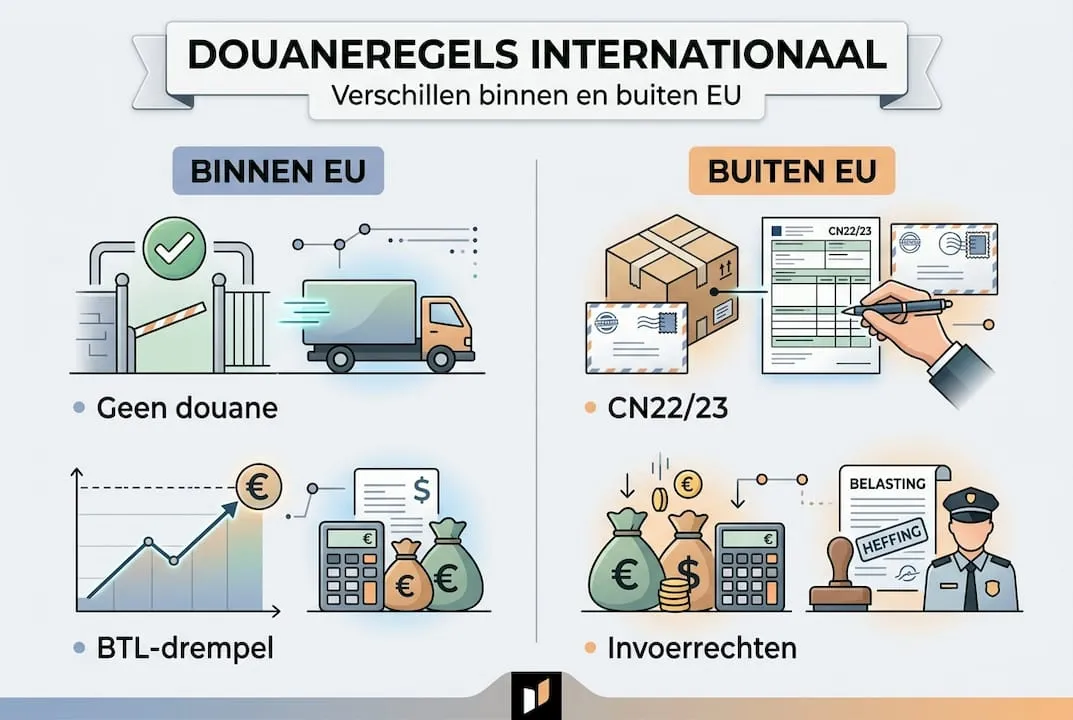
What does this mean in practice? Suppose you sell handmade jewelry to customers in Germany, Belgium, and Italy. As long as your total revenue in those countries remains below €10,000, you simply charge Dutch VAT. If you exceed that threshold, you switch to OSS. This is simpler than it sounds and prevents you from having to file separate tax returns in multiple countries.
The international-shipping-rules for EU shipments are relatively straightforward. However, there are a few key points to consider:
- No customs duties or declarations for shipments within the EU
- VAT obligation in the destination country for distance sales exceeding €10,000
- OSS scheme enables centralized VAT filing
- Some goods are subject to specific regulations (e.g., food or medicine)
- Always check if your product has special requirements per country
The role of customs in EU shipments is limited, but VAT administration requires attention if you’re seriously selling to foreign consumers.
Pro tip: Register for the OSS scheme in a timely manner via the Tax Authority. Don’t wait until you’ve already exceeded the threshold, as you’ll then need to correct it retroactively. That costs time and energy you’d rather invest in your business.
Now that the basics for shipments within the EU are clear, let’s look at shipping outside the EU.
Customs Rules for Shipments Outside the EU
Are you shipping to countries outside the EU, such as the US, UK, Australia, or Japan? Then the rules are much more extensive. Customs in the destination country inspects every shipment and levies import duties and VAT based on the value and type of goods. Good preparation here isn’t a luxury—it’s a necessity.
The mandatory export-documents-outside-eu include several components. Here’s an overview of the steps you’ll go through:
- Export declaration: This is the official notification to Dutch customs that your goods are leaving the country. It’s mandatory for shipments over €1,000. Carriers often handle this for you, but always double-check.
- Determine the HS code: The Harmonized System code is an internationally numbered system used by customs authorities worldwide to classify products. Each HS code determines the applicable import duty rate. An incorrect code leads to delays or additional charges.
- Complete CN22 or CN23: These are customs declarations attached to the package. Use CN22 for shipments up to 300 SDR in value and CN23 for those above. Both forms include information about the contents, value, and origin.
- Commercial invoice: Contains the value of the goods, sender and recipient details, and a clear description of the contents.
- Packing list: A detailed overview of all items in the package, including weight and dimensions.
Document | When required | Purpose |
|---|---|---|
CN22 | Shipments up to 300 SDR in value | Customs declaration for small shipments |
CN23 | Shipments above 300 SDR in value | Customs declaration for larger shipments |
Commercial invoice | Always for commercial shipments | Value determination and identification |
Export declaration | Shipments over €1,000 | Official export notification |
Packing list | Recommended for multiple items | Verification and control |
Correctly completing-customs-forms is crucial. One mistake in the product description can mean your shipment is delayed for weeks. Also, check out the customs clearance tips for extra guidance on complex shipments.

Pro tip: Always write product descriptions as specifically as possible. Not “clothing” but “blue cotton women’s blouse, size M.” Customs officers need to understand at a glance what’s in the package. Vague descriptions are the fastest way to a delayed shipment.
In addition to customs regulations outside the EU, there are special arrangements for dropshipping and e-commerce.
Special Arrangements: OSS and IOSS for E-Commerce and Dropshipping
For small businesses and e-commerce entrepreneurs, there are two schemes that make life much easier: OSS (One Stop Shop) and IOSS (Import One Stop Shop). Both are designed to reduce administrative burden, but they work differently.
OSS has already been discussed in the context of EU shipments. IOSS is specifically for dropshipping and imports from outside the EU. The IOSS e-commerce scheme works as follows: you import products from outside the EU and deliver them to private individuals within the EU. As long as the value per shipment remains under €150, the buyer does not pay import VAT upon receipt. You remit the VAT monthly via a single return in the Netherlands.
This is a major advantage for dropshippers selling products from, for example, China or the US to European customers. Without IOSS, the customer would be surprised at the door with a VAT invoice, leading to poor experiences and returns. With IOSS, the VAT is already included in the sales price.
Scheme | For | Threshold | Declaration |
|---|---|---|---|
OSS | EU sellers to EU private individuals | €10,000 per year | Quarterly |
IOSS | Import from outside EU to EU private individuals | €150 per shipment | Monthly |
Benefits of IOSS at a glance:
- Faster customs clearance because VAT has already been paid
- No unpleasant surprises for the customer upon delivery
- One monthly declaration instead of registration in every EU country
- Less chance of refused parcels or returns
Also check the information on e-commerce-customs-clearance for more practical insights.
Pro tip: Make sure your IOSS number is always on the customs form. If the number is missing, the shipment will be treated as if no IOSS is registered. The customer will then still have to pay import VAT, and that is exactly what you want to avoid.
In addition to these fiscal schemes, a new import duty has been introduced since July 2026 for certain imports.
New Rules 2026: Fixed Import Duty for E-Commerce Imports up to €150
From 1 July 2026, there is an important change for e-commerce businesses importing products from outside the EU. There is now a fixed import duty of €3 per product type for imports with a value up to €150. Additionally, a handling fee of €2 is expected around 1 November 2026; this is not yet final. This is a temporary measure, but the impact is already noticeable.
What exactly is changing? Previously, imports up to €150 were exempt from import duties. This exemption has now been replaced by a fixed amount per product type. This may sound small, but for businesses importing hundreds of small parcels daily, it quickly adds up.
“The measure is temporary in nature, but businesses should already adjust their pricing and logistics processes. Do not wait until the permanent scheme is in place.”
Which products fall under this scheme?
- Clothing and accessories
- Electronics and gadgets
- Toys and hobby items
- Cosmetics and personal care products
- Household items
- Jewelry and decoration
These are precisely the categories popular on platforms like Temu, Shein, and AliExpress. The measure is partly driven by the enormous growth of cheap imports from Asia. Check the packaging requirements 2026 for additional information on what else is changing this year.
For small businesses, this means you need to review your cost price calculation. A product worth €10 now incurs an additional €3 import duty, and soon possibly a €2 handling fee. This can add up to 50% extra costs on top of the product value. Adjust your prices and margins in a timely manner.
Now that all customs rules and exceptions have been discussed, here is a practical look at applying them.
Practical: What Most Businesses Miss in Customs Procedures
Official sources like the Tax and Customs Administration and the Chamber of Commerce explain the rules correctly, but they describe the world as it should be. The logistics reality is different. Based on our experience at Parcel International, we repeatedly see the same mistakes, even among businesses that think they have everything in order.
The biggest pitfall is a vague product description. “Gift items” or “miscellaneous goods” are descriptions that raise a red flag at every customs post. The practical customs clearance tips show how to easily solve this with specific, honest descriptions.
A second common mistake is forgetting documents for shipments that just exceed a threshold value. Many businesses know the rules for standard situations but forget that a slightly heavier shipment suddenly requires different forms. Always check the weight and value before sending a parcel.
“Compliance does not guarantee smooth processing. A correctly filled-out form with a vague description still leads to delays.”
OSS and IOSS significantly reduce the administrative burden, but only if you apply them consistently and correctly. Filling out forms is a skill that you develop through repetition and attention to detail. Take the time to train your team in this, because one mistake per day is a serious problem over the course of a year.
Next Step: Smart Shipping and Applying Customs Rules Directly
You now know everything about customs rules, but smart shipping only starts with the right logistics partner.
Parcel International has been guiding individuals and small businesses with international shipments to over 220 countries since 2007. We not only help you with the right documentation but also with choosing the fastest and most cost-effective shipping option. Compare the rates of different carriers directly on our platform. Discover how to address the causes-of-delays and start shipping without surprises today.
Can't find your question? Our support team is here for you 24/7 via the help centre.
What documents do I need for exports outside the EU?
Key documents include the commercial invoice, certificate of origin, packing list, transport documents, and import permits.
What changes on July 1, 2026, for small shipments?
The exemption for shipments up to €150 has been abolished. Until July 1, 2028, a temporary fixed import duty of €3 per product type applies to shipments from outside the EU to consumers. A handling fee of €2 is expected around November 2026 but is not yet finalized.
Are there customs regulations within the EU?
No customs duties apply within the EU due to the free movement of goods, but you must still comply with national product requirements, VAT rules, and excise goods regulations.
What is the advantage of the IOSS scheme?
IOSS simplifies importing from outside the EU by eliminating import VAT for shipments up to €150 to EU consumers, with a single monthly declaration in the Netherlands.
Get a grip on your parcel shipping
Compare carriers, choose the best price and keep track of your international shipments. You can calculate and book without an account.
