
TL;DR:
- Clear delivery terms prevent complaints, return issues, and legal disputes.
- International shipping requires the use of Incoterms such as DAP and DDP for proper risk allocation.
- Clear agreements and communication build customer trust and improve international logistics.
Many online stores starting to ship internationally assume their standard delivery terms are sufficient. This is a costly misunderstanding. Incorrect or unclear agreements on delivery, costs, and risk transfer lead to complaints, return issues, and even legal conflicts. Especially if you sell within the EU strict rules apply regarding mandatory communication. In this article, you’ll learn exactly what delivery terms are, which elements you should never omit, how Incoterms work, and how to avoid common mistakes.
Key Insights
Point | Details |
|---|---|
Clear Delivery Terms Required | Always ensure clear agreements on delivery time, costs, and risk transfer. |
Incoterms Make a Difference | Choose and specify the correct Incoterm for each international shipment to avoid surprises. |
Avoid Common Mistakes | Explicitly address returns and what to do in case of delays or damage—prevent disputes by documenting everything. |
Don’t Forget Legislation | Your delivery terms must comply with European transparency and return obligations. |
Make It Strategic | Delivery terms are more than a formality: use them as a growth accelerator and reputation safeguard. |
What Are Delivery Terms Exactly?
Delivery terms are the rules of your logistical promise to the customer. They specify when a package will be delivered, who bears the costs, when the risk transfers from seller to buyer, and what happens if something goes wrong. Many entrepreneurs confuse delivery terms with general terms and conditions. These are two different things.
General terms and conditions govern the broader business relationship: payment terms, liability, dispute resolution. Delivery terms are more specific and focus solely on the physical transport and transfer of goods. However, delivery terms must be included in the general terms and conditions , along with information on delivery time, shipping costs, risk transfer, and the right of withdrawal.
What Must Be Legally Included? Consider:
- Delivery Time: when can the customer expect the package?
- Shipping Costs: who pays what, and are there additional costs for international shipments?
- Risk Transfer: at what point does the risk of loss or damage transfer to the buyer?
- Right of Withdrawal: the customer has the right to return within 14 days for distance purchases
- Contact Information: who can be contacted in case of issues?
A practical example: if a package gets lost en route from the Netherlands to Spain, and your delivery terms do not clearly describe when the risk transfers, you are legally vulnerable as the seller. The customer can hold you liable, even if the carrier made the mistake.
Unclear delivery terms are not a legal detail. They are a direct threat to customer satisfaction and your revenue.
For international shipments, additional rules apply. Consider international shipping regulations regarding customs, prohibited goods, and country-specific requirements. Ignoring these rules risks delays, holds, or returns of packages.
Key Components of Delivery Terms for E-commerce
Now that the basics are clear, let’s look at what you really need to address in your delivery terms. Not as a legal formality, but as a practical tool for smooth deliveries and satisfied customers.
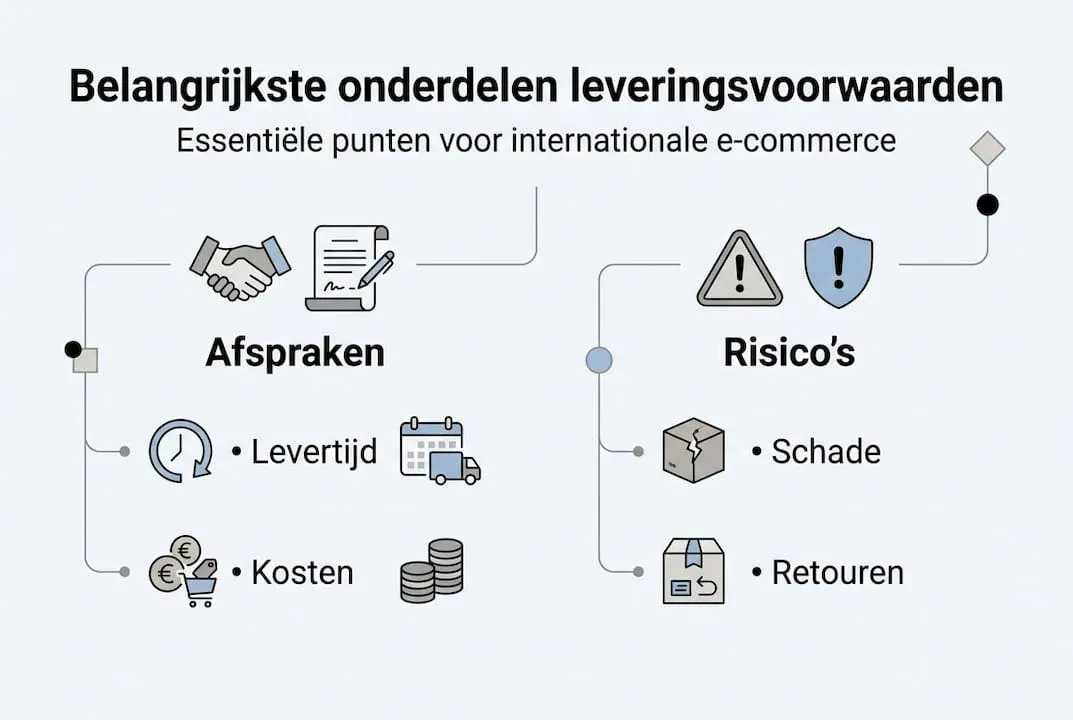
The five core components that should never be missing:
- Delivery Time: Always provide a realistic expectation. According to EU regulations, a maximum delivery time of 30 days applies unless otherwise agreed. Internationally, this may be longer, but communicate this proactively. Learn more about what delivery time means in this delivery-time-explanation.
- Shipping Costs: Be transparent about all costs, including potential import duties or VAT for shipments outside the EU. Hidden costs are the fastest way to a negative review.
- Risk Transfer: Specify the moment you are no longer responsible. This is directly linked to the Incoterms you use (more on this in the next section).
- Returns and Cancellation: Describe step-by-step how returns work. Who pays the return costs? What is the timeframe? The difference between pickup and delivery also plays a role in responsibility.
- Damage and Loss: What does your company do if a package arrives damaged? A clear protocol prevents endless discussions.
Here’s an overview of how these components translate into practical agreements:
Component | What You Specify | Risk Without Clarity |
|---|---|---|
Delivery Time | Expected days, exceptions | Complaints, refund obligations |
Costs | All costs including customs | Hidden costs, distrust |
Risk Transfer | Moment of transfer | Liability disputes |
Returns | Timeframe, procedure, costs | Legal conflicts |
Damage/Loss | Procedure and compensation | Reputational damage |
Pro tip: Send a confirmation email with a summary of the delivery agreements for every order. This prevents disputes afterward and strengthens customer trust.
International Shipping and Incoterms: How to Do It Right
Now that you know what’s required, let’s focus on international shipping and the role of Incoterms. Incoterms (International Commercial Terms) are international standard rules that specify who bears which costs and when the risk transfers during transport. They were developed by the International Chamber of Commerce and are used worldwide.
The most commonly used Incoterms 2020 for small and medium-sized e-commerce businesses are DAP, DDP, EXW, and FCA. Each has a different distribution of responsibility.

Incoterm | Risk Transfer | Costs for Seller | Suitable for |
|---|---|---|---|
DAP | At destination delivery | Transport, not import | Most B2C shipments |
DDP | At delivery, all paid | All-inclusive import | Full customer convenience |
EXW | At pickup from seller | Minimal | Not recommended for webshops |
FCA | At handover to carrier | Export costs | B2B, experienced importers |
Which Incoterm do you choose and when?
- DAP (Delivered at Place): You arrange transport to the customer’s door. The customer pays import duties themselves. Ideal for shipments to countries where the customer is familiar with customs procedures.
- DDP (Delivered Duty Paid): You handle everything, including customs and import duties. This maximizes customer convenience but requires more of your logistics expertise. Read more about international shipping risks before choosing DDP.
- EXW (Ex Works): The buyer picks up and arranges everything. Almost never suitable for webshops.
- FCA (Free Carrier): You deliver to the carrier; afterward, the risk is with the buyer. Useful in practical logistics scenarios where the buyer uses their own freight forwarder.
Pro-tip: Always specify the exact location and version of the Incoterms in your contract or invoice. Write, for example, “DAP Amsterdam, Incoterms 2020” and not just “DAP.” Without this precision, disputes can arise due to differing interpretations.
Pitfalls and best practices for delivery terms in practice
Finally, we discuss how to avoid common mistakes and apply delivery terms practically. Even entrepreneurs who understand Incoterms often make errors that cost them customers.
The most common pitfalls:
- Incoterm not specified: You state “DDP” but omit the location or version. In a dispute, no one knows which rules apply.
- Risk transfer unclear: You write “delivery under reservation” without defining what that means. The customer assumes you remain responsible; you assume otherwise.
- Vague return agreements: No clear timeframe or procedure. Result: endless email exchanges and dissatisfied customers.
- No consideration for customs: For VAT and customs regulations outside the EU, additional obligations apply. Who informs the customer about import duties?
- No protocol for delays: What do you do if a package arrives late? Learn more about causes and solutions in our package-delay-explanation.
Best practices that actually work:
- Use a checklist per destination: which rules apply in that country?
- Communicate proactively about delays. Customers accept delays but not silence.
- Have your delivery terms reviewed annually for relevance, especially when expanding into new markets.
- Use clear language in your terms. Legal jargon backfires with consumers.
In case of delays or non-delivery, you, as the seller, are obligated to inform the customer and refund within 14 days if delivery is impossible. For international logistics outside the EU, additional customs obligations apply, which must be arranged in advance.
The consequences of poor delivery agreements are greater than you think. A single negative experience can lead to bad reviews. And reviews determine for many new customers whether they buy from you.
Our perspective: What no one tells you about delivery terms
After years of hands-on experience with international shipments, we see one pattern recurring: entrepreneurs fill in Incoterms because they have to, not because they understand what they’re agreeing to. They copy a template, paste “DAP” into their terms, and think they’re done. But that template is written for an average business, not your specific logistics chain.
Standard texts rarely align with your growth plans. If you decide to ship to Australia or Canada tomorrow, the risks change fundamentally. Customs regulations, delivery times, and liability work differently. A template doesn’t account for that.
Smart entrepreneurs build delivery terms strategically as a competitive advantage. Clear agreements reduce customer inquiries, shorten issue resolution time, and increase conversion because customers gain more trust. See how to approach this via ecommerce-logistics-optimization. Delivery terms aren’t a legal burden. They’re an opportunity to stand out.
Shipping internationally smarter? Discover your advantage
You now know what clear delivery terms entail and how to use them strategically. The next step is ensuring your logistics processes align with those agreements. Because good terms without reliable execution don’t work.

Parcel International has helped small and medium-sized webshops with international shipments to over 220 countries since 2007. From comparing carriers to navigating customs-regulations-explanation and avoiding causes-of-delays. Discover how to elevate your logistics with international-shipping-optimization and keep customers abroad truly satisfied.
Can't find your question? Our support team is here for you 24/7 via the help centre.
What should always be included in delivery terms?
Always specify delivery time, costs, risk transfer, return policy, and liability for damage or loss. This ensures compliance with legal requirements and prevents ambiguity in delivery agreements.
What is the difference between delivery terms and Incoterms?
Delivery terms govern all agreements related to delivery in a broad sense. Incoterms are international standard rules that specifically define the division of costs and risks between seller and buyer during transport.
What happens if there is a delay in delivery?
Inform your customer immediately and transparently. If delivery proves impossible, you are required to refund the amount within 14 days according to EU regulations.
Which Incoterms are most suitable for small online stores?
DAP or DDP give you the most control over the delivery experience. EXW carries more risk for the buyer and is almost never the right choice for online stores.
Get a grip on your parcel shipping
Compare carriers, choose the best price and keep track of your international shipments. You can calculate and book without an account.
