
In a nutshell:
- Transport insurance protects goods against loss, damage, and theft during international transit, mitigating financial risk. There are two main types: one-time insurance for occasional shipments and continuous insurance for frequent shipments, with key differences in premiums and flexibility. Selecting the right coverage, aligning with Incoterms, and matching risk transfer are crucial for full protection.
Transport insurance is the coverage that protects your goods against loss, damage, and theft during transit, from the moment of loading to unloading. Without this coverage, international shippers face significant financial risk—whether it’s individuals sending a valuable item or small businesses regularly shipping packages abroad. Under the CMR convention, carrier liability for road transport is limited to approximately €10 per kilogram. For a 2-kilogram laptop worth €1,200, this means a maximum compensation of just €20. A proper transport insurance policy fully covers that gap.
What Types of Transport Insurance Are Available?
Choosing the right transport insurance starts with understanding the two main types of transport insurance: one-time insurance and continuous insurance.
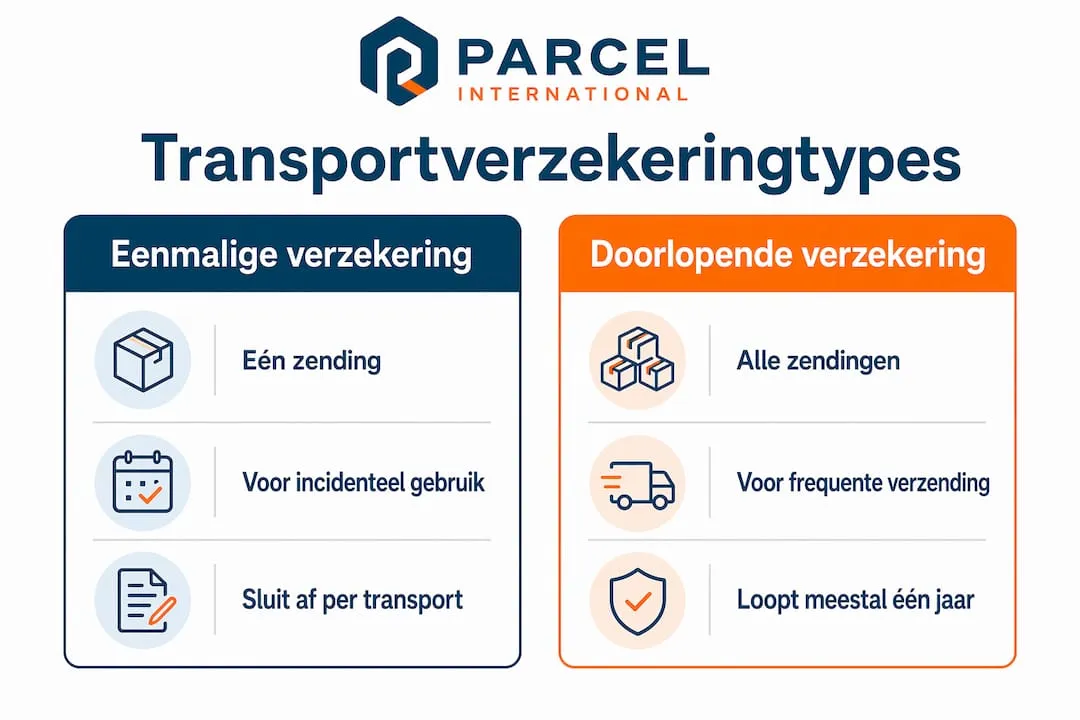
One-Time Insurance
A one-time insurance policy covers a single, specific shipment. You purchase the policy before transport, and coverage ends once the goods are delivered. This is the best option if you occasionally ship valuable items, such as artwork, machinery, or electronic devices. The premium is relatively high per shipment, but you only pay when you actually ship something.
Continuous Insurance

A continuous policy covers all shipments within an agreed period, typically one year. Small businesses that ship goods weekly or monthly benefit the most from this option. The administrative burden is lower because you don’t need to purchase a separate policy for each shipment. Additionally, the premium per shipment is usually lower than with one-time insurance.
Feature | One-Time Insurance | Continuous Insurance |
|---|---|---|
Suitable for | Occasional or high-value shipments | Frequent, regular shipments |
Premium | Higher per shipment | Lower per shipment with volume |
Administration | Purchase per shipment | Single purchase, automatic coverage |
Flexibility | High, adjustable per case | Less flexible, fixed terms |
SME Startup Costs | Variable | From approximately €20 per month |
Pro Tip: If you ship more than ten packages internationally per month, always opt for a continuous policy. The cost savings and administrative ease far outweigh the slightly less flexible terms.
Continuous transport insurance also offers administrative convenience and cost savings for frequent shipments, provided it is well-aligned with shipment volume and goods value.
What Determines Your Policy’s Premium and Coverage?
Transport insurance premiums typically range between 0.15% and 0.50% of the shipment’s value. While this may seem low, for a €10,000 shipment, the premium can amount to €15 to €50 per transport. Four key factors determine where you fall within this range.
Type of Goods: Fragile products like glass or electronics incur higher premiums than robust goods such as metal parts. Perishable items require specific clauses.
Route and Destination: Shipping to countries with higher crime rates or less reliable infrastructure increases the premium. A shipment to Germany costs less than one to a politically unstable country.
Transport Method: Air freight has a different risk profile than sea freight or road transport. Sea freight involves risks like humidity, seawater, and long transit times, while air freight is faster but more sensitive to vibrations and pressure changes.
Coverage Type: This is the most decisive factor for both premium and protection.
All-Risk vs. Named Perils
All-risk coverage covers all damage unless explicitly excluded in the policy. Named perils only cover risks specifically listed, such as fire, theft, or collision. The difference may seem subtle, but in practice, named perils often lead to denied claims. For example, if your goods are damaged by humidity in a container, all-risk covers it. Named perils only cover it if humidity is explicitly mentioned in the policy. For small businesses with varied goods, all-risk is the safest choice.
Transport insurance also covers temporary storage and transshipment during transit. This is relevant for multimodal transport, where goods are transferred between trucks, ships, or planes. Without this clause, a coverage gap arises precisely when goods are most vulnerable.
Pro Tip: Always explicitly ask whether temporary storage during transit is included in the quote. For multimodal international transport, this is not a minor detail but a fundamental requirement.
How Do I Align My Insurance with Incoterms?
Incoterms are international delivery terms that define who bears the risk during transport and who is liable for damage. Your transport insurance choice must always align with the Incoterms in your delivery contract. Failing to do so risks coverage gaps in case of damage.
For more details on how to apply Incoterms in your logistics check out the comprehensive guide from Parcel International.
Most Common Incoterms and Their Impact on Your Insurance:
- EXW (Ex Works): The buyer assumes risk from the moment goods are ready at the seller’s location. As the buyer, you are responsible for the full transport insurance, including the initial leg of the journey.
- FCA (Free Carrier): The seller delivers to an agreed location. The risk transfers to the buyer once the goods are handed over to the carrier. Both parties must ensure their policy aligns with this transfer moment.
- CIF (Cost, Insurance and Freight): The seller pays for freight and arranges minimal insurance. Note: The minimal CIF insurance covers only 110% of the invoice value and provides limited coverage. As a buyer, it is wise to take out additional coverage.
- DDP (Delivered Duty Paid): The seller bears the risk up to the buyer’s door. In this case, the seller is responsible for full transport insurance.
For international shipments Incoterms determine who bears the risk and what insurance is required. Always verify that your policy aligns with the moment the risk transfers from the seller to the buyer. A mismatch here is one of the most common causes of denied claims.
What should I look for when comparing transport insurance?
Comparing transport insurance involves more than just looking at the premium. The cheapest policy is rarely the best choice if coverage falls short when you file a claim. Use the following criteria as a guide.
Coverage type: Preferably choose all-risk over named perils, especially if you ship various types of goods. Small businesses face an increased risk of denied claims due to choosing the wrong coverage type.
Exclusions: Read the exclusions carefully. Common exclusions include damage due to insufficient packaging, inherent product defects, and delays. If you regularly ship fragile goods, check whether insufficient packaging is listed as an exclusion and adjust your packaging standards accordingly.
Deductible: A higher deductible lowers the premium but increases your financial exposure for minor damages. For small businesses with tight margins, a low deductible is often wiser than a low premium.
Maximum compensation: Ensure the maximum compensation aligns with the actual value of your shipments. Some policies apply a fixed maximum limit per shipment or per year.
Provider reputation and service: Fast and fair claims handling is at least as important as the premium. Look for providers with transparent claims processes and clear contact options.
Pro tip: Always request a sample policy before signing. Compare the exclusions of at least three providers side by side. Small differences in the fine print can make the difference between full compensation and nothing in the event of a claim.
The right transport insurance prevents financial risks in case of loss, damage, or theft and keeps your operations and customer relationships intact. This is not a luxury but a basic requirement for anyone shipping internationally.
Want to know which shipping insurance best fits your specific situation? The Parcel International guide to taking out shipping insurance provides a clear step-by-step plan.
Key insights
Choose the best transport insurance by evaluating coverage type, Incoterms alignment, and premium structure together, not separately.
Point | Details |
|---|---|
CMR liability is limited | Carriers compensate a maximum of approximately €10 per kilogram; additional coverage is necessary for full value protection. |
Choose all-risk over named perils | All-risk covers all damage unless excluded; named perils more often lead to denied claims for variable goods. |
Align policy with Incoterms | Check when the risk transfers and ensure your insurance covers that exact moment. |
Ongoing policy saves costs | For more than ten shipments per month, an ongoing policy is cheaper and administratively simpler. |
Read exclusions before signing | Insufficient packaging and inherent defects are common exclusions that block claims. |
My honest take on transport insurance
I see it happen time and again: entrepreneurs take out transport insurance, file it away, and forget about it. Two years later, their product range has changed, routes have expanded to new markets, and the policy still covers the situation from two years ago. Insurance inertia is a real risk. Existing policies no longer always match changed goods or routes.
What I also see is people opting for the cheapest policy without reading the exclusions. That’s like buying an umbrella with a hole in it. The premium is low, but when it rains, you still get wet. Customization per business and type of goods is not a luxury—it’s the only way to truly be covered.
My advice is straightforward: schedule an annual review to assess your policy against your current situation. Check which goods you now ship, via which routes, and with which carriers. Compare that with what your policy covers. If there’s a gap, close it before damage occurs. A good overview of shipping insurance can help with this.
Finally: don’t skimp on coverage type. The difference in premium between all-risk and named perils is small. The difference in protection during a claim can be enormous. Choose all-risk, read the exclusions, and align your policy with your Incoterms. That’s the foundation of any good transport insurance.
— Pascal
International shipping with Parcel International
Parcel International has been active since 2007 and handles international shipments to over 220 countries and territories. The platform allows you to compare shipping options, select carriers, and send packages without hidden costs.
For small businesses and individuals shipping internationally, Parcel International offers a streamlined platform where you can quickly find the right combination of carrier and insurance. Whether you're sending a one-time valuable shipment or regularly exporting goods, the platform adapts to your needs. Ship your first international parcel with confidence.
Can't find your question? Our support team is here for you 24/7 via the help centre.
What is the difference between all-risk and basic insurance?
An all-risk insurance covers nearly all forms of damage, including partial damage, while basic insurance policies are more limited and often only compensate for total loss or severe damage.
What exactly does a transport insurance cover?
Transport insurance covers damage, loss, and theft of goods during transport by road, sea, air, and rail, including temporary storage during transit. All-risk policies cover all damage unless explicitly excluded; named perils policies cover only the listed risks.
How much does transport insurance cost?
The premium typically ranges between 0.15% and 0.50% of the shipment's value. When you insure through Parcel International, you’ll see the premium immediately upon booking; it depends on the declared value and the carrier.
Why are Incoterms important for my transport insurance?
Incoterms determine when risk transfers from seller to buyer. If your insurance does not align with this transfer point, damage may fall outside coverage. Always ensure your policy covers the correct segment of the route.
When should I choose an ongoing insurance policy instead of a one-time policy?
Choose an ongoing policy if you ship more than ten consignments per month. The cost per shipment is lower, and the administrative burden is reduced. A one-time policy is more suitable for occasional or particularly high-value shipments.
Get a grip on your parcel shipping
Compare carriers, choose the best price and keep track of your international shipments. You can calculate and book without an account.