
TL;DR:
- Many small and medium-sized e-commerce businesses underestimate the risks of carrier selection, especially due to fake carriers. Choosing the right carrier is essential for customer satisfaction, cost savings, and reputation, with reliability and technological support being more important than price alone. A multi-carrier strategy and digital waybills like eCMR offer effective ways to enhance security, efficiency, and growth opportunities.
The role of carrier selection is seriously underestimated by many small and medium-sized e-commerce businesses. You choose a carrier, ship your parcel, and hope it arrives. But the reality is riskier: nearly 160,000 cargo theft incidents were recorded by TAPA between 2022 and 2024, often caused by so-called fake carriers. Those who do not make a conscious choice in carrier selection face avoidable financial and reputational risks.
Key Insights
Point | Details |
|---|---|
Carrier selection protects more than costs | Choosing the right carrier increases customer satisfaction and prevents losses from delayed deliveries. |
Fake carriers pose a significant risk | Verification and control of carriers are essential to prevent damage from fraud. |
Multi-carrier strategy enhances flexibility | Use multiple carriers for better distribution and optimal international coverage. |
Digitalization accelerates processes | eCMR reduces errors and speeds up customs clearance for international shipments. |
Strategy over price alone | Focus on reliability and technology, not just the lowest price, for sustainable growth. |
Why carrier selection is essential for e-commerce success
Carrier selection goes beyond comparing rate lists. The carrier you choose largely determines how your customer experiences the purchase process from payment to the moment the parcel arrives at their door. A slow delivery, damaged packaging, or a missed return: the customer holds you, the online store, responsible, not the carrier.
Many businesses fall into the price trap. They choose the cheapest option and only discover after multiple complaints that this choice results in customer loss, return costs, and reputational damage. The right carrier protects your conversion rate, margins, and reputation simultaneously.
The aspects of carrier selection that truly matter are broader than many businesses realize:
- Reliability: What percentage of shipments arrive on time?
- Geographic coverage: Does the carrier serve all the countries you ship to?
- Technology: Does the carrier offer real-time tracking and integrations with your platform?
- Customer service: How quickly and effectively are issues resolved?
- Damage and loss rate: How does the carrier handle fragile or high-value parcels?
- Cost transparency: Are there hidden surcharges for fuel, remote areas, or customs?
“Choosing a carrier based on price alone is like hiring a contractor based on their daily rate without reviewing their recent projects. The damage caused by poor selection can never be recouped by what you save on shipping costs.”
If you want to optimize international shipping, it is useful to evaluate per market which carriers provide the best local service. Not every carrier performs equally well in every country. Use a detailed international logistics checklist to ensure nothing is overlooked.
The risks of fake carriers and how to avoid them
Now that we understand the importance of carrier selection, it is crucial to also recognize fraud risks and how to avoid them. Fake carriers are transport companies that pose as legitimate providers but actually intercept cargo or never deliver it. They use forged documents and stolen data from real carriers to gain trust.
What makes this especially dangerous for small and medium-sized businesses? Shippers remain legally responsible for verifying the carrier they use. If you use a fake carrier and the cargo disappears, the damage is your responsibility unless you can prove you verified carefully.
How to protect your business in practice:
- Check the Chamber of Commerce number of every new carrier via the official trade register of the country of origin.
- Request transport licenses and verify these with the relevant national transport authority.
- Perform a VIES/EORI check for European carriers. Strict verification procedures such as EORI checks are a necessary basic protection.
- Verify the physical address of the carrier via satellite images or a visit. Fake companies often use virtual office spaces.
- Be extra cautious with last-minute changes: a fake carrier may request a different vehicle, driver, or adjusted route just before pickup.
- Use GPS tracking via an independent solution for high-value shipments. Deviations from the planned route are a direct warning.
Pro tip: Establish an internal verification protocol that every new carrier must go through before you assign a first shipment. Treat this as onboarding. Setting it up properly once will save you many problems later.
Want to know which reliable international shipping solutions are available for small and medium-sized businesses? A good shipping service also filters out a large portion of fraud risks for you.
The right multi-carrier strategy for international shipping
With the risks and benefits of carrier selection in mind, we now focus on a practical multi-carrier approach. The most effective carrier selection never means relying on just one carrier. That is too vulnerable.
For small and medium-sized e-commerce businesses, maintaining 2 to 4 carriers is the ideal structure: a primary carrier for your standard shipments, a secondary as a backup, and one or more specialist carriers for specific markets or shipment types.
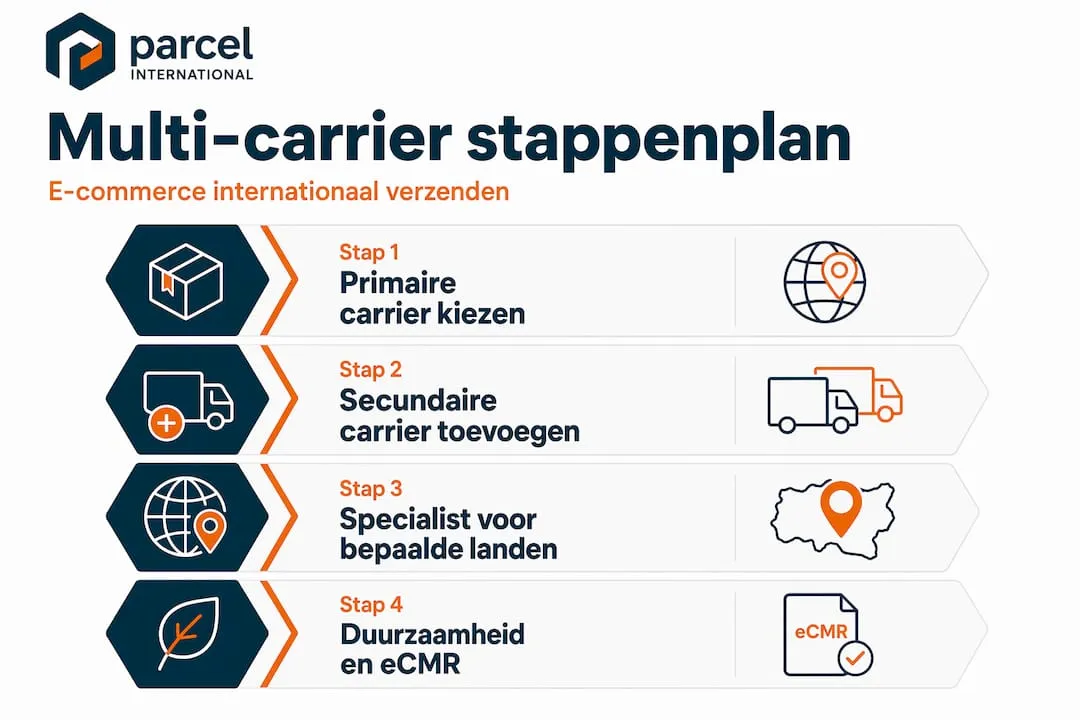
Carrier Type | Function | When to Use |
|---|---|---|
Primary Carrier | Standard daily shipments | The bulk of your orders |
Secondary Carrier | Backup during disruptions or peak periods | Black Friday, strikes |
Specialist Carrier | Cross-border, cold chain, oversized | Specific product categories |
Regional Carrier | Local delivery in specific markets | Germany, Benelux, etc. |
What makes a multi-carrier approach truly effective? Centralization, automation, and data analytics are the three pillars. Without centralized visibility across all carriers, you won’t know which carrier is truly performing. Without automation, management becomes too time-consuming. And without data, you’ll never know when it’s time to switch or negotiate.
Practical benefits of a multi-carrier approach:
- You negotiate better with carriers when you know you can switch.
- You spread the risk of delays during peak periods or strikes.
- You can deploy carriers by destination or product type based on their strengths.
- You strengthen your negotiating position by having comparable data.
Pro tip: Start small. Carefully choose your primary carrier first. Only add a second carrier once you have enough volume to gather meaningful performance data. Blindly switching to a multi-carrier model without data leads to chaos.
Want to save on international shipping costs without compromising service? A well-structured multi-carrier setup is often the fastest way to achieve this. Also, check out the practical tips for your international shipping list to further optimize your operations.
The role of the digital consignment note (eCMR) in carrier selection and efficiency
Beyond carrier selection and multi-carrier strategy, digitalization—such as the eCMR (electronic consignment note)—helps accelerate and secure shipping processes. A paper CMR (Convention on the Contract for the International Carriage of Goods by Road) is a transport document required for every cross-border road freight shipment. Processing it takes an average of 10 to 15 minutes per shipment, and the risk of errors is high.
The digital version, the eCMR, reduces this to 2 to 3 minutes. That’s not a marginal improvement. For 50 shipments per week, this saves hours of administrative work.
Key benefits of eCMR for e-commerce businesses:
- Faster handover processing: Digital documents are instantly accessible to all parties in the chain.
- Fewer errors: Mandatory fields and automatic validation prevent human mistakes.
- Better traceability: All parties see the same document status in real-time.
- Legal validity: eCMR has the same legal status as the paper version in the EU.
- Lower costs: No printing or storage costs for paper documents.
Statistic: Digital CMR saves up to 75% of processing time compared to paper.
This directly impacts your carrier selection. Carriers that support eCMR give you an operational advantage. If you select a carrier that still relies entirely on paper, you’ll fall behind. Always ask new carriers explicitly if they support eCMR and how far their digital integration goes.
Want to reduce delivery times for international shipments? eCMR is one of the most underestimated tools for this, simply because documentary delays at borders are one of the most common causes of longer delivery times.
How small and mid-sized e-commerce businesses apply carrier selection
After understanding the theory and tools, here’s a practical carrier selection approach tailored for your e-commerce business. Theory without execution doesn’t help anyone. This is how you make effective carrier selection a reality.
Step-by-step approach:
- Map your shipping profile. Which countries do you ship to? What are your average weights and dimensions? Do you have special products like hazardous goods or high-value items?
- Select carriers based on more than price. Choosing carriers based solely on price leads to mistakes and lower margins. Also consider reliability, customer service, and technological integration.
- Verify all documents and licenses using the steps outlined in the fraud section above. Make this a standard part of your procurement process.
- Establish an SLA (Service Level Agreement) with each carrier. Define: maximum delivery times per destination, damage procedures, and escalation timelines.
- Automate label generation and routing. Manual choices per shipment waste time and lead to errors. Use software that automatically selects the best carrier based on weight, destination, and priority.
- Monitor carrier performance monthly. Track punctuality, damage rates, and customer service response times. Use this data in your annual negotiations.
What to always keep an eye on:
- Unexpected route deviations for active shipments.
- Drivers calling with requests outside normal procedures.
- Carriers suddenly offering discounts well below market rates.
- Issues with carrier accessibility outside business hours.
Pro tip: Assign one contact person at each carrier for your team to escalate issues to. This sounds simple but prevents problems from getting stuck in slow-responding general service lines.
If you want to start with international shipping or improve your current approach, it’s also useful to thoroughly compare courier services before making a final decision.
The unseen impact of carrier selection on e-commerce growth
Here’s something most logistics guides won’t tell you: carrier selection isn’t just an operational cost. It’s a growth engine.
Look at how customers decide today. Delivery time and reliability now rank higher than product price for repeat purchases. A customer who experiences two delayed deliveries won’t return. No discount will bring them back. That loss isn’t offset by what you saved on freight costs.
Most small businesses optimize their carrier selection purely based on cost and only scale their criteria as they grow. However, it is precisely during the growth phase that a reliable carrier becomes the foundation for building customer trust. Focusing incorrectly on price over reliability undermines your margins and customer satisfaction at that very moment.
There is also a growing sustainability dimension. More and more consumers are asking about the CO2 footprint of their deliveries. Carriers that transparently report on emissions help your business use this as a distinguishing feature. Those who incorporate this into their selection process now are building a lead that will be much harder to replicate in two years.
Technological integration is the third underestimated aspect. Carriers that can connect to your e-commerce platform via an API enable automatic tracking updates, real-time inventory synchronization, and proactive customer communication. This significantly reduces your customer service pressure. Every day you delay this, you pay in customer service costs.
Companies that treat carrier selection as a core part of their best practices for international shipping grow structurally faster than those that handle it reactively. Not because they spend more money, but because they lose less to remediation costs, reverse logistics, and customer churn.
Discover solutions for optimal carrier selection and international shipping
Now that you understand the role and importance of carrier selection, it’s time to take action. Parcel International helps small and medium-sized e-commerce businesses compare and select reliable carriers for international shipments to over 220 countries and territories.

With our tools, you can compare rates and delivery times from multiple carriers in one place, without hidden costs. Would you like to save on international shipping costs while maintaining reliability? Or do you want to understand the most common causes of delays and how to prevent them? Parcel International, active since 2007, provides the expertise and network to ship smarter. Compare courier services today and discover which carrier best fits your products and markets.
Can't find your question? Our support team is here for you 24/7 via the help centre.
How can I identify a fraudulent carrier?
A fraudulent carrier often uses fake contact information, unusual domain names, and requests off-platform communication. Always verify their legitimacy through reliable public registers such as the Dutch Chamber of Commerce (KvK) or a European transport database.
Should I always use multiple carriers?
A multi-carrier approach is the best choice for most growing e-commerce businesses, but a single carrier may suffice temporarily if volume and destinations are limited. Regular comparisons remain advisable regardless of your strategy.
Why is carrier selection so important for my e-commerce business?
Carrier selection determines not only your shipping costs but also delivery times, customer satisfaction, and reputation. The right carrier protects your conversion rate and margins, directly impacting your business growth.
What are the benefits of a digital consignment note (eCMR)?
eCMR speeds up document processing and reduces errors through automatic validation.
Get a grip on your parcel shipping
Compare carriers, choose the best price and keep track of your international shipments. You can calculate and book without an account.
