
In short:
- Cargo insurance protects the full value of goods during international transport.
- It offers broader coverage than carrier liability, which is often limited to a low maximum amount.
Cargo insurance covers the financial value of goods against damage, loss, or theft during transport. For individuals and small businesses shipping internationally, this is not a luxury but a necessity. Carrier liability is legally limited, meaning you often receive only a fraction of the actual value in case of damage. With the right policy, you are fully protected, regardless of who is responsible for the damage. Parcel International explains step-by-step in this article how cargo insurance works, what it costs, and how to make the best choice.

Cargo Insurance Explained: What Is It and Why Do You Need It?
Cargo insurance, also known in the industry as goods-in-transit insurance or marine cargo insurance, covers the value of goods during transport from A to B. The insurance protects the owner of the goods, not the carrier. This distinction is crucial.
Carriers have their own liability insurance, but it rarely covers the full damage. Under the CMR rules, the international treaty for road transport, the maximum compensation is approximately €10 per kilogram of damaged weight. A pallet of electronics weighing 500 kilograms with a value of €40,000 would then only yield €5,000. The difference of €35,000 is for your account.
Both individuals moving and small businesses with international shipments benefit from cargo insurance. The choice between a temporary or continuous policy depends on how often you ship and how valuable your goods are. Those who ship internationally regularly benefit from a continuous policy. Those who occasionally send a valuable shipment are better off with a one-time insurance.
What Types of Cargo Insurance Are Available?
The international market standard for cargo coverage is the Institute Cargo Clauses, established by the London Institute of Underwriters. There are three variants: ICC A, ICC B, and ICC C. They differ significantly in the breadth of coverage.
ICC A offers the broadest coverage. All risks are covered unless explicitly excluded in the policy. Exclusions include intent, inherent defect of the goods, and political unrest. ICC A is the recommended choice for valuable or fragile goods.
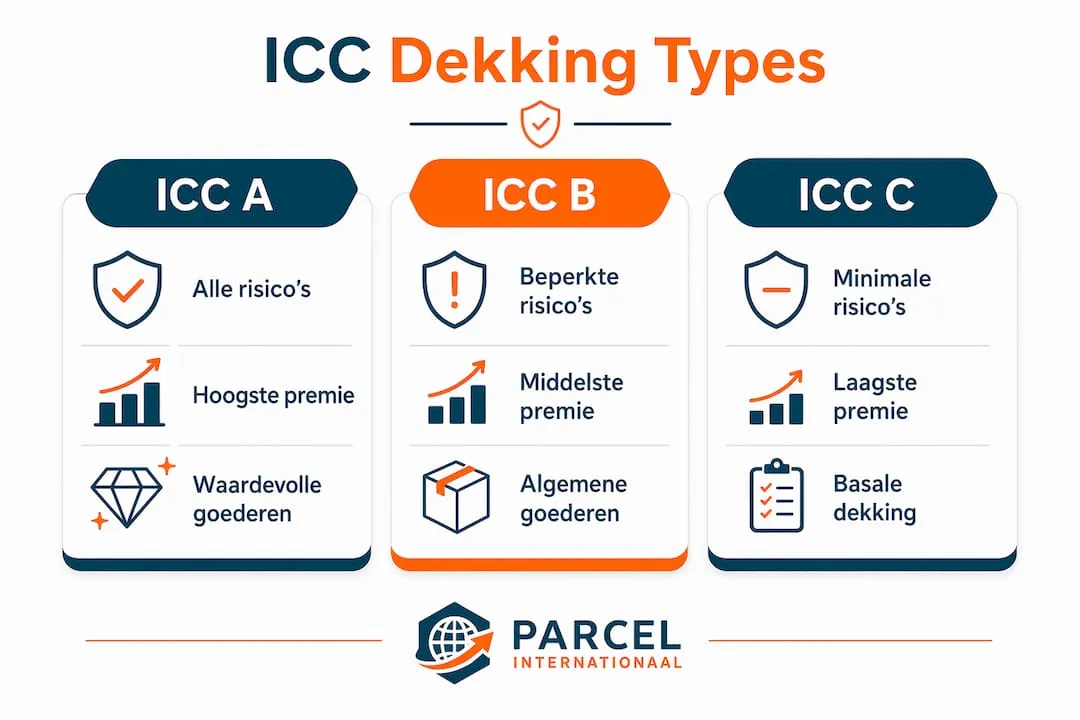
ICC B covers a more limited list of named risks, such as fire, explosion, ship stranding, earthquake, and cargo falling overboard. Damage from water entering the hold is also covered under ICC B. For standard goods with an average risk profile, this is a common choice.
ICC C offers the narrowest coverage. Only the most severe calamities are covered: fire, explosion, stranding, sinking, and overturning of the transport vehicle. Theft and damage during loading and unloading are not included. ICC C is suitable for robust goods with low value.
Clause | Coverage | Suitable for |
|---|---|---|
ICC A | All risks, unless excluded | Valuable and fragile goods |
ICC B | Named risks, including water damage | Standard goods, average risk |
ICC C | Only severe calamities | Robust goods, low value |
The premium increases with the breadth of coverage. ICC A costs more than ICC C but also offers significantly more security. For most international shipments by individuals and small businesses, ICC A is the most sensible choice.
Pro tip: When in doubt, always choose ICC A. The premium increase compared to ICC C is small relative to the risk you take with narrow coverage.
More information about the different insurance options for international parcels can be found in the comprehensive guide by Parcel International.
What Is the Difference Between Cargo Insurance and Carrier Liability Insurance?
This is the most underestimated difference in logistics. Carrier liability insurance covers the legal liability of the carrier. Cargo insurance covers the value of your goods, regardless of who is at fault.
The carrier's liability coverage often compensates only up to legal limits and not the full value of the damage. For road transport, the CMR convention applies; for air transport, the Montreal Convention; and for sea transport, the Hague-Visby Rules. All these treaties limit the maximum compensation per kilogram or per shipment.
Shippers often underestimate these limitations. They assume the carrier will cover all damage in case of loss. This is incorrect. If the carrier is not at fault, their insurance pays nothing. Think of damage caused by a flood or an earthquake. Only your own cargo insurance covers such cases.
Feature | Cargo Insurance | Carrier Liability |
|---|---|---|
Who is insured? | Owner of the goods | The carrier |
Compensation in case of damage | Full value of goods | Limited to legal maximum |
Applies in case of force majeure? | Yes, depending on clause | No |
Premium paid by | Shipper or buyer | Carrier |
Recommended for | All shippers | Carriers themselves |
Pro tip: Always ask your carrier which treaty their liability is based on and what the maximum amount per kilogram is. Compare this with the actual value of your shipment.
In case of limited carrier compensation, the shipper may have to pay the difference themselves. Your own cargo insurance prevents you from ending up in that situation.
How Are Cargo Insurance Premiums Calculated?
The premium for cargo insurance is a percentage of the insured value of the goods. This percentage typically ranges between 0.1% and 0.3% of the insured value per shipment. For high-risk goods, such as electronics or artworks, it can go up to 0.5%.
For a shipment worth €50,000, you pay roughly €50 to €150 in premium. That’s a small price compared to the risk of total loss. For small businesses with regular shipments, ongoing policies are often more cost-effective than one-off insurance per shipment.
Factors determining the premium:
- Type of goods: Fragile or high-value goods incur a higher premium.
- Transport route: Routes through countries with a higher risk of theft or political unrest increase the premium.
- Selected clause: ICC A is more expensive than ICC B or ICC C.
- Deductible: A higher deductible lowers the premium.
- Packaging and prevention: Insurers value a strong safety policy. Preventive measures can reduce damage claims and thus lower premium costs.
Shipment value | Premium (0.1%) | Premium (0.3%) | Premium (0.5%) |
|---|---|---|---|
€5,000 | €5 | €15 | €25 |
€20,000 | €20 | €60 | €100 |
€50,000 | €50 | €150 | €250 |
€100,000 | €100 | €300 | €500 |
For small businesses shipping fewer than five times a month, a one-off policy per shipment is often cheaper than an ongoing policy. If you ship more than ten times a month, an ongoing policy is almost always more cost-effective.
Always request multiple quotes from insurers. Premiums can vary significantly for the same coverage. Provide an accurate description of the goods, the route, and the packaging.
What risks does transport insurance cover, and what are the exclusions?
Transport insurance covers more than just accidents. Depending on the selected clause, it also includes theft, fire, damage during loading and unloading, and refrigeration damage for temperature-controlled shipments. This makes the insurance widely applicable for various types of shipments.
What is typically covered?
- Damage from traffic accidents or vehicle rollovers
- Theft of the entire shipment or part of it
- Fire and explosion during transport
- Damage during loading and unloading
- Water damage from flooding or seawater intrusion (ICC A and B)
- Refrigeration damage for temperature-controlled shipments
- Loss overboard during sea transport
What is typically excluded?
- Inherent defect: Damage caused by a characteristic of the product itself, such as spoilage of improperly refrigerated goods.
- Non-compliant packaging: If the packaging does not meet the carrier’s or policy’s requirements, the insurer will reject the claim.
- Political unrest and war: Damage from strikes, war, or terrorism is not covered by default unless you purchase an additional clause.
- Intent or negligence: Damage you caused yourself or could have prevented.
- Delay: Financial loss due to delay is rarely covered.
Packaging is one of the most underestimated conditions. Proper packaging according to ISTA standards and taking photos before transport helps support damage claims and prevents rejection by the insurer. ISTA stands for International Safe Transit Association and sets globally recognized packaging test standards.
Pro tip: Always take photos of the goods and packaging before handing them over to the carrier. Without proof of their condition before transport, a claim is much harder to substantiate.
Claim outcomes are negatively affected by non-compliant packaging and lack of evidence at handover. Knowing this, ensure your documentation is always in order. Also, keep the bill of lading, invoice, and packing list safe.
How to choose the right transport insurance for your situation?
The right choice depends on four factors: the value of your goods, their vulnerability, how often you ship, and which Incoterm applies.
Incoterms determine who bears the risk and insurance responsibility during international shipments. Under CIF (Cost, Insurance, and Freight) and CIP (Carriage and Insurance Paid), the seller is required to arrange insurance. Under EXW (Ex Works) and FCA (Free Carrier), the responsibility lies with the buyer. Always check which Incoterm is stated in your contract before purchasing a policy.
Follow these steps to choose the right policy:
- Determine the value of your goods. Use the invoice value plus any transport costs as the basis for the insured amount.
- Assess vulnerability. Fragile, perishable, or high-value goods require ICC A. Robust goods can suffice with ICC B or ICC C.
- Choose the right modality. Marine, air freight, and road transport insurances each have their own clauses and risk profiles.
- Decide between one-off and ongoing. Individuals and small businesses with occasional shipments opt for a one-off policy. Those who ship regularly benefit from an ongoing policy.
- Read the policy terms carefully. Pay attention to the deductible, exclusions, and packaging requirements.
- Request multiple quotes. Premiums vary by insurer. Compare not only the price but also the coverage.
Communicate openly with your insurer about the nature of the goods and the route. An insurer unaware that you’re shipping electronics via a high-risk route may later reject the claim based on incorrect disclosure. Transparency when purchasing prevents issues in case of damage.
Key insights
Transport insurance is the only way to fully protect the value of goods in case of damage or loss during international transport, regardless of the carrier’s liability.
Point | Details |
|---|---|
Carrier liability is limited | Under CMR, the carrier compensates a maximum of approximately €10 per kilogram, often far below the actual value. |
ICC A offers the broadest coverage | All risks are covered unless explicitly excluded, ideal for high-value shipments. |
Premium is low relative to risk | For a shipment worth €50,000, you pay €50 to €150 in premium for full coverage. |
Packaging determines claim outcome | Non-compliant packaging leads to claim rejection, regardless of the cause of damage. |
Incoterms determine who insures | Under CIF and CIP, the seller insures; under EXW and FCA, the buyer insures. |
Why I consider transport insurance the cheapest insurance available
After years in the logistics sector, I’ve seen one thing time and time again: shippers who assume the carrier handles everything in case of damage. That’s the costliest misconception in the industry.
A good transport insurance policy isn’t an expense—it’s an investment in business continuity and customer satisfaction. Imagine this: you send a €30,000 shipment to a customer in Japan. The vessel sustains damage due to severe weather. The carrier doesn’t compensate, as it was an act of God. Without your own insurance, you bear the loss. With insurance, the damage is covered within weeks, and the customer relationship remains intact.
The most common mistake I see is people not taking packaging requirements seriously. They pack goods the way they always have, without checking if it meets policy conditions. When damage occurs, the insurer rejects the claim. That’s avoidable. Spend five minutes reviewing the packaging requirements and take photos before shipping.
My advice for small businesses: take out an ongoing policy as soon as you ship more than five consignments per month. The premium is lower per shipment, and you won’t have to arrange insurance every time. That saves time and prevents accidentally sending an uninsured shipment because you forgot.
Comparing transport insurance is always worthwhile. Premiums for the same coverage can vary significantly between insurers. But beware: the cheapest policy isn’t always the best. Check the exclusions, deductible, and the insurer’s reputation for handling claims.
— Pascal
Ship internationally with confidence using Parcelinternational
Parcelinternational handles international shipments to over 220 countries and territories, with experience since 2007. The platform lets you easily compare shipping options and choose the right carrier, with no hidden costs.
A successful shipment starts with proper preparation. Parcelinternational’s international logistics checklist guides you step-by-step to organize your shipment, including insurance selection. For those who want to know which insurance policies apply to shipping Parcelinternational offers a complete guide. Take a look and send your next package with the confidence that everything is in order.
Can't find your question? Our support team is here for you 24/7 via the help centre.
What does the carrier cover in case of damage, and why is it insufficient?
You receive only limited compensation per kilogram, approximately €3.40 domestically and around €10 internationally, which rarely covers the actual value.
How much does transport insurance cost?
The premium typically ranges between 0.15% and 0.50% of the shipment's value. When you insure through Parcel International, you’ll see the premium immediately upon booking; it depends on the declared value and the carrier.
What exactly is transport insurance?
Transport insurance covers the financial value of goods against damage, loss, or theft during transit. The insurance protects the owner of the goods, not the carrier.
What is the difference between ICC A, B, and C?
ICC A covers all risks unless excluded, ICC B covers a limited list of named risks, and ICC C covers only major incidents such as fire or sinking. ICC A is most suitable for valuable or fragile goods.
When should the buyer arrange transport insurance?
Under Incoterms such as EXW and FCA, the buyer is responsible for insurance. Always check which Incoterm is specified in your purchase contract to determine who is responsible for the insurance.
Get a grip on your parcel shipping
Compare carriers, choose the best price and keep track of your international shipments. You can calculate and book without an account.