
TL;DR:
- Cargo theft in the Netherlands has tripled, with damages reaching up to €140,000 per incident.
- Cargo insurance provides full protection, unlike the limited coverage of carrier liability.
- For international shipping, additional risks such as phantom carriers and customs delays are important to monitor and insure properly.
Cargo theft in the Netherlands has tripled in recent years, with damages potentially reaching up to €140,000 per incident. For e-commerce entrepreneurs shipping internationally, this is not an abstract statistic but a real business risk. A lost or damaged package costs not only money but also customer trust. In this article, you’ll learn exactly what cargo insurance entails, how it differs from standard carrier liability, which exceptions apply, and what to watch out for with international shipments.
Key Insights
Point | Details |
|---|---|
Full Coverage Possible | Cargo insurance covers the full value of your goods, not just a per-kilogram rate. |
Common Risks | Fire, theft, damage during loading/unloading, and loss are standardly covered. |
Watch for Exceptions | Not everything is covered, such as intentional damage, fraud, hazardous materials, and return shipments. |
International Extras | For international shipments, Incoterms, customs, and phantom carriers play a major role. |
Prevention Works | Smart preparation and risk management lead to fewer damages and lower premiums. |
What Is Cargo Insurance and What Does It Cover?
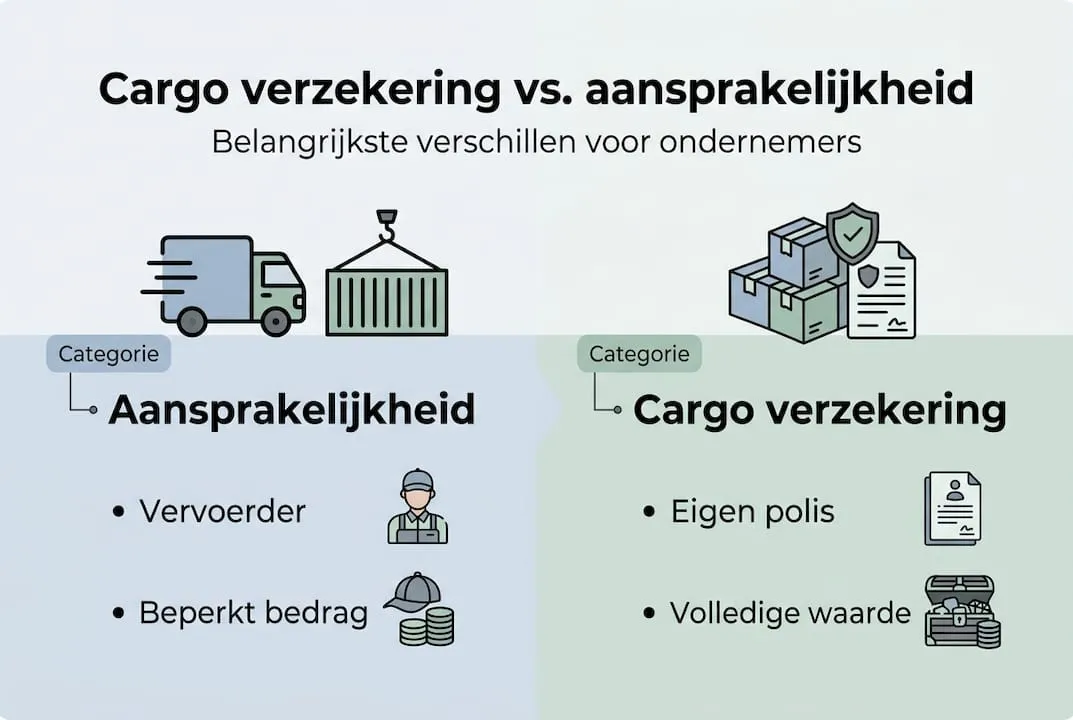
Cargo insurance is another term for a goods-in-transit insurance. It is an insurance policy that protects your goods during transport, from the moment they leave your warehouse until they arrive at the recipient. The carrier does not take out this insurance—you, as the owner of the goods, do.
This distinction is crucial. Many entrepreneurs assume the carrier is responsible if something goes wrong. That is partially true, but the compensation a carrier offers is legally limited and rarely covers the actual value of your products. More on this in the next section.
What Exactly Does Cargo Insurance Cover?
A standard goods-in-transit insurance policy covers risks such as:
- Fire and explosion during transport
- Storm and weather conditions
- Theft and vandalism
- Loss of shipment
- Damage during loading and unloading
- Strikes or labor disputes
- Temperature damage for sensitive products
This coverage applies to all common modes of transport: road, rail, air, and sea. Whether you’re shipping a container or sending a package via an express service, you can insure your goods.
“Cargo insurance gives you, as an entrepreneur, control over your own risk. You are not dependent on what a carrier is willing to compensate.”
Pro Tip: Take out shipping insurance based on the invoice value of your goods, not an estimated value. This prevents disputes during a claim and ensures you receive the full value.
Important to know: there are different levels of coverage. An all-risk policy covers virtually all causes of damage unless explicitly excluded. A named perils policy only covers the risks literally stated in the policy. For e-commerce entrepreneurs, all-risk is usually the smartest choice, especially for valuable or fragile products. Learn more about shipping-insurance-options to understand which options suit your situation.
How Does Cargo Insurance Differ from Carrier Liability?
Now that we know what cargo insurance covers, it’s useful to understand how it differs from standard carrier liability. This is where many entrepreneurs go wrong.
Carrier liability is the legal obligation of a transport company to compensate for damage caused by their own fault or negligence. Sounds good, but the compensation is legally limited to €3.40 per kilogram for domestic transport and approximately €10 per kilogram for international transport under CMR or AVC rules.
Imagine this: you ship a package containing electronics worth €2,000. The package weighs 5 kilograms. For international transport, you would receive a maximum of €50 if the carrier is liable. That’s just 2.5% of the actual value.
Feature | Carrier Liability | Cargo Insurance |
|---|---|---|
Who Takes It Out? | Carrier | You as the owner |
Compensation | Limited per kilogram | Full value |
Carrier’s Fault Required? | Yes | No |
Theft Covered? | Sometimes | Yes |
Temperature Damage Covered? | Rarely | Possible |
Costs | Included in transport | Separate premium |
Another key difference: with carrier liability, you must prove the carrier is at fault. This is legally challenging and time-consuming. With your own cargo insurance, you report the damage to your insurer, who handles the claim. More direct control, less hassle.
The international-shipping-risks are also greater than many realize. With multiple carriers in a chain, such as in multimodal transport, proving liability becomes even more complex. Your own insurance bypasses this issue entirely.
- Carrier liability provides a basic safety net, not full protection
- Cargo insurance is the only way to fully protect your investment
- Also check out the types-of-shipping-insurance to see which best fits your products
What Are the Exclusions and Limitations of Cargo Insurance?
Not everything is covered by cargo insurance. Here are the key exclusions.

Cargo insurance is powerful but not a blank check. Insurers standardly exclude certain situations and product categories. If you’re unaware of this, you may face unpleasant surprises when filing a claim.
What Is Standardly Excluded?
The following situations and goods are typically not covered:
- Intent or gross negligence by the insured
- Fraud and illegal practices
- Natural Disasters (in many standard policies)
- Cash, Securities, and Jewelry
- Live Animals
- Hazardous Materials Without Special Permits
- Shipments to High-Risk Areas Without Prior Approval
- Intellectual Value or Consequential Damages
- Returns, Unless Explicitly Covered
“Many entrepreneurs only discover during a claim that their returns are not covered. Always check this in advance in the policy terms.”
Pro Tip: Do you sell products close to an excluded category, such as cosmetics with alcohol or batteries? Explicitly ask your insurer if and how these are covered. Some insurers offer custom solutions, but only if you proactively inquire. Properly preparing your goods for transport also reduces the risk of denied claims.
Another point of attention is the NIWO License for professional transport. If you work with carriers that do not have the correct licenses, this can affect the validity of your insurance. Always verify that your carrier is certified.
Finally, some policies include a deductible. This means you pay a portion of small claims yourself. For e-commerce entrepreneurs with many small shipments, it is wise to consciously choose this deductible based on the average value per package.
International Cargo Insurance: Additional Risks and Considerations
International shipments involve additional risks that can impact coverage and conditions.
International shipments bring a different dynamic compared to domestic transport. More links in the chain mean more opportunities for things to go wrong. And the financial consequences are greater.
Four Key Considerations for International Cargo Insurance:
- Incoterms Determine Who Insures. Under CIF (Cost, Insurance, and Freight) and CIP (Carriage and Insurance Paid), you as the seller are required to take out insurance. For other Incoterms, the responsibility lies with the buyer. Know which agreements you are making.
- Multimodal Transport Increases Complexity. If your package travels by truck, boat, and plane, different liability rules apply per leg. A continuous cargo insurance policy covers all modes in one policy.
- Customs and Delays. Goods held at customs are not automatically covered by transport insurance. Check if your policy covers stationary transport.
- Ghost Carriers Are a Growing Problem. The damage per case can be significant.
Risk | Domestic | International |
|---|---|---|
Annual Theft (Netherlands) | High | 13,000 Worldwide (2022) |
Average Damage | Variable | €140,000 per Case |
Ghost Carriers | Rare | Growing Risk |
Liability Chain | Simple | Complex |
Pro Tip: For international shipments, always opt for an all-risk policy with global coverage. Check if cold damage, strikes, and war risks can be additionally covered when shipping to specific regions. Review the international shipments and international-shipping-options to better align your logistics choices with your insurance needs.
Our Vision: How to Make Cargo Insurance Truly Valuable?
After reviewing the risks and conditions, it’s time for a sharper perspective: how do you make cargo insurance truly practical?
The biggest misconception we see among e-commerce entrepreneurs is that insurance is a replacement for proper risk management. It is not. Insurance is a safety net, not a strategy. Entrepreneurs who rely solely on their policy and do nothing about packaging, carrier selection, or documentation unnecessarily risk denied claims.
Smart insurance means: know exactly what you are insuring, for what value, and under what conditions. Combine this with preventive measures. Good packaging, reliable carriers, and correct shipping documents are just as important as the policy itself. To prevent loss, you must be proactive on both fronts.
Our advice: treat cargo insurance as a business investment, not a mandatory checkbox. Evaluate annually whether your coverage still aligns with your product portfolio and shipping volumes. The market changes, and so does your risk.
More Certainty and Convenience with Parcel International
Ready to start shipping safely and securely? At Parcel International, we help e-commerce entrepreneurs daily find the right shipping solutions, including insurance options tailored to your products and destinations.
Through our platform, you can easily compare carriers and shipping options for over 220 countries. You’ll know exactly what you’re paying for, what’s covered, and how your shipment is progressing. Learn how to prevent causes of delays. We’ve been doing this since 2007 and understand what international logistics demands from e-commerce entrepreneurs. Take a look today and confidently send your first insured shipment.
Can't find your question? Our support team is here for you 24/7 via the help centre.
Is cargo insurance mandatory for international shipments?
Cargo insurance is mandatory under Incoterms CIF and CIP.
What does the carrier cover in case of damage, and why is it insufficient?
You receive only limited compensation per kilogram, approximately €3.40 domestically and around €10 internationally, which rarely covers the actual value.
Are return shipments automatically covered by cargo insurance?
No, return shipments are often excluded from standard coverage. Always check the policy terms and request additional coverage if necessary.
How high is the risk of damage or theft in international transport?
Cargo theft occurs regularly in the Netherlands, and the damage per incident can be significant, underscoring the importance of adequate coverage.
Get a grip on your parcel shipping
Compare carriers, choose the best price and keep track of your international shipments. You can calculate and book without an account.

Recommendation
- Shipping Sea Containers: The Complete Guide for E-Commerce 2026 – Send with Parcel International
- What Does a Carrier Do? Essentials for Webshops – Send with Parcel International
- Key Shipping Insurance Policies: A Complete Guide – Send with Parcel International
- Master Industry Terms for Shipping Containers: A Guide