
TL;DR:
- Cargo insurance protects SMEs from financial losses due to damage, loss, or theft during international transport. A robust policy ensures faster payouts and avoids lengthy legal procedures with carriers, which is critical for customer satisfaction. Preventive measures and timely documentation minimize claim rejections and costs, strengthening your insurance and logistics strategy.
Imagine this: A €2,000 electronics shipment leaves your warehouse for a customer in Germany. Midway through the journey, the box is found severely damaged, and the contents are unusable. The carrier acknowledges the loss but compensates only a fraction of the actual value. For small and medium-sized e-commerce businesses, this is not a hypothetical scenario but a real financial risk. A cargo insurance specifically protects you against damage, theft, or loss during international shipments. This checklist guides you step-by-step to secure the right coverage and safeguard your business.
Key Insights
Point | Details |
|---|---|
Limit Liability | Your own cargo insurance protects against the limited coverage provided by carriers. |
Checklist as a Foundation | A step-by-step checklist helps you avoid common mistakes when insuring and filing claims. |
Prevention Pays Off | Meeting prevention requirements lowers premiums and increases the likelihood of successful claims. |
Documentation is Crucial | Ensure complete evidence in case of damage to avoid missing out on payouts. |
Why Cargo Insurance is Essential for International Shipments
Shipping internationally means navigating a world of logistical uncertainties. Packages change hands multiple times, pass through customs, are transferred onto ships or planes, and may travel for weeks. Each step in the chain presents potential issues. The damage from a lost shipment isn’t just financial—it can be disastrous for customer relationships.
Consider the most common risks: loss of an entire shipment due to incorrect routing or theft at a transshipment point, damage from mishandling or adverse weather conditions, and theft of high-value goods in transit. Electronics, jewelry, and designer products are particularly attractive to thieves operating in major logistics hubs. For an SME shipping ten to fifty packages a week, one lost shipment can seriously impact monthly margins.
Many businesses rely on carrier liability, but this is a dangerous misconception. The CMR liability of carriers is legally limited to 8.33 SDR per kilogram (approximately €10). This means a 5-kilogram package with a purchase value of €500 would only receive around €50 in compensation from the carrier in case of loss. You cover the difference. A dedicated cargo insurance policy covers the actual invoice value of your goods, including shipping costs and sometimes even profit margins.
Situation | Carrier CMR Liability | Dedicated Cargo Insurance |
|---|---|---|
Package Weight | 5 kg | 5 kg |
Purchase Value of Goods | €500 | €500 |
Maximum Compensation | Approximately €50 | €500 (invoice value) |
Deductible | No | Depends on policy |
Legal Proceedings | Often necessary | Rarely needed |
The benefits of a dedicated policy are clear. You receive faster payouts, avoid legal battles with carriers, and your customers don’t face long waits for resolutions. This is crucial: in e-commerce, customers expect quick problem-solving, not weeks of waiting while you dispute a claim.

For goods with a high-risk profile, such as medical equipment, electronics, or antiques, additional considerations apply. Standard policies may exclude certain product categories or impose lower limits. Also, review the key shipping insurance options relevant to your specific product category to avoid gaps in coverage.
Core Risks in International E-Commerce Shipments:
- Loss of entire packages due to routing errors
- Damage from improper storage or handling at transshipment points
- Water damage during sea freight or due to weather conditions
- Theft of high-value goods in logistics hubs
- Delays leading to spoilage of temperature-sensitive products
- Customs seizure without reimbursement
Checklist: What to Arrange for Optimal Cargo Insurance
Now that the necessity is clear, here’s a concrete checklist for airtight cargo insurance. This isn’t a one-time task but an ongoing responsibility that requires regular review.
Step 1: Review Your Policy Coverage
Read your policy thoroughly. Pay attention not just to what’s covered but to the exclusions. Common exclusions include damage due to inherent product defects, inadequate packaging, or force majeure situations. Ask your insurer explicitly about coverage for multimodal transport, where goods travel via multiple methods (road, air, sea).
Step 2: Verify Coverage for Your Product Category
Fragile or high-value goods like medical products or electronics require specific coverage. Always request written confirmation that your exact products are covered, not just a general product category.
Step 3: Ensure Multimodal Transport is Explicitly Mentioned
If your shipments travel via both road and air freight, the policy must explicitly state this. Some insurance policies cover only road transport and exclude sea or air freight.
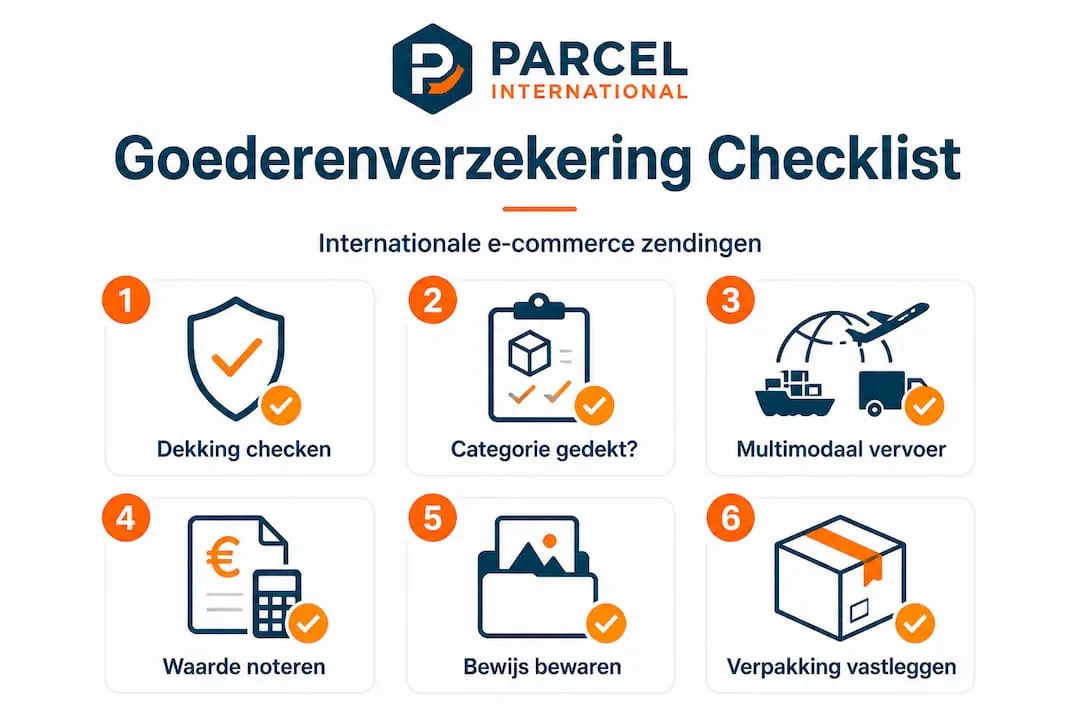
Step 4: Record the Insured Value per Shipment
Ensure the insured value matches the current invoice value plus shipping costs. Underinsurance is one of the most common mistakes made by SMEs.
Step 5: Organize and Retain All Shipping Documents and Invoices
No claim without evidence. Save invoices, packing slips, and digital confirmations for each shipment. A simple spreadsheet or a cloud system works fine.
Step 6: Document Packaging Standards in Writing
Your insurer may deny a claim if the packaging is found to be inadequate. Document which packaging methods you use for which products.
Step 7: Compare Standard and Extended Coverage for Your Routes
Component | Standard Coverage | Extended Coverage |
|---|---|---|
Damage Due to Handling | Yes | Yes |
Theft | Partial | Yes, including robbery |
Water Damage | Not Always | Yes |
Electronics and High-Tech | Sometimes Excluded | Specifically Covered |
Multimodal Transport | Sometimes Excluded | Explicitly Covered |
Deductible | Higher | Lower or Nil |
Compensation | Repair Value | New Value or Invoice Value |
The shipping-insurance-overview for international parcels provides a solid starting point to make the right choice for your products and routes.
Pro Tip: Combine cargo insurance with inventory insurance if you also store valuable stock in your own warehouse. Both risks—in the warehouse and during transport—are then covered under one logical policy. Ask your insurer about a combined policy, which is often more cost-effective than two separate contracts.
Step-by-Step Claims Process for Damage or Loss
When something goes wrong, it’s crucial to act quickly and effectively. The faster and more carefully you respond, the greater the chance of full compensation. Many SMEs leave money on the table by taking the wrong steps or waiting too long.
The correct procedure for damage or loss:
- Minimize further damage immediately. If a shipment arrives damaged, accept it under reservation and note this on the receipt. Store the goods safely and prevent further damage or contamination.
- Document everything visually. Take photos and videos of the packaging and contents, preferably before touching anything. Note the date and time. This visual evidence forms the basis of your claim.
- Report the damage to your insurer immediately. Do not wait. Many policies have a short reporting window; check your policy terms. Late reporting is one of the most common reasons for claim rejection.
- Submit all evidence documents. Include invoices, inventory lists, and quotes for repair or replacement. The damage-reporting-steps require you to also send proof of transport costs, along with correspondence with the carrier.
- Wait for expert inspection or further instructions. For larger claims, the insurer will send an expert. Do not move or dispose of the damaged goods before the expert has visited, unless instructed otherwise.
- File the claim formally and follow the procedure. Use your insurer’s official claim documents and send everything via registered mail or the customer portal.
- Receive compensation and close the file. Ensure you receive confirmation of the compensation and archive the entire file for future reference.
A well-documented claim is faster and more successful than one where you have to gather documents afterward. Those who have everything ready rarely have to wait long for payment.
Common Mistakes in Damage Claims:
- Reporting too late to the insurer
- Not taking photos before unpacking
- Signing the receipt without noting “reservation”
- Disposing of damaged goods before the expert has seen them
- Forgetting to hold the carrier liable
Pro Tip: Create a standard “damage protocol” document and display it in your warehouse. Ensure every team member knows what to do if a damaged shipment arrives or if a customer reports a missing parcel. Also, check out our guide on filing shipping insurance claims for a practical overview of claim steps per situation.
Prevention and Cost Savings: How to Make Your Policy Claim-Proof
Beyond reacting to damage, preventing issues yields the greatest benefits, financially as well. Companies that systematically invest in prevention pay lower premiums, have fewer claim-related hassles, and build more trust with customers. Prevention isn’t an extra burden—it’s a smart investment.
Preventive measures with immediate impact:
- Use double packaging for fragile or valuable goods. Bubble wrap, foam rubber, and sturdy outer boxes significantly reduce the risk of transport damage.
- Seal every package with professional tape and avoid reused boxes that may already be weakened.
- Mark fragile contents clearly on all sides of the box.
- Use tracking-systems that provide real-time insight into the location and status of a shipment. Early detection of issues increases the chances of intervention.
- Declare high-risk routes to your insurer. Routes through countries with a higher risk of theft or political unrest may require additional coverage. Premium reduction through prevention is real: insurers reward companies that demonstrably meet security requirements and adhere to proper packaging standards.
- Use professional packaging techniques for each product segment. Check out our packaging-tips-for-reducing-damage to see how you can significantly reduce the risk of transport damage.
- Review your policy when changes occur. New routes, new product categories, or higher shipment values require an update to your insurance. Failing to keep your policy up to date risks underinsurance.
How to Avoid Claim Rejection Due to Incomplete Files
One of the most frustrating situations for an SME is a claim being rejected not because there was no damage, but because the documentation was incomplete. This is entirely preventable. Ensure you create a mini-file for every international shipment with the following elements: the invoice, the waybill, a photo of the packaged parcel before shipping, and the carrier’s confirmation.
Store this data for at least two years. Not all claims are filed immediately. Sometimes customers discover months later that a product was damaged during transport, even if the damage wasn’t immediately visible.
Good safely packaging parcels is also one of the factors insurers consider when determining your premium. Those who demonstrably package with care are rewarded with lower costs.
Pro tip: Establish a quarterly routine to review your insurance policy on three key points: Are the covered product categories still up to date? Do the insured values match your current turnover? And have new routes or shipping methods been added that your policy doesn’t yet cover? Fifteen minutes per quarter can save you thousands of euros.
Our vision: Cargo insurance is not a side note, but core business
Over the years we’ve facilitated international shipping, one thing consistently stands out: Insurance is seen as a mandatory checkbox, not a strategic part of business operations. This is a fundamental misconception that costs growing SMEs money—sometimes a lot of it.
We see two patterns. Companies just starting with international sales think: “It won’t be that bad; we only ship a few boxes a week.” And companies that have been active internationally for years think: “We’ve never had problems, so it’ll be fine.” Both attitudes are dangerous. Risks accumulate as you grow. The more you ship, the statistically higher the chance of incidents.
But there’s a positive side that’s rarely highlighted: Good cargo insurance is a competitive advantage. Customers who know their order is fully insured have more confidence. Online stores that respond quickly and proactively to damage—without waiting for an endless claims process—build loyalty no marketing budget can buy.
What we repeatedly see going wrong is this scenario: A company grows quickly, expands into three new countries, starts using air freight alongside existing road shipments, and forgets to update the policy. Then something goes wrong on an air freight route, and the policy only covers road transport. The gap is entirely at their own expense. This isn’t an edge case—it’s a pattern we encounter regularly.
Our recommendation for every entrepreneur taking international growth seriously: Treat insurance like you treat your international shipping checklist—as a living document that you actively manage and update. Not set-and-forget, but a conscious part of your logistics strategy.
The most successful e-commerce companies we see growing in international markets aren’t those that never have problems. They’re the ones that expect problems, prepare for them, and can act quickly when something goes wrong. Insurance isn’t optional in this—it’s the foundation.
More certainty and international growth? Our tools can help you further
After completing this checklist, you’ll know exactly what’s needed for good cargo insurance. But insurance is just one part of successful international logistics. At Parcel International, we’ve been helping SME e-commerce businesses with reliable, cost-effective international shipping to over 220 countries and regions since 2007.
Whether you want to start by comparing parcel services without first creating an account, or you want to work on a fully optimized shipping strategy via our complete logistics checklist, we provide the tools and clarity to grow safely. No hidden costs, no unnecessary complexity—just the certainty your business needs to scale internationally.
Can't find your question? Our support team is here for you 24/7 via the help centre.
Is cargo insurance mandatory for international shipments?
Cargo insurance is mandatory under Incoterms CIF and CIP.
What documents are required for a damage claim on an international shipment?
Proof of damage, photos, packing slip, and insurance documents are essential. For damage claims, evidence and proper documentation are necessary to qualify for compensation.
What is the difference between CMR insurance and cargo insurance?
CMR insurance covers the carrier's legal liability, while cargo insurance compensates the actual value of your goods, regardless of fault.
Can all types of goods be insured?
Not all goods are automatically covered under a standard policy: fragile or high-value items such as electronics or medical equipment require additional or specific coverage.
Get a grip on your parcel shipping
Compare carriers, choose the best price and keep track of your international shipments. You can calculate and book without an account.