
Want to know the exact cost of an international shipment before booking? Use a landed-cost calculator or freight forwarder platform that includes all costs: transport rate, fuel surcharges, insurance, customs clearance, and import duties. This gives you an exact online price, not an estimate that may change later.
Three steps to get an exact price now:
- Measure your package (length × width × height in cm) and note the gross weight
- Look up the HS code of your product via the EU Tariff Finder
- Select DDP as the Incoterm and request a detailed quote from Parcel International
Key Insights
An exact online shipping price requires complete input (dimensions, weight, HS code, and Incoterm) and a landed-cost calculator that breaks down transport, surcharges, customs clearance, and import duties separately.
Point | Details |
|---|---|
Accurate input is everything | Incorrect dimensions or a missing HS code are the most common causes of price discrepancies. |
DDP prevents surprises | With DDP, all costs are settled upfront; with DAP, the recipient pays import duties afterward. |
Detailed line items are mandatory | Check if transport, surcharges, customs clearance, import duties, and VAT are separately visible in the quote. |
0% VAT for exports outside the EU | Explicitly state the zero rate on the invoice and ensure proper documentation for tax authorities. |
Parcel International as a starting point | Parcel International offers real-time rate comparison with DDP options and document upload in 220+ countries. |
When is an online shipping price truly exact?
An exact online shipping price is the full landed cost: the amount the recipient pays for the shipment upon arrival, including transport, surcharges, insurance, customs clearance, and import duties. This differs from the estimate provided by most standard calculators.
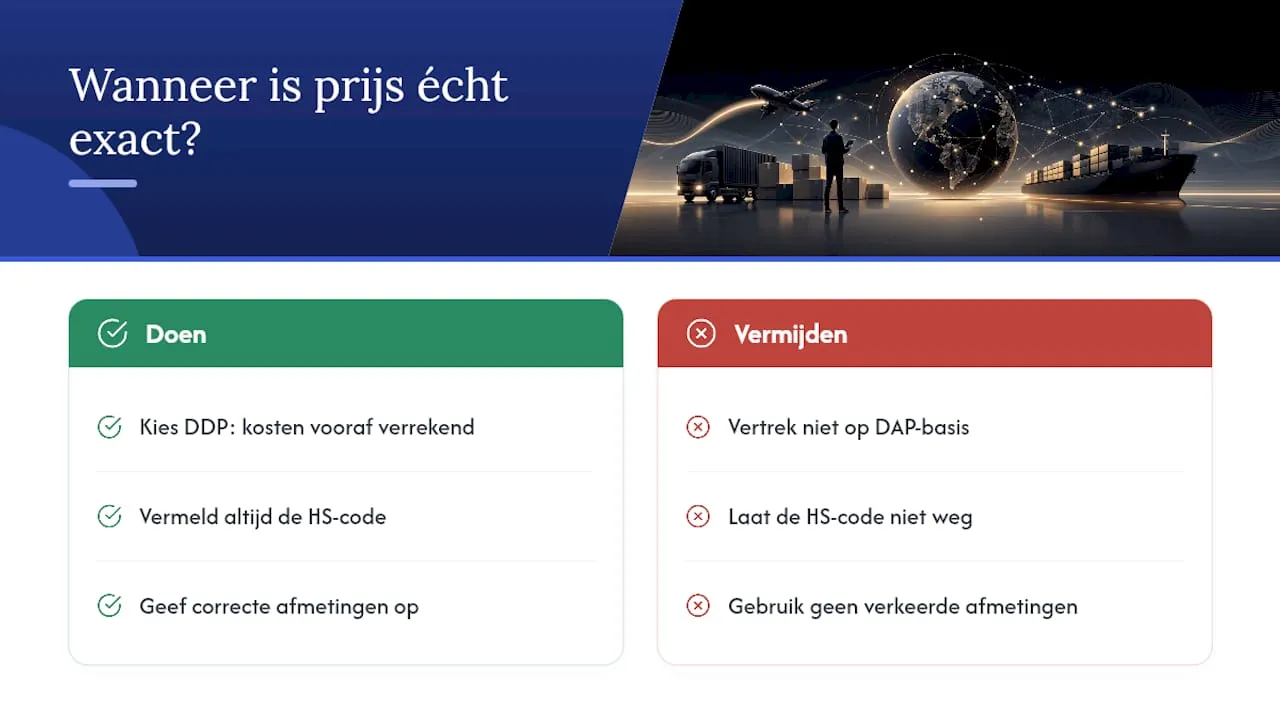
A price remains an estimate when the HS code is missing, dimensions are incorrect, or the shipment is sent on a DAP basis. With DAP (Delivered at Place), the recipient pays import costs afterward, so you can never show a complete amount upfront. If you choose DDP (Delivered Duty Paid), then all costs are settled upfront and the price you see online is the price the customer pays.
For e-commerce sellers, this difference is crucial. A customer who receives an unexpected customs invoice upon delivery is unlikely to make a repeat purchase.
What data do you need for a reliable rate calculation?
Without complete input, there is no exact price. This is the data every serious calculator or freight forwarder requires:
Package details
- Exact origin and delivery addresses, including postal code
- Gross weight and net weight in kg
- Dimensions per package: length × width × height in cm
- Number of packages and packaging type
Commercial data
- HS/GS code (minimum 6 digits)
- Commercial value and currency
- Nature of goods (hazardous, excise-sensitive, regulated)
Shipping terms
- Selected Incoterm (DDP, DAP, EXW, FOB, or CIF)
- Desired service level: express or economy
- Insurance coverage and additional services such as signature confirmation
Calculate volumetric weight
Carriers always charge the higher of the actual weight and the volumetric weight. The formula is:
Volumetric weight (kg) = (length cm × width cm × height cm) ÷ 5,000
A box measuring 40 × 30 × 20 cm has a volumetric weight of 4.8 kg. If the contents weigh only 2 kg, you pay for 4.8 kg. Volumetric weight and incorrect measurements are the most common causes of discrepancies between the online quote and the final invoice.
Pro tip: Always measure the outer package including packaging material, not the product itself. Even a few centimeters difference can place you in a higher weight class.
What factors determine the final shipping price?
A complete quote consists of more than just the transport rate. These are the components your online tool should display:
- Base rate: dependent on carrier, zone, and service level (express vs. economy)
- Volumetric weight vs. actual weight: carriers always use the higher of the two
- Fuel surcharge: varies by carrier and is adjusted periodically
- Remote area surcharge: for addresses outside the standard delivery zone
- Security and handling surcharges: dependent on type of goods and air freight
- Customs clearance costs: fee for the customs agent, documentation, and certificates
- Import duties and VAT: calculated based on HS code, customs value, and destination country; who bears these costs depends on the selected Incoterm
- Insurance: optional, but certainly worthwhile for higher-value shipments
Standard calculators often do not automatically include import duties and customs costs unless the tool is specifically designed as a landed-cost calculator. Always check which cost items are and are not included in the quote.
Which customs documents are required for exports outside the EU?
For every shipment leaving the EU, a fixed set of obligations applies. The export declaration is submitted to the customs office of export via the national electronic system of the country of dispatch.
Required documents:
- Commercial invoice with value, description, and HS code
- Packing list with weights and dimensions per package
- Transport document (waybill, air waybill, or bill of lading)
- Any certificates or permits for regulated goods
VAT treatment: for goods exported outside the EU, the 0% VAT rateapplies. State this explicitly on the invoice and ensure proper documentation; otherwise, tax authorities may refuse the zero rate.
With DDP, the seller handles most formalities, including import duties on the recipient's side. This requires more preparation but provides the customer with a fully pre-calculated price. Always plan customs clearance in advance: delays due to missing documents cost more than the extra preparation.
Step-by-step guide to requesting an exact online shipping price
Here’s how to request a reliable quote and verify its accuracy:
- Gather all inputs from the checklist above: dimensions, weights, HS code, commercial value, and delivery address
- Select your Incoterm — choose DDP if you want to provide customers with a fully pre-calculated price
- Enter the details using a landed-cost calculator or a freight forwarder platform like Parcelinternational
- Request itemized line items: transport, fuel surcharge, clearance, import duties, VAT, and insurance listed separately
- Compare at least two quotes on the same line items — not just the total amount
- Check the terms and conditions: are HS code, transport mode, insurance coverage, and clearance costs separately visible?
- Upload documents and book: commercial invoice, packing list, authorize clearance, and confirm payment
Verify for each quote whether the HS code has been processed correctly. An incorrect code leads to inaccurate import duties and a deviating final invoice. Learn more about the booking process in the step-by-step booking guide from Parcelinternational.
After booking, the process typically proceeds as follows: pickup or drop-off on day 1, export handling and departure on day 1–2, transit depending on destination and service level (express: 1–5 business days, economy: 5–15 business days), import clearance upon arrival, and last-mile delivery as the final step. DDP shipments undergo import clearance without recipient intervention.

How does Parcelinternational provide accurate online shipping rates?
Parcelinternational offers real-time rate comparison, allowing you to view multiple carriers side by side, including itemized cost breakdowns. The platform supports DDP options, provides HS code assistance, and enables document upload for clearance within the same booking.
Active since 2007 and operational in 220+ countries, the platform processes quotes and bookings without hidden fees. In practice, this means: one invoice with all costs, no surprise charges upon delivery, and a booking process you can complete in just a few minutes. For e-commerce sellers shipping multiple orders per week, the rate comparison alone saves time.
Practical ways to reduce your shipping costs
Knowing the exact price is step one. Reducing that price is step two.
- Optimize packaging: reduce empty space to lower the volumetric weight; a smaller box may place you in a lower rate class
- Consolidate shipments: combining multiple small parcels into one shipment reduces the cost per unit
- Choose economy for non-time-sensitive orders: the difference compared to express can be a multiple of the base rate
- Use correct HS codes: an incorrect code leads to excessive import duties or delays in clearance
- Compare spot rates: platforms that automatically compare multiple carriers provide access to rates you would never get from a single carrier
- Incorporate processing costs into your pricing: packaging time and labor should be part of the cost price, not an after-the-fact surprise
Transparency about cost items increases conversion: customers who see an itemized landed cost at checkout are less likely to abandon their purchase than those who only see the full costs upon delivery.
What makes the real difference in practice?
DAP shipments are the silent conversion killer in international e-commerce. The price looks attractive at checkout, but the recipient receives a customs invoice upon delivery. This leads to complaints, returns, and negative reviews, even if the shipment itself went smoothly.
DDP solves this but requires preparation: correct HS codes, a reliable clearance agent, and a platform that can calculate costs upfront. Most invoice discrepancies I see don’t come from poor carriers but from incorrect dimensions or a missing HS code. These are two things you have full control over. Spend five minutes on accurate input, and you eliminate the biggest source of price differences.
Get an exact online price now from Parcelinternational
Shipping internationally without knowing all costs upfront risks customer satisfaction. Parcelinternational provides a fully itemized landed cost, including transport, surcharges, clearance, and import duties, before you book.

Enter your package details, choose DDP if you want to offer customers a surprise-free price, and compare carriers side by side. No hidden costs, no account required to get started. Calculate your exact shipping rate and book in one flow.
Sources
Official and practical resources to set up your export correctly:
- Customs duties and export procedures – Your Europe
- Guide to exporting goods | Access2Markets
- Exporting goods outside the EU | Business Portal
- How are shipping costs for international orders calculated? – Ship24
- International shipping for e-commerce: a 2026 guide – Shopify
Save these links for your export documentation and use them when training staff who process shipments.
Get a grip on your parcel shipping
Compare carriers, choose the best price and keep track of your international shipments. You can calculate and book without an account.
