
The fastest and most reliable method is to choose an express or economy shipment based on your deadline and budget. Switzerland is outside the EU, so VAT and potential import duties always apply, and you’ll need a commercial invoice with an HS code. Check the value of your shipment, gather the correct documents, and compare rates directly via Parcel International before booking.
In summary:
- For a package to Switzerland, it’s essential to always use the correct HS code and a detailed commercial invoice to prevent customs delays.
- The total costs include not only the shipping rate but also import duties, VAT, clearance fees, and any insurance, which can make small shipments relatively more expensive.
- Switzerland is outside the EU and has its own rules: VAT is only levied above a low tax threshold, and import duties are often calculated by weight. Check the current regulations with the Swiss customs authority (FCA).
- For household goods moving to Switzerland, a separate procedure applies, requiring a form and proof that the items have been in your possession for over six months. Start this process several weeks in advance.
- Pack fragile items carefully, verify whether batteries and food products are permitted, and use reliable services like Parcel International for correct procedures and documentation.
Which Shipping Option Suits a Package to Switzerland?
For most shipments to Switzerland, you choose between express and economy. Express typically means fast delivery within a few business days and costs significantly more, but it provides certainty for deadlines. Economy takes several business days and is the cheaper option when speed isn’t a priority.
Once a shipment exceeds a few dozen kilograms or requires a pallet, you shift toward road or air freight. This applies to businesses shipping furniture, inventory, or machine parts: courier rates become cost-prohibitive, and a pallet shipment via road is more efficient, even if it takes longer.
The choice depends on three factors:
- Time pressure: a business deadline or birthday gift requires express shipping.
- Weight and volume: above a certain threshold, a pallet is cheaper per kilogram than courier rates.
- Value of the contents: expensive or fragile items warrant extra insurance, even though tracking and basic insurance are included in most services.
Tracking and basic insurance are included in nearly every service, but this coverage is often limited to a fixed amount per shipment. If you’re sending something of higher value, take out additional insurance. For business deadlines, always build in a one-day buffer: customs checks can delay an economy shipment, even if the transit itself is fast.
What Does a Package to Switzerland Cost, and What Are the Clearance Fees?
The total cost consists of four components: the carrier’s base rate, fuel or service surcharges, any insurance premium, and clearance fees. The last component is often overlooked, yet it can significantly impact the total bill for small shipments.
Carriers calculate clearance fees in different ways. Postal services often charge a fixed fee of over €10, while some couriers use a percentage of the shipment value with a minimum amount. For a €40 package, this fixed cost can weigh more heavily than for a €400 shipment.
Pro tip: If in doubt, always ask your carrier for the exact clearance fee upfront. A difference of a few euros on a small shipment adds up quickly.
Cost Component | Example | When Applicable |
|---|---|---|
PostNL Clearance Fees | €13.00 | Fixed fee per shipment |
EMS Clearance Fees | €17.50 | Fixed fee per shipment |
Percentage-Based Clearance (e.g., UPS) | 2.5% of the value, with a minimum | For higher shipment values |
VAT | Almost always | Applies to virtually every commercial shipment |
Import Duties | Usually from €150 shipment value | Above the exemption threshold |
For small e-commerce shipments, import duties are often waived under €150, but VAT almost always applies. To minimize these costs, ensure an accurate invoice value and, where possible, proof of origin: this can reduce import duties under applicable trade agreements.
Which Customs Documents Are Required for Switzerland?
Switzerland is not part of the EU customs union, so every shipment undergoes an official border procedure. Customs outlines how declarations work for e-commerce shipments and when import duties and VAT apply. Without the correct paperwork, your package will be held at the border, causing delays that a simple checklist can prevent.
For a standard commercial or private shipment, you’ll need:
- A commercial invoice with a clear description of the contents and their value.
- The correct HS code per item, available via the tax authority’s commodity codes.
- A packing list when shipping multiple items or boxes.
- A proof of origin, such as a Certificate of Origin or EUR1, if you want to reduce import duties under a trade agreement.
- Any permits for regulated goods, depending on the product category.
If you’re moving to Switzerland and shipping household goods, a different process applies. To request an exemption from import duties and VAT, use form 18.44, the Umzugsgut form. You must prove the items have been in your possession for over six months and are intended for personal use, with a detailed packing list as evidence.
Pro tip: Start the application for form 18.44 several weeks before your move date. An incomplete packing list is the most common reason an exemption is denied.
Customs may hold a shipment for inspection, which typically adds a few extra days of delay on top of the standard delivery time. If in doubt about tariffs or classification, consult the Tax Authority, not the carrier. For business or larger shipments, it may be worthwhile to engage a customs broker who can arrange T1, T2, or EUR1 documents for you, which saves time especially with bulk shipments.
How to package a parcel safely and what cannot be sent to Switzerland?
Always package fragile or valuable items with at least five centimeters of cushioning material on all sides, using a double box when the contents are delicate. Secure all seams with strong tape, not just the top and bottom.
Lithium batteries are often permitted but with restrictions: loose batteries above a certain capacity are usually prohibited in standard parcel transport and require a specialized dangerous goods shipment. Alcohol and certain food products have their own import regulations and sometimes require a permit, depending on the product type and quantity.
- Always check with your carrier first for every shipment containing batteries, liquids, or food to confirm if the item is allowed.
- Be aware of maximum dimensions and weights per service class: express shipments often have a lower weight limit than economy or freight services.
- If in doubt about a specific product, consulting the carrier is faster and safer than handling a refused shipment afterward.
Book your parcel to Switzerland in five steps
You don’t need to figure out which carrier is the fastest or most affordable for your route. Parcel International has been comparing rates from multiple carriers since 2007 for express, economy, air, sea, and road transport to over 220 countries—no mandatory account and no hidden fees.
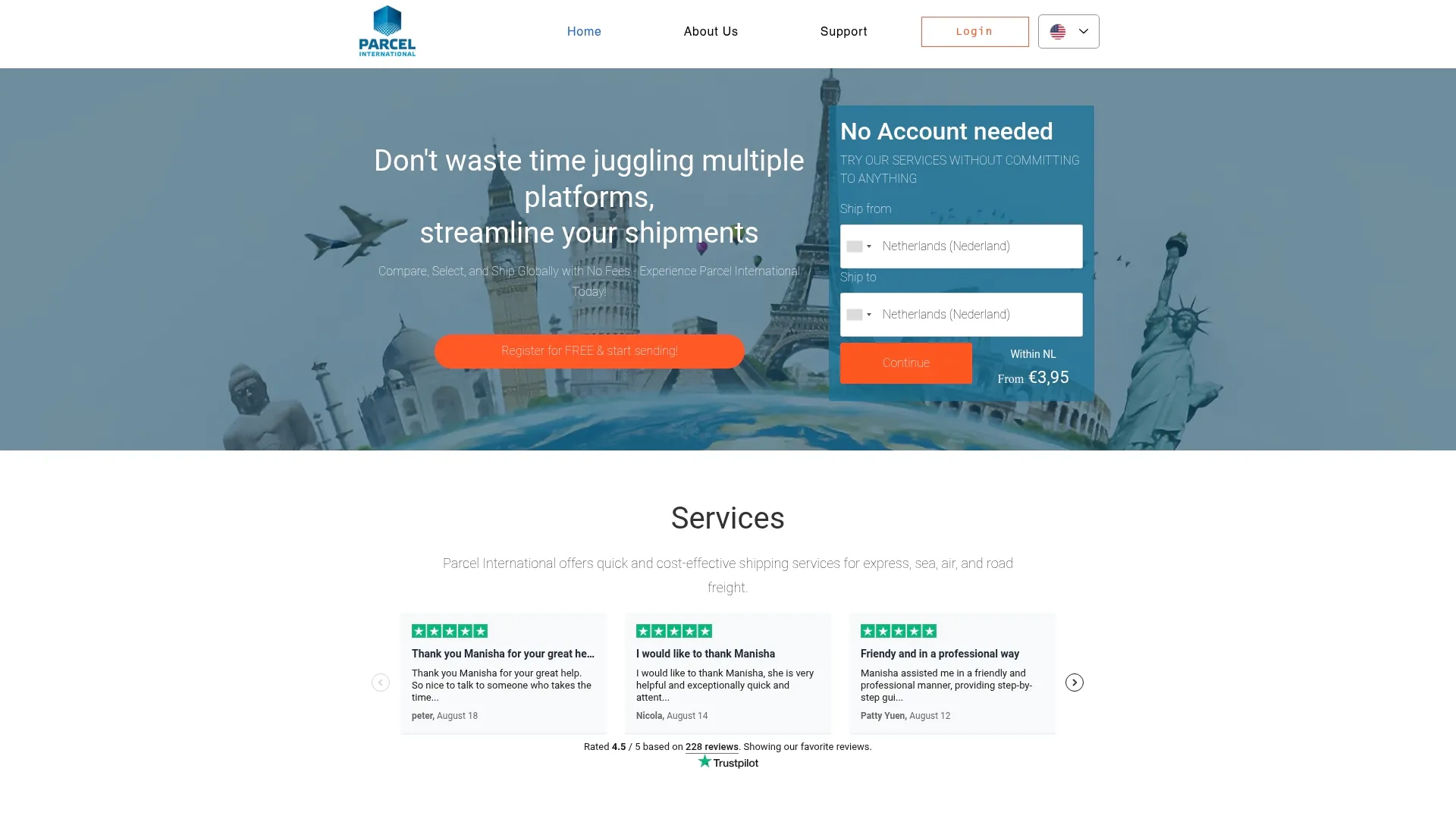
Here’s how to do it:
- Measure and weigh your parcel accurately; incorrect dimensions often lead to additional charges later.
- Compare services based on delivery time and price using the rate calculator.
- Fill in customs details: value, HS code, and description of the contents.
- Print the label and securely attach it to the box.
- Submit the shipment at a drop-off point or arrange for pickup.
Parcel International automatically generates the required customs documentation, provides track & trace for every shipment, and offers insurance options for valuable contents. If you’re unsure about the correct HS code or which documents you need, consult the customs formalities and HS codes before booking. For a full overview of shipping conditions and services per country, review the international-shipping-rules. Compare your rates now and book your shipment to Switzerland in just a few minutes.
Where do shipments to Switzerland often go wrong?
The most common mistake is an incorrect or overly vague HS code on the invoice. A description like “gift” or “clothing” is insufficient: customs requires a specific code, and an incorrect one almost always leads to delays or additional charges.
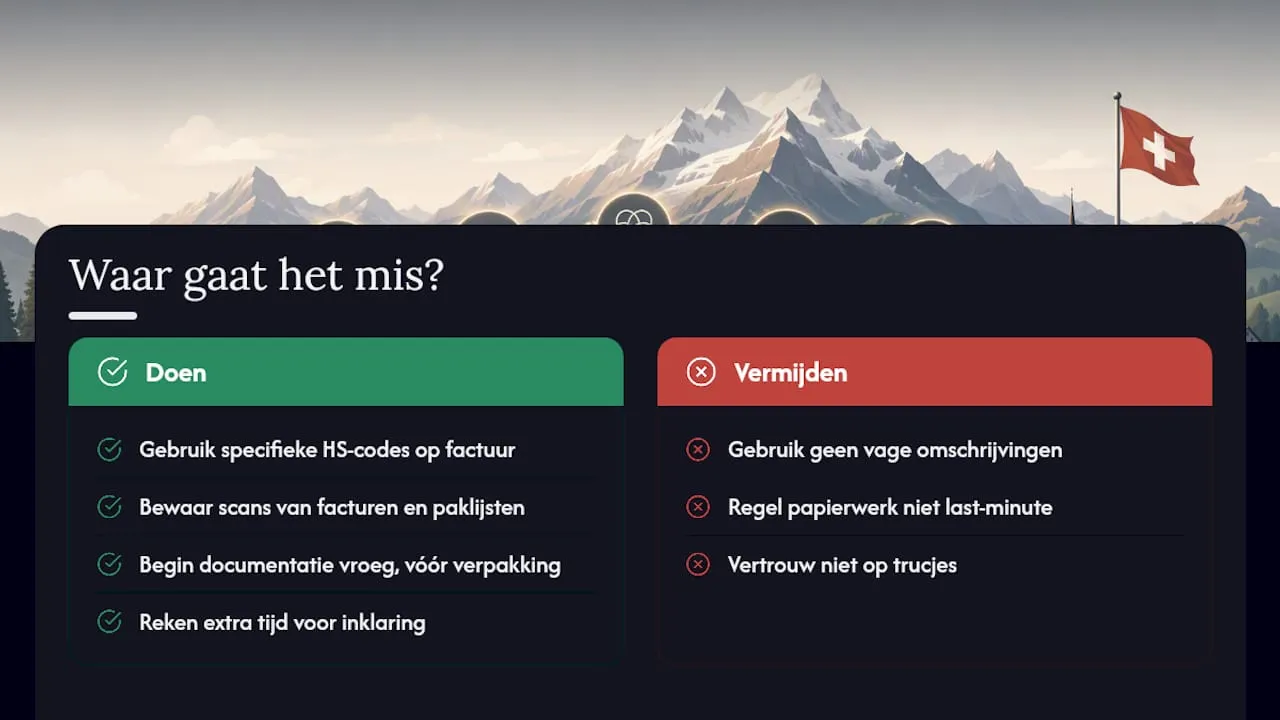
The second pitfall is incomplete paperwork when arranged last minute. If you’re drafting a packing list the day before shipping, you’ll often miss details that later require corrections. Always keep scans of every invoice, packing list, and permit, and start documenting as soon as you know you’ll be shipping—not just when the parcel is already packed.
What I’ve seen repeatedly in years of international shipping experience: people underestimate how much time customs clearance can take, while the shipping time itself often aligns with the stated schedule. Since 2007, Parcel International has relied on this experience to make shipments to Switzerland predictable—not through shortcuts, but by ensuring the administrative foundation is in place before the parcel leaves your door.
— Pascal
Get a grip on your parcel shipping
Compare carriers, choose the best price and keep track of your international shipments. You can calculate and book without an account.
