
In short:
- Air freight is the fastest and most reliable way to ship goods internationally. It offers speed, security, and global reach, making it particularly suitable for valuable, perishable, or urgent shipments. Sustainability remains a challenge due to the high CO₂ emissions compared to sea and road transport.
Air freight is the fastest and most reliable mode of transport for international goods. With an average speed of 500 mph and fixed flight schedules that eliminate delays caused by traffic congestion, air transport provides a combination of speed, security, and global reach unmatched by any other modality. Whether you're shipping perishable products, exporting high-value electronics, or serving e-commerce customers in Asia, the benefits of air freight are tangible and measurable. Parcel International has been helping businesses and individuals optimize these advantages since 2007, serving over 220 countries and territories.
What are the key advantages of air freight?
Air freight combines four unique attributes in logistics: speed, reliability, security, and reach.

Speed is the most cited advantage. While sea freight from Rotterdam to Shanghai takes three to five weeks, the same shipment can be flown there in one to two days. This time savings directly translates to value for many businesses, especially when customers expect fast delivery.
Reliability is an underrated advantage. Aircraft don’t get stuck in traffic or delayed by roadworks. Flight schedules are tightly planned, and deviations are rare, making air freight predictable—a critical factor for supply chain planning.
Security is a major consideration for valuable or fragile goods. Airports enforce strict security protocols, and shipments are handled less frequently than in road transport, reducing the risk of damage or theft.
Global reach is the fourth pillar. Air freight can reach nearly every country, including destinations that are difficult or time-consuming to access by ship or truck, such as island nations, remote regions in Africa, or mountainous areas in South America.
- Speed: 500 mph average, deliveries within 24–72 hours worldwide
- Reliability: minimal delays due to fixed flight schedules
- Security: strict airport security measures and fewer handling points
- Reach: access to over 220 countries and territories
- Ideal for: perishable goods, electronics, pharmaceuticals, and luxury items
Pro tip: Don’t use air freight only for urgent shipments. For high-value-per-kilogram products like jewelry or semiconductors, the higher freight cost is often negligible compared to the value of the cargo.
How does air freight compare to sea and road transport?
The choice between air, sea, and road transport depends on three variables: speed, cost, and volume. Air freight excels in speed but is more expensive and has limited capacity.
The cost of air freight is higher than that of sea or road transport. This premium is justified by speed and precision. For bulk goods with low value per kilogram, sea freight is almost always the better choice. For time-sensitive or high-value shipments, air freight is the clear winner.
Road transport offers flexibility within Europe. A truck can travel directly door-to-door without the need for an airport or port. However, once the destination is outside Europe, road transport is no longer an option, leaving the choice between air and sea freight.
Review the differences between air and sea freight for a detailed decision-making guide tailored to your situation.
Feature | Air Freight | Sea Freight | Road Transport |
|---|---|---|---|
Speed | 24–72 hours worldwide | 2–6 weeks | 1–7 days (Europe) |
Cost | High | Low | Moderate |
Maximum Volume | Limited | Very large | Large |
Reliability | Very high | Moderate | High |
Reach | Global | Global | Primarily Europe |
Ideal for | Urgent, high-value | Bulk, non-urgent | Regional, door-to-door |
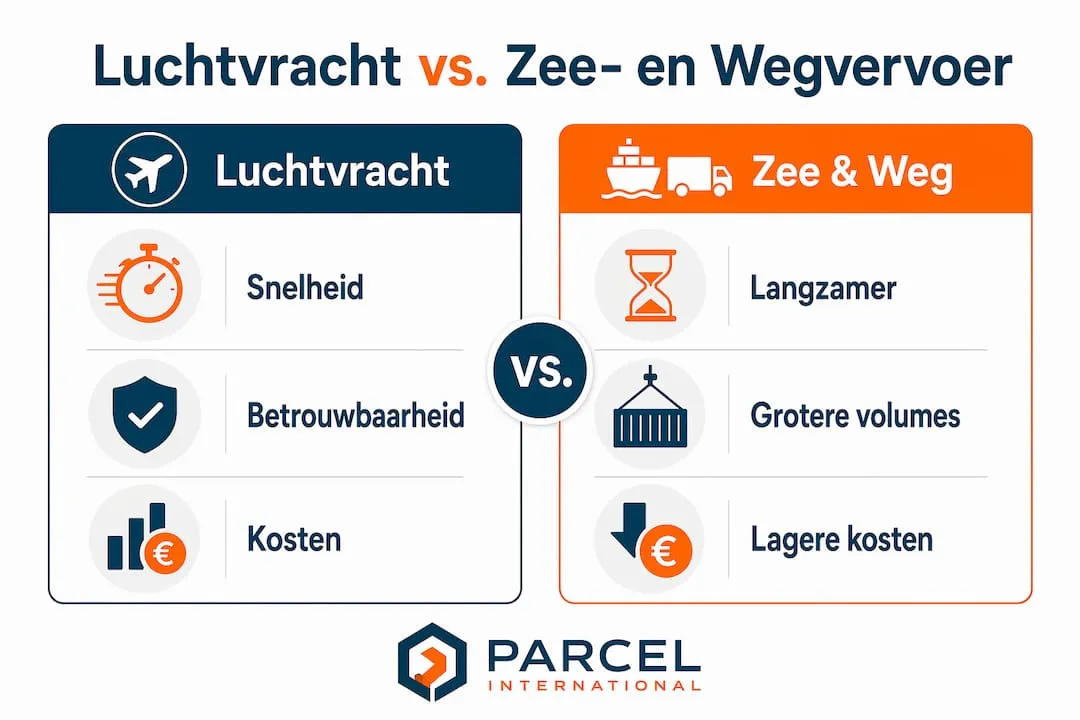
Pro tip: Combine transport modes for long-haul shipments. Send goods by air to a regional hub, then use road transport for the final leg. This saves costs without sacrificing much speed.
Which logistical factors determine the success of air freight?
The success of an air freight shipment hinges on preparation. Incomplete or incorrect submissions lead to higher costs and longer wait times.
Experts recommend accurately documenting weight, dimensions, and the so-called 'ready time' before making air freight arrangements. Without this baseline data, quotes are unreliable, and planning cannot be accurate. A shipment that isn’t ready on time will miss its flight and have to wait for the next available connection.
Additional handling, incomplete documentation, or late ready times directly result in delays and higher costs. Airports operate with strict acceptance windows. Missing these windows incurs storage fees and negates the speed advantage that air freight is chosen for in the first place.
Four steps for a smooth air freight shipment:
- Record baseline data. Measure and weigh each package accurately. Use the volumetric weight if it exceeds the actual weight, as airlines always charge based on the higher of the two.
- Prepare documentation. Ensure you have a correct invoice, packing list, and, if required, a certificate of origin. Missing paperwork can hold up shipments at customs.
- Confirm the ready time. Provide the exact time the shipment will be ready for pickup. Include a buffer of at least two hours.
- Choose a single point of contact. Having one contact person at the carrier prevents miscommunication and speeds up problem resolution.
Follow the air freight shipping workflow from Parcel International for a step-by-step guide specifically designed for e-commerce businesses.
What are the environmental impacts of air freight?
Air freight is the fastest mode of transport, but also the most CO₂-intensive. Those who consciously opt for air transport must understand this trade-off.
The average CO₂ emissions of air freight amount to approximately 602 g/ton-km. For comparison, sea freight emits only a fraction of that per ton-km. This gap is significant and has direct implications for companies pursuing sustainability goals or reporting on their Scope 3 emissions.
Mode of Transport | CO₂ Emissions (g/ton-km) | Relative Impact |
|---|---|---|
Air Freight | 602.000 | Very High |
Road Transport | 62.000 | High |
Sea Freight | 8.000–16.000 | Low |
Rail Transport | 22.000 | Moderate |
The industry is working on solutions. Sustainable innovations in air freight include the use of biofuels and more efficient aircraft, but environmental challenges remain a real concern. Aircraft manufacturers like Airbus and Boeing are investing in hybrid propulsion and lighter materials, though large-scale implementation is still years away.
Companies using air freight that want to reduce their ecological footprint can take three steps. First, consolidate shipments to ensure planes fly at full capacity. Second, opt for direct flights without layovers, as takeoff and landing consume the most fuel. Third, offset remaining emissions through certified CO₂ compensation programs like Gold Standard or Verra.
When is Air Freight the Best Choice?
Air freight is not the right solution for every shipment. The choice depends on urgency, value, weight, and destination.
Companies opt for air freight when speed and safety for hazardous or perishable goods are a priority. A flower exporter in Aalsmeer shipping roses to Japan cannot wait for a container ship. A pharmaceutical company sending vaccines to West Africa has no choice: the cold chain and urgency require air transport.
Situations Where Air Freight is the Best Choice:
- Perishable Products: Fresh flowers, fish, meat, and pharmaceuticals have a limited shelf life that rules out sea freight.
- High-Value Goods: Jewelry, artwork, and semiconductors justify the higher freight costs due to their high value per kilogram.
- Urgent Spare Parts: A production shutdown costs more per hour than an air freight rate. Machinery manufacturers always ship critical parts by air.
- E-Commerce with Fast Delivery Promises: Online retailers promising “next-day delivery” to international customers rely on air freight.
- Small, Lightweight Shipments: For packages under 100 kg, air freight is often competitively priced compared to sea freight, especially when accounting for port storage costs.
Air freight is less suitable for bulk goods with low value per kilogram, such as construction materials, furniture, or raw materials. In these cases, sea freight always wins on price. Explore the 7 types of international shipments for a full overview of which shipping method suits which type of cargo.
Key Insights
Air freight is the fastest and most reliable choice for international shipments where speed, safety, and global reach outweigh higher transport costs.
Point | Details |
|---|---|
Speed and Reliability | Air freight reaches 800 km/h with minimal delays due to fixed flight schedules. |
Cost vs. Benefit | Higher rates are justified for high-value, urgent, or perishable goods. |
Preparation is Key | Accurate weight and dimension data, plus a correct ready time, prevent delays and additional costs. |
Environmental Consideration | CO₂ emissions of approximately 602 g/ton-km make air freight the heaviest choice for the environment. |
Right Situations | Choose air freight for e-commerce, pharmaceuticals, spare parts, and luxury goods. |
What I See Differently After Years in Logistics
Nearly every comparison of transport modes ends with the same conclusion: air freight is expensive, so use it only when absolutely necessary. That’s true, but it misses the core of what makes air freight truly valuable.
The real value of air freight isn’t just speed—it’s predictability. A shipment leaving on Wednesday will arrive on Friday. Period. No storm warnings, no port strikes, no Suez Canal congestion. That certainty comes at a price, but for companies that must keep promises to customers, that price is rarely too high.
What I also see: many companies underestimate the hidden costs of slow shipping. Storage costs at ports, customer service costs from late delivery complaints, lost repeat purchases. When you add those costs to the sea freight rate, air freight becomes cost-effective for more products than you might initially think.
The biggest pitfall I encounter is poor preparation. A smooth air freight shipment starts with accurate basic data like weight and dimensions. If that’s not in order, you’ll pay extra. Always. I’ve seen shipments delayed by two days because the weight on the waybill didn’t match the actual weight at the airport. Two days that completely negated the speed advantage.
My advice: don’t treat air freight as a last resort. Build it in as a structural option for the right product categories. Analyze which of your products have a high value per kilogram, a short shelf life, or customers who expect speed. For those products, air freight isn’t a luxury—it’s the logical choice.
— Pascal
Ship Smarter with Parcel International
Parcel International handles international air freight shipments to over 220 countries and territories, with access to carriers like DHL, FedEx, and PostNL. Through the platform, you can compare rates, choose the best carrier, and track your shipment in real time.

Whether you have a one-time urgent shipment or regularly ship internationally: via Parcel International, you can send packages express with carriers like DHL and FedEx; air freight is available on request via a quote. No hidden costs, no surprises. View the full offering at parcelinternational.com Start shipping more efficiently today.
Can't find your question? Our support team is here for you 24/7 via the help centre.
When Is Air Freight the Best Option?
Choose air freight for shipments where speed and freshness are critical, such as perishable goods. This method ensures delivery within 1 to 5 days and prevents spoilage with temperature-controlled handling.
What is the biggest advantage of air freight?
Speed combined with reliability. Air freight achieves an average speed of 800 km/h and has minimal delays due to fixed flight schedules, making it the most predictable mode of transport for international shipments.
How can you prevent delays in air freight shipments?
Accurately record the weight, dimensions, and ready time before making a booking. Incomplete documents or a late ready time are the most common causes of delays and additional costs in air freight.
How large is the CO₂ emission of air freight?
The average CO₂ emission of air freight is approximately 602 g/ton-km. This is significantly higher than sea freight (8–16 g/ton-km) or road transport (62 g/ton-km).
Which goods are most suitable for air freight?
Perishable products such as fresh flowers and pharmaceuticals, high-value goods like electronics and jewelry, and urgent spare parts are most suitable. For these categories, the high value per kilogram or time-critical nature justifies the higher freight costs.
Get a grip on your parcel shipping
Compare carriers, choose the best price and keep track of your international shipments. You can calculate and book without an account.
