
Collecting shipping addresses may seem simple. It’s often thought to be just a matter of filling in names and streets. But did you know that international shipments frequently fail due to minor address errors? The real secret lies in smartly organizing and keeping those addresses up to date. This can uncover opportunities to save hours of work and frustration that many businesses never see coming.

Brief Summary
- 1. Collect and organize addressesCentralize shipping addresses from various sources for efficient management.
- 2. Ensure data accuracyVerify that essential address information is complete and correct.
- 3. Implement a robust systemChoose a suitable address management system that meets your logistics needs.
- 4. Test and verify addressesEstablish a procedure to regularly check addresses for accuracy.
- 5. Maintain data continuouslySchedule regular updates to remove outdated or inaccurate information.
Step 1: Collect and organize existing shipping addresses
Collecting and organizing shipping addresses is the fundamental first step in efficiently managing your logistics process. This phase lays the foundation for accurate and streamlined shipments, saving you valuable time and resources.
Start by inventorying all your existing shipping addresses from various sources. Gather data from your customer database, e-commerce platforms, order management systems, and spreadsheets. It’s crucial to consolidate all available address data in a central, structured location.
Use digital solutions that simplify address management. Digital archiving solutions can help systematically store and manage your shipping addresses. Consider specialized software that offers automatic address validation and cleansing.
During collection, pay extra attention to the accuracy and completeness of each address. Verify that the following details are present:
- Full first and last name
- Full street name and house number
- Postal code and city
- Country
- Additional contact information such as phone number or email address
Accounting for variations in address formats is essential. International shipments often require specific notations or additional information. Ensure your system is flexible enough to handle different address structures.
After collecting, organizing the data is just as important. Use a consistent format and classification system. Consider categorizing based on characteristics such as shipping frequency, geographic region, or customer type. This facilitates later searches and analyses.
A practical tip is to regularly update and review your address database. Remove duplicate entries, correct errors, and delete outdated contact information. A clean and current address database prevents shipping issues and increases the efficiency of your logistics process.
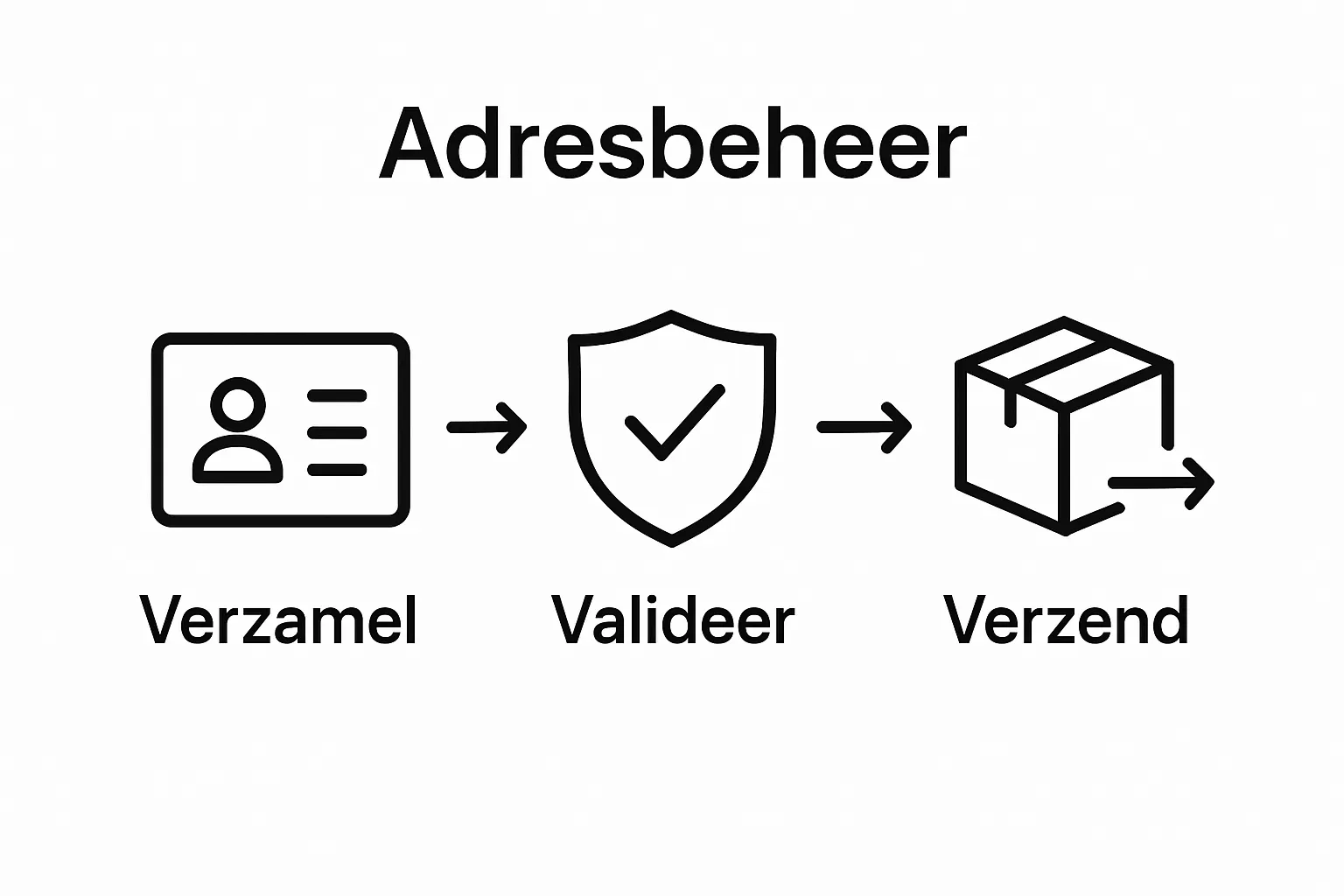
The overview below shows all key steps for effective shipping address management, including desired outcomes and core actions.
Step | Core Action | Key Outcome |
|---|---|---|
Collect & organize | Centralize and structure address data | Organized, up-to-date address database |
Determine required data | Standardize information and verify completeness | Complete and accurate address information |
Implement system | Choose, migrate, and train staff | Reliable address management |
Test & verify | Use tools and manual checks | Error-free, validated address database |
Maintain & update | Schedule maintenance and request updates from customers | Address database remains current and reliable |
Step 2: Identify required information and data
After collecting your shipping addresses, the next crucial step is identifying the specific information and data necessary for a seamless shipping process. This step forms the backbone of an efficient address management system and prevents future logistical challenges.
Start by defining the essential address details required for each shipment. Not all shipments are the same, so it’s important to understand the specific requirements for different destinations and shipping methods. For example, international shipments often need more detailed information than domestic ones.
According to government standards for address data , the following core details must be collected:
- Recipient’s full name
- Full street name with house number
- Additional address information (apartment, floor, suite)
- Postal code and city name
- Region or province
- Country
- Contact phone number
- Optional electronic contact address
But collecting data alone isn’t enough. You must also ensure the quality and accuracy of this information. This means standardizing address notations, removing unnecessary spaces, correcting typos, and ensuring consistency in country codes and postal code formats.
Consider advanced techniques such as automated address validation. Modern software solutions can check addresses in real time, suggest corrections, and even fill in missing information. These tools can save a lot of manual work and improve the reliability of your address database.
Also, think about additional metadata that can optimize your shipping process. Data such as shipping history, preferred carriers, or special delivery instructions can provide valuable context. This extra information can help make smarter logistical decisions and enhance the customer experience.
In conclusion: a thorough understanding of the required information is essential. Don’t just collect data—ensure its quality, uniformity, and usability. A well-structured and accurate address database is the key to efficient and hassle-free shipments.
Step 3: Implement a Reliable Address Management System
After collecting and identifying your shipping addresses, it’s time for a crucial step: implementing a reliable address management system. This system will form the backbone of your efficient logistics processes and future shipping strategies.
Start by selecting a suitable management system that aligns with the scale and complexity of your shipping operations. Whether you run a small e-commerce store or a large international enterprise, the right technological infrastructure is essential for seamless address processing.
When selecting your system, look for functionalities that meet your specific needs. A robust address management system should offer more than just storage. Seek solutions with advanced validation and management features. Key characteristics include:
- Automated address verification and correction
- Batch update capabilities
- Integration with existing shipping systems
- Secure data storage
- Detailed reporting capabilities
Implementation begins with thorough data migration. Carefully convert your collected addresses to the new system, paying extra attention to data quality and consistency. Avoid manual entry by using import features that minimize errors.
Data protection is a critical aspect of address management. Ensure your chosen system complies with relevant privacy regulations such as the General Data Protection Regulation (GDPR). Implement strong security measures like encryption, two-factor authentication, and controlled access rights.
Training is often an undervalued part of system implementation. Invest time in educating your team about the new address management system. Ensure every employee working with the system understands how to correctly enter, update, and manage data.
It’s advisable to roll out the system in phases. Start with a test phase using a limited set of addresses to validate functionality and reliability. Gather user feedback and make adjustments as needed before proceeding with full implementation.
Regular maintenance and updates are essential for the continued effectiveness of your address management system. Schedule periodic reviews to ensure data accuracy, remove outdated information, and integrate new features that can enhance your logistics processes.
Step 4: Test and Verify the Accuracy of Shipping Addresses
After implementing your address management system, testing and verifying the accuracy of shipping addresses is a critical step to prevent errors and ensure the efficiency of your logistics process. This phase helps avoid potentially costly mistakes and guarantees the reliability of your shipping data.
Start by establishing a systematic verification procedure that includes multiple layers of checks. The goal is not only to identify errors but also to proactively correct them before they lead to shipping issues.
An initial verification method is the use of automated validation tools. These software solutions can quickly verify large volumes of addresses for:
- Accuracy of postal codes
- Consistency of address formats
- Presence of all required data
- Removal of duplicate entries
- Detection of potential typos
In addition to automated checks, manual verification remains indispensable. Assign a responsible team member to sample and review addresses, with special attention to international and complex shipping addresses.
Extra care is required for international shipping addresses. Each country has its own addressing conventions and postal requirements. According to form validation guidelines , it’s essential to inform users immediately about potential errors and provide confirmation upon successful entry.
Consider implementing real-time validation. This means addresses are checked at the point of entry, allowing errors to be corrected immediately. Modern systems can even suggest correct address formats or fill in missing information.
Periodic bulk verification campaigns are also valuable. Schedule a full review of your address database each quarter. Remove outdated or inaccurate data and update contact information as needed.
Remember that address validation is an ongoing process. Technological changes, relocations, and other factors can continuously impact your address database.
Stay vigilant and regularly update your verification procedures.
Finally, it’s crucial to develop an error reporting system . Document all identified inaccuracies, analyze patterns, and use these insights to continuously improve your address management processes.
Step 5: Maintain and Update Your Shipping Addresses Regularly
Maintaining and updating shipping addresses is an ongoing process that is essential for the efficiency and accuracy of your logistics operations. Without regular maintenance, your address database can quickly become outdated, leading to failed deliveries, wasted resources, and customer dissatisfaction.
Start by setting up a systematic maintenance schedule. Just as a car requires periodic maintenance, your address database needs regular inspection and updates. Create a structured plan to review your address data thoroughly each quarter.
International logistics best practices emphasize the importance of accurate address data for efficient global trade. Your maintenance process should include various strategies to ensure data quality:
- Check for outdated contact information
- Remove duplicate or incomplete addresses
- Validate address changes with customers
- Integrate new address information
- Correct Common Error Patterns
Automated update methods can significantly reduce your manual efforts. Many modern CRM systems and address management platforms offer features such as automatic address validation and real-time update tools. These systems can connect with external databases to automatically implement address changes.
Actively involve your customers in the maintenance process. Send periodic requests for them to verify and update their contact details. This can be done via newsletters, emails, or dedicated forms on your website. Customers appreciate it when businesses make an effort to keep their information up to date.
Pay special attention to international address changes. Countries may change postal codes, adjust street naming systems, or redefine administrative regions. Subscribe to international address information sources or use specialized software that tracks such changes.
Always document your maintenance processes. Record when updates were performed, who performed them, and what changes were made. This transparency helps in tracing potential errors and provides a solid foundation for future improvements.
Remember that address maintenance is not a one-time task, but an ongoing commitment.
This checklist provides verification and maintenance actions for a reliable address database. Complete each step for maximum accuracy.
Checklist Action | Description | Recommended Frequency |
|---|---|---|
Check for outdated addresses | Remove or update non-functional data | Quarterly |
Detect duplicate entries | Merge or remove duplicate records | Quarterly |
Run automatic validation | Use validation tools to identify current errors | With every update |
Manual spot checks | Verify addresses individually for errors | Periodically, at least twice a year |
Request and update customer data | Ask customers to confirm their information | Annually or quarterly |
Update international changes | Track postal code and street adjustments worldwide | Ongoing |
Maintain a change log | Document who, when, and what was modified | Continuous |

Effortlessly Manage Addresses and Global Shipping
Maintaining shipping addresses often takes too much time and quickly leads to errors. Incomplete data and outdated addresses can slow down your international logistics and cause frustration for your customers. With the helpful tips from our step-by-step guide, you’ll understand how crucial reliable and up-to-date information is for a smooth shipping process. But what if you combine this control with a smart shipping solution that makes everything easier?
Take this moment to effortlessly organize your shipping addresses and start shipping globally right away. Experience how Parcel International streamlines your complete logistics. Easily compare shipping options, manage international addresses, and ship to over 220 countries. Opt for an efficient and hassle-free approach. Discover the convenience directly on our website and take the first step toward seamless global shipping today.
Managing Shipping Addresses
Can't find your question? Our support team is here for you 24/7 via the help centre.
What is international shipping?
International shipping is the process of transporting goods across national borders. This involves various steps such as documentation, customs regulations, and transportation modes.
What is the package shipping process?
The package shipping process is the series of logistical steps taken to transport a package from the sender to the recipient. This includes preparation, packaging, labeling, and transportation of the package.
What is the first step in shipping an international package?
Your first step is to accurately collect all address details for both the sender and the recipient. Ensure you gather full names, addresses, and contact information to avoid delays.
What checks should I perform before shipping my package?
Ensure the address on the label is legible and complete, the parcel is properly packaged, and all necessary documents are included. This quick check helps prevent delays and potential returns.
How do I enter shipping details for my international shipment?
Make sure you enter a detailed description of your goods, including the exact quantity and value. Check all information carefully to avoid delays, and gather the required documents such as invoices or certificates of origin.
What should I do to determine the contents and value of my package?
To determine the contents and value of your shipment, provide a detailed description of all goods, including material, dimensions, and weight. Ensure the commercial or shipping value is accurately specified.
How do I rate products for shipping?
Start with a thorough inspection of each product. Pay attention to dimensions, fragility, weight, and material composition. Also check for any prohibited or regulated materials.
How do I determine my shipping needs for international shipping?
To determine your shipping needs, consider the nature of your goods, weight, dimensions, and fragility. Also, analyze the destination location and required customs regulations.
How do I properly prepare special shipments?
For special shipments, such as hazardous goods, accurate classification and special packaging are required. Ensure you have all necessary documentation and permits on hand to avoid delays.
What does it mean to register a shipment?
Filing a shipment is the formal process of submitting customs documentation for goods being shipped internationally. This ensures compliance with all regulations before your goods cross the border.
What are the consequences of an incorrect shipment registration?
Incorrect declarations can lead to border delays, additional inspection fees and fines, and even seizure of your shipment, which can harm your business reputation.
What should I consider regarding address formats by country?
For each destination country, verify the specific order of address elements, such as where the house number is positioned and whether special characters are permitted. Maintain a checklist to confirm these details before applying labels.
How do I ensure the accuracy of my shipping addresses?
Ensure all required address details are provided and implement automated validation tools for real-time address verification. This helps prevent shipping errors.
How can I regularly update my shipping addresses?
Create a maintenance plan to review and update your address database every quarter. Use automated validation tools and involve customers in updating their information.
How do I find the postal code for an address in a foreign country?
Visit the official postal website of the destination country and use their postal code lookup tool with the street name, house number, and city name. Alternatively, you can use international postal code databases that aggregate information from multiple countries. Always verify through a second source for accuracy.
What if I can’t find the postal code?
Contact the recipient and request verification of the complete address, including the postal code. Some addresses in rural areas may not have a specific postal code; in such cases, the city name and street are often sufficient. Consult the local postal organization for alternative solutions.
Why is a correct postal code so important for international shipping?
A correct postal code ensures your package is efficiently routed through automated sorting systems to the right destination. Without the correct postal code, your shipment may be delayed, end up in the wrong sorting center, or even be returned, resulting in additional costs.
Which websites are reliable for postal code lookup?
The most reliable sources are official national postal websites such as Deutsche Post for Germany, Royal Mail for the United Kingdom, and USPS for the United States. International platforms that aggregate data from official sources are also trustworthy, but always verify the information is up to date.
How can I check if a postal code is still current?
Verify the postal code through the most recent official postal website of the country and cross-check it with at least one other reliable source. Some countries publish updates on postal code changes on their websites. If in doubt, contact the local postal organization to confirm the current postal code.
What are the most popular countries for international shipping from the Netherlands?
Germany, Belgium, France, the United Kingdom, the United States, and Italy are the most popular countries for export and e-commerce shipments from the Netherlands, with Germany being the largest trading partner, accounting for over 20 percent of total exports.
What determines whether a destination is efficient for shipping?
Factors include shipping costs, delivery time, customs regulations, reliability of logistics, and customer demand. Customs and administrative processes can make up a significant portion of total shipping costs and are often an underestimated factor.
How can you minimize risks when shipping to unfamiliar countries?
Start with small shipments, thoroughly check local regulations, and choose carriers with proven experience in the destination country. Only after consistent results over several months is it advisable to develop that destination structurally.
What is the fastest shipping method within Europe?
Air freight is technically the fastest, with delivery in 1 to 3 days, but road transport within Europe offers the best balance between speed and cost for most EU destinations, typically taking 3 to 7 days. For neighboring countries like Germany and Belgium, it is often just as fast.
What is the most common mistake in international shipping?
Incorrect or incomplete documentation is the most common mistake. Missing invoice values and vague product descriptions directly lead to customs delays.
How do I find the correct HS code for my product?
Use the official search tool of the Dutch Customs or the World Customs Organization. Enter a specific product description and select the most appropriate code.
What happens if my package has the wrong address?
A package with an incorrect address will not be delivered and will end up in the carrier’s depot. Without a return address, the package is lost. Always double-check each address field before shipping.
Do I always need to include a packing list?
For shipments outside the EU, an invoice is mandatory; a packing list is strongly recommended, especially for multiple packages. Inconsistencies between the invoice and packing list can lead to delays, even if the error is minor.
How do I choose the right shipping option for my package?
Compare options based on weight, dimensions, delivery time, and destination. Consider volumetric weight, as carriers charge based on the higher of the two (actual or volumetric weight).
How should I write the postal code on an address label?
Write the Dutch postal code as four digits, followed by two letters, then two spaces before the city name in uppercase, such as “1234 AB AMSTERDAM”. Do not use hyphens, as sorting machines do not recognize them.
Is the country name required on an international address label?
Yes, the country name is mandatory for international shipments. Write the country name in uppercase as the last line on the label, preferably in English, such as “GERMANY” or “UNITED KINGDOM”.
Where should I place the address label on the package?
Place the label on the largest and most visible side of the package. Ensure the label does not cover any folds or tape to remain scannable during sorting.
What should I do if I make a mistake on the address label?
Remove the incorrect label completely and print a new one. Never place a corrected label over an old one, as scanners may read the wrong address.
What does an address in England look like?
An English address consists of the recipient’s name, house number and street name, the post town in uppercase, and the postal code on a separate line, also in uppercase. For shipments from abroad, add “UNITED KINGDOM” as the last line.
How do I write my address in English?
Use the same format as a British address: house number and street, city name, postal code, and country. Include your own address as the return address on a package to the UK so that an undeliverable shipment can be returned without additional costs.
What does a postal code in England look like?
A UK postcode consists of 5 to 7 alphanumeric characters, divided into an outward code and an inward code, separated by a space, such as “M1 1AE” or “EC1A 1BB”. The UPU outlines the six valid notation formats used in the country.
Is a county required in a British address?
No, a county is not required as long as the post town and postcode are correctly provided. The PAF Code of Practice confirms that these two elements are decisive for postal sorting, not the county.
Get a grip on your parcel shipping
Compare carriers, choose the best price and keep track of your international shipments. You can calculate and book without an account.
